What Is a Knorr-Bremse SK7 Caliper with Carrier Bracket (Pads Not Included)?
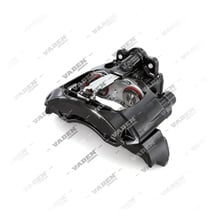
The Knorr-Bremse SK7 Caliper with Carrier Bracket (Pads Not Included) is the complete-assembly version of the Knorr-Bremse SK7 disc brake caliper used on heavy commercial vehicles, supplied with its carrier bracket but without pads. In the field this product group is also called a "caliper and carrier kit," "complete body and bracket set," or simply "caliper with carrier." The caliper is the main housing that clamps onto the disc and transmits braking force; the carrier is the structural part that fixes the caliper to the axle's steering knuckle and absorbs the torque load generated during braking. This category matters most when the carrier is damaged, cracked, or badly worn, since replacing only the caliper body still leaves the carrier to be ordered separately. Pads sit outside this kit and must be sourced and fitted separately once the caliper is installed.
How Does a Knorr-Bremse SK7 Caliper with Carrier Bracket Work?
When the driver presses the brake pedal, air or hydraulic pressure activates the piston assembly inside the caliper. The piston pushes the pad backing plates against both faces of the disc, and friction slows the vehicle. The carrier bracket absorbs the reaction torque generated in this process, keeping the caliper fixed and aligned on the steering knuckle; without it, the caliper cannot hold position, and uneven pad wear or vibration follows. On SK7-type calipers, the sliding pin mechanism lets the caliper move axially on the carrier, so the pads apply even pressure across the disc. A precise-tolerance fit between carrier and caliper body is critical both for braking performance and for the service life of the pins and guide surfaces.
Technical Specifications
The caliper body is typically cast from high-strength iron, while the carrier bracket uses the same material class or a comparably strong alloy; both parts are built for high heat and repeated load cycles. Piston diameter, sliding pin size, and the position of the carrier's mounting holes vary by variant within the SK7 family, and these dimensions must match the original specification exactly. Left (L) and right (R) part numbers differ: bracket hole angles and sliding pin orientation mirror each other by vehicle side, so L and R must never be mixed up. Rather than a single fixed figure, torque tolerances, piston-to-cylinder clearance, and bolt torques should be treated as general ranges, with the manufacturer's current service manual as the final reference. Compatibility checks should confirm axle type, disc diameter, and bracket mounting pattern together.
Types and Subgroups
- Left (L) Side Complete Kit: Built for the vehicle's left steering knuckle, with its own dedicated bracket hole layout.
- Right (R) Side Complete Kit: Supplied for the right steering knuckle under a different part number than the left-side version.
- Front Axle Applications: Higher braking load, typically a larger piston diameter, built for front-axle use.
- Rear Axle Applications: Different carrier geometry and mounting interface than the front-axle version.
- Kits Including the Sliding Pin Group: Also include guide pins and boot sets, cutting the need for extra parts after installation.
How to Choose the Right Knorr-Bremse SK7 Caliper with Carrier Bracket
To choose correctly, first confirm the side (L/R) and axle position (front/rear) from the vehicle's chassis number or the coding on the existing part. Next, verify that the current disc diameter and thickness match the piston-to-pad clearance range of the new caliper; a mismatched combination directly affects braking performance. The number and spacing of the carrier bracket's mounting holes on the steering knuckle must also match the vehicle's original mounting pattern exactly. The table below summarizes the key criteria to check during selection.
Selection Criteria for the Knorr-Bremse SK7 Caliper with Carrier Bracket| Criterion | Check Point |
|---|
| Side (L/R) | Bracket hole angle facing the steering knuckle and sliding pin orientation |
| Axle Position | Difference in piston diameter and carrier geometry for front or rear axle |
| Disc Match | Overlap between the existing disc diameter/thickness and the caliper opening |
| Bracket Connection | Number and spacing of mounting holes on the steering knuckle, and bolt size |
| Sliding Pin Status | Whether the pin and boot set are included in the kit |
| Pad Compatibility | Fit of the separately sourced pads with the caliper's internal clearance dimension |
Maintenance and Key Considerations
- Tighten Carrier-to-Caliper Bolts to the Correct Torque: Under- or over-tightening causes cracking or loosening at the carrier; use the value specified by the manufacturer.
- Clean and Lubricate the Sliding Pins: The guide pins must move freely so the pads contact the disc evenly.
- Inspect the Bracket Surface Before Installation: Corrosion or burrs can prevent the caliper from seating fully on the carrier.
- Renew the Boots and Dust Covers: Worn boots let moisture and dirt into the sliding pin mechanism, causing it to seize.
- Plan the Pad Installation Separately: Since this kit ships without pads, a suitable pad set must be sourced and fitted at the same time.
Common Failures and Solutions
- One-Sided or Uneven Pad Wear: Usually caused by seized sliding pins; clean and lubricate them, and replace with the carrier if necessary.
- Vibration or Noise Under Braking: Can result from a loose carrier bracket bolt or a worn contact surface; check bolt torque and inspect the surfaces.
- Caliper Not Seating Fully on the Disc: The wrong side (L/R) part may have been fitted; re-verify the part number and mounting orientation.
- Visible Crack in the Carrier: Caused by prolonged excessive torque load or impact; a cracked carrier should never be repaired, only replaced as a complete unit.
- Stiffness or Delayed Response at the Brake Pedal: May stem from misalignment on the piston-carrier axis; check the sliding pin group and carrier alignment.
Why VADEN ORIGINAL?
VADEN ORIGINAL manufactures these kits to original equipment dimensions and tolerances, so the fit between carrier bracket and caliper body is achieved without extra fitting work after installation. Broad OEM cross-reference coverage makes it easy to pin down the correct application on Knorr-Bremse SK7-equipped vehicles from brands such as Mercedes-Benz, MAN, Scania, Volvo, and DAF. Production runs through a quality control process built for export to over 100 countries, and since the kit ships complete, the risk of part-mismatch errors during fleet maintenance is reduced.
Conclusion
The Knorr-Bremse SK7 Caliper with Carrier Bracket (Pads Not Included) is a practical solution for renewing the caliper and bracket together, within correct tolerances, on vehicles whose carrier is damaged or worn. Once the correct side (L/R) and axle position are chosen and pads are sourced separately, this VADEN ORIGINAL-quality kit delivers reliable, long-lasting braking performance.
Frequently Asked Questions (FAQ)
Does the Knorr-Bremse SK7 Caliper with Carrier Bracket kit include brake pads?
No, this kit does not include pads; it covers only the caliper body and the carrier bracket. A pad set matching the caliper's internal clearance dimension must be sourced and fitted separately.
Why buy the complete kit with carrier instead of replacing only the caliper?
If the carrier bracket is cracked, worn, or deformed, replacing the caliper alone will not solve the problem; the new caliper will again develop uneven wear or vibration. The complete kit with carrier ensures both parts are renewed as a fully matched pair, improving installation safety.
Can the left (L) and right (R) parts be used interchangeably?
No, the carrier bracket's mounting angle on the steering knuckle and the sliding pin orientation are designed differently for each side. Fitting the wrong side prevents the caliper from seating properly on the disc and negatively affects braking performance.
Which vehicles is this caliper compatible with?
Knorr-Bremse SK7-type calipers are fitted on various European heavy commercial vehicle brands that use this equipment. For exact compatibility, we recommend verifying against the chassis number and the existing part code, and consulting the vehicle manufacturer's current service manual.
What torque value should be used when installing the carrier bracket?
The torque value varies by vehicle and axle type; rather than a fixed figure, use the value specified in the vehicle manufacturer's current service manual. Under- or over-tightening can cause the bracket to crack or loosen and vibrate.