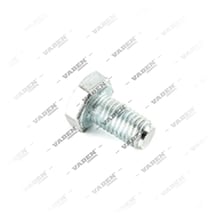
What are the functions of the Brake Pad Bolt?
The bolt's functions within the brake system can be summarized as follows.
- Retention: Keeps the pad fixed inside the caliper or carrier.
- Force transfer: Transmits the reaction force generated during braking to the caliper housing.
- Vibration resistance: Provides resistance against loosening through its locking feature.
- Position accuracy: Helps keep the pad in parallel contact with the disc surface.
- Maintenance convenience: Allows quick removal and refitting during a pad change.
What are the symptoms of a faulty Brake Pad Bolt?
When the bolt loosens or wears, the first symptom is a metallic squeak or knocking noise during braking; this noise becomes more noticeable especially with light brake application at low speed. The pad can move inside the caliper, causing uneven wear and creating a vibration feeling at the brake pedal. Visual inspection may reveal rounding of the bolt head (worn thread marks), rust, or looseness. In advanced cases the bolt can snap completely or fall out, leaving the pad loose inside the caliper and causing a serious brake failure. In some cases the locking washer is found missing or deformed. A bolt loosening from vibration often first reveals itself with a light knock, and this noise is usually more noticeable on rough ground or during cornering braking; drivers may mistake it for a stone hitting the wheel and ignore it, delaying early diagnosis.
How is the Brake Pad Bolt checked?
To check, the vehicle should be raised and the wheel removed, then the bolts inside the caliper visually inspected. Bolt heads should be checked for tightness with a torque wrench, but care must be taken since over-tightening can damage the thread. The locking washer or clip should be checked to see whether it is in place and undeformed. The pad is moved by hand inside the caliper to test for play; play can indicate a loose bolt. If the thread surface shows corrosion or wear, the bolt must be replaced. During the check, not only the bolt itself but also the thread bore it sits in should be examined; if the bore's thread is worn, even a new bolt risks not holding torque, and the bore may need repair (such as with a helicoil insert).
What should be considered during replacement?
Before replacement, the brake system should be brought to a safe state and the vehicle secured. When removing the old bolt, care must be taken not to damage the thread bore. The new bolt should be tightened to the torque value specified by the manufacturer, with thread locker applied if specified. The locking washer or clip must always be renewed; the old one should never be reused. After installation, it should be confirmed by hand that the pad sits free but firmly positioned inside the caliper, without play. The brake pedal should be pressed and released several times to confirm normal system operation. Once installation is complete, the vehicle should be taken on a short low-speed test drive, applying the brakes to confirm the squeak or knocking noise has fully disappeared; if the noise persists, the bolt or pad position should be reviewed again.
How is the Brake Pad Bolt selected?
Selection is determined by bolt length, thread size and strength class. The table below summarizes the selection criteria.
Brake Pad Bolt selection criteria| Criterion | Description |
|---|
| Thread size | Must exactly match the caliper or carrier's thread bore |
| Bolt length | Must be the correct length for the pad and housing thickness |
| Strength class | A steel grade resistant to high shear force should be chosen |
| Locking type | Washer, clip or self-locking thread must be compatible |
| Coating | A corrosion-resistant surface coating is preferred |
Maintenance and service life
Bolt life depends on vibration intensity and load conditions; the bolt and its locking feature must always be checked during pad replacement. If wear is found on the thread surface, the bolt should not be reused and must be replaced with a new one. Checking torque at periodic maintenance prevents failures caused by loosening. Adding bolt torque checks to the fleet maintenance schedule alongside pad replacement helps prevent squeaking and vibration complaints before drivers report them.
VADEN Brake Pad Bolt
VADEN manufactures pad bolts for heavy commercial vehicle brake calipers to OE dimensions and strength standards. Reliable locking performance and correct torque tolerances give workshops a secure connection solution.
Frequently Asked Questions (FAQ)
What happens if the brake pad bolt loosens?
The pad moves inside the caliper, causing uneven wear and squeaking; if it progresses, it can lead to a serious brake failure.
Can the locking washer be reused?
No, since its locking performance would drop, a new washer or clip must be used with every replacement.
How tight should the bolt be torqued?
It should be torqued to the value specified in the vehicle's current service manual; over-tightening can damage the thread.
Does the bolt always get replaced when the pad is changed?
It can be reused if the thread surface and locking feature are sound, but it must be replaced if there is wear or corrosion.
Does bolt corrosion affect brake performance?
Yes, a corroded bolt is more prone to loosening and can disturb the pad's position, leading to uneven braking.