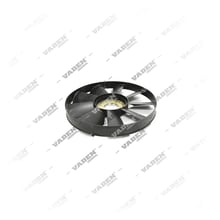
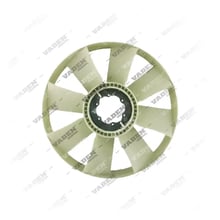
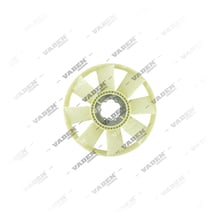
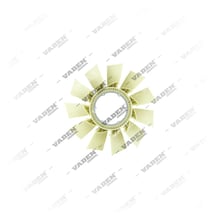
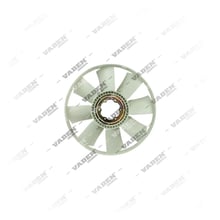
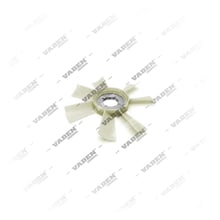
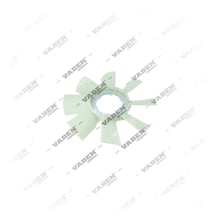
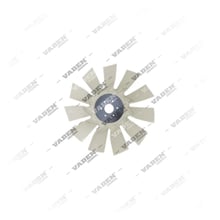
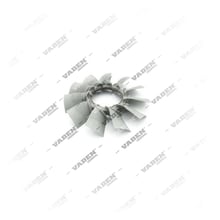
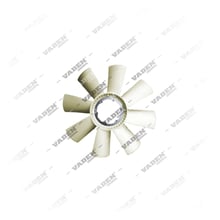
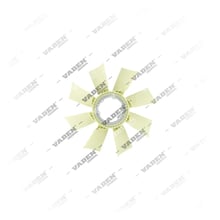
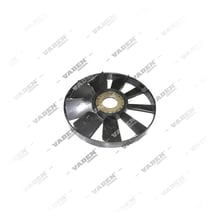
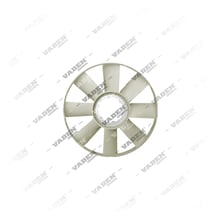
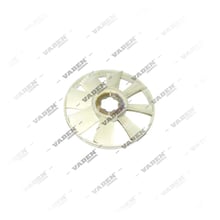
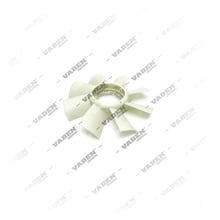
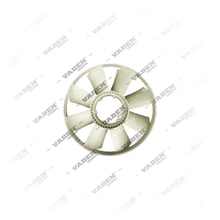
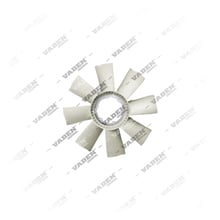
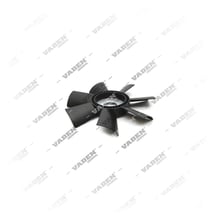
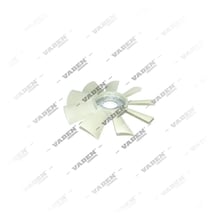
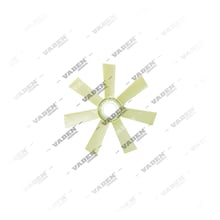
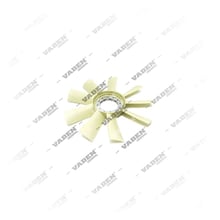
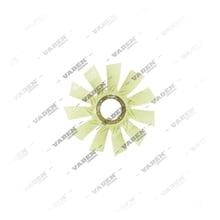
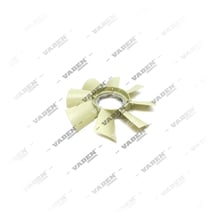
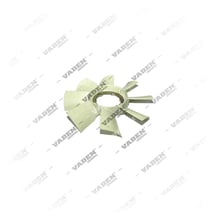
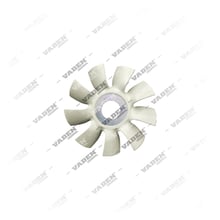
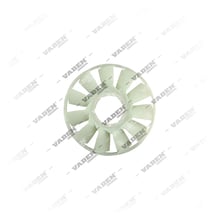
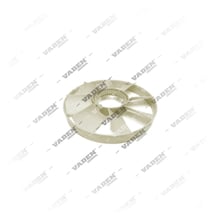
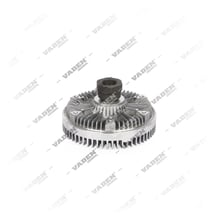
What Is a Fan Blade?
The fan blade is the bladed, rotating cooling component in a heavy commercial vehicle's cooling system that draws air through the radiator core. Heat generated by the engine is carried to the radiator by the coolant and released into the airflow there. Because the natural airflow created by vehicle speed is not enough at idle, on a steep climb under heavy load, or in stop-and-go traffic, the fan blade generates the airflow that is actually needed. In the field it is also called the cooling fan blade, fan wheel, or simply the fan; on trucks, tractor units, buses, trailers and construction equipment it is the most heavily stressed rotating part of the cooling fan assembly.
How Does a Fan Blade Work?
The blade gets its rotation from the crankshaft, either through the fan clutch or the pulley. Blade angle and profile convert this rotation into axial airflow, drawn through the radiator, intercooler and condenser. The fan shroud collects this airflow and reduces edge leakage, increasing efficiency. When cooling demand drops, the clutch disengages the blade, cutting unnecessary power draw, fuel consumption and noise.
- Air intake: As the blades rotate they create low pressure behind the radiator, pulling outside air through the core.
- Heat transfer: The air passing over the core surface picks up heat from the coolant, keeping the engine within its operating temperature range.
- Drive and engagement: A viscous or electromagnetic clutch adjusts blade speed, or disengages it entirely, based on coolant temperature.
- Airflow direction: Proper clearance between the shroud and the blade tips keeps air from escaping around the sides, preserving efficiency.
Fan Blade Technical Specifications
Heavy-duty fan blades are built to withstand continuous operation at high rotational speed and the temperature swings of the engine bay. Glass-fibre-reinforced polyamide is the most common material; heavy-duty applications also use aluminium or composite designs with a metal hub. Sizing is defined by diameter, blade count, blade angle, hub depth and the bolt-hole pattern. The figures below are general ranges only; the vehicle manufacturer's current service manual is the final authority in each application.
- Diameter range: Typically 500-800 mm on heavy commercial vehicles; it must match the inside dimension of the fan shroud.
- Blade count: Generally ranges from 6 to 11; count and angle together set the balance between airflow volume and noise.
- Bolt pattern: The number of bolt holes, hole diameter and pitch circle diameter on the hub must match the clutch flange exactly.
- Balancing: Blades are dynamically balanced; imbalance causes premature wear on the clutch bearing and the water pump bearing.
Fan Blade Types and Subgroups
- Plastic composite blades: Made from glass-fibre-reinforced polyamide; lightweight, and their low inertia puts less strain on the clutch and the belt.
- Metal-body blades: Built in aluminium or steel construction; preferred for high ambient temperatures and severe-duty operation.
- Viscous-clutch-driven blades: Change speed with temperature via a silicone-fluid-filled clutch; the most common arrangement on heavy vehicles.
- Electromagnetic-clutch blades: Fully engage or fully disengage on a signal from the control unit, giving precise temperature control.
- Fixed-drive blades: Bolt directly to the pulley and rotate continuously; found on construction equipment and some bus applications.
- Shroud and mounting components: A complementary group covering the shroud that collects the airflow, the spacer flange, bolts and other mounting hardware.
How to Choose the Right Fan Blade
The most reliable way to choose is to start from the OE reference number printed on the removed part. If the number cannot be read, matching is done by measuring diameter, blade count, rotation direction, hub depth and the hole pattern. An incorrect diameter or hub depth causes the blade to contact the shroud or the radiator. The table below summarises the criteria that should be verified before ordering.
Fan blade selection and compatibility criteria| Criterion | Verification note |
|---|
| OE reference number | The most precise method; read the number stamped on the hub or blade root |
| Outer diameter | Measured tip to tip and compared with the shroud's inside diameter |
| Blade count and angle | Determines airflow volume and noise level; count them on the original part |
| Rotation direction | The wrong direction reverses the airflow; check blade pitch against the engine's rotation direction |
| Hub bolt pattern | Hole count, hole diameter and pitch circle diameter are measured with calipers |
| Clutch type | Viscous, electromagnetic and fixed-drive designs each use a different hub interface |
Fan Blade Maintenance and What to Watch For
The blade should be visually inspected at every scheduled service. If a crack, a broken blade tip or a deformed hub is found, the part is not repaired, it is replaced. For installation torques, follow the vehicle manufacturer's current service manual; tighten bolts crosswise, in stages.
- Carry out a visual check: Inspect the blade roots for hairline cracks, the tips for breakage, and the hub for deformation.
- Measure the clearance: Keep the gap between blade tip and shroud at the manufacturer's specified value, and don't overlook cracks in the shroud.
- Assess the clutch at the same time: A weak-holding clutch or a bearing with play will cause even a newly installed blade to fail within a short time.
- Do not disturb the balance elements: Balance weights on the blades must not be removed, and bent blades should never be straightened by hand.
- Keep the cores clean: If the radiator and intercooler become clogged, cooling performance drops even with a fully sound blade.
Common Faults and Their Solutions
- Overheating at idle and on climbs: A broken blade or a weak clutch has reduced airflow; check the blade and the clutch together.
- Vibration and droning in the engine bay: Blade loss or disturbed balance causes uneven rotation; replace the blade and check bearing play.
- Scraping noise: An incorrect diameter, a loose engine mount, or a bent shroud can bring the blade tip into contact; measure the clearance and correct the faulty component.
- Bolts working loose: Unbalanced rotation and incorrect tightening torque are the main causes; renew the bolts and tighten them in stages to the specified value.
- Cracking and discolouration on the blades: High temperature, oil contact and material ageing have made the plastic brittle; the part must be replaced.
Why VADEN ORIGINAL?
- Manufactured to OE dimensions: Diameter, blade count and angle, hub depth and bolt pattern match the original part exactly.
- Broad OEM cross-reference: Cross-matched against OE part numbers for Mercedes-Benz, MAN, Scania, Volvo, DAF, Iveco, Renault Trucks, BMC and Ford vehicles.
- Balanced before shipping: Every blade is checked before dispatch so that imbalance cannot damage the clutch or the water pump bearing.
- Durable material: The material is selected to withstand the heat, vibration and oil-vapour conditions inside the engine bay.
- Shipping network spanning over 100 countries: Backed by a broad distribution and stock structure that shortens parts wait times for fleets and workshops.
Conclusion
The fan blade is a cooling-system part that looks simple but whose failure carries heavy consequences. A broken blade or an incorrectly sized diameter can start a chain reaction that ends in overheating and even cylinder head damage. For this reason the blade should be assessed together with the clutch and the shroud, and selection should be based on the OE reference number.
Frequently Asked Questions (FAQ)
What does a fan blade do?
The fan blade draws enough air through the radiator core to let the coolant release its heat into the atmosphere. Because the natural airflow generated by vehicle speed is not sufficient at idle, under heavy load, or in stop-and-go traffic, the blade produces the airflow that is actually required. As a result, it plays a direct role in keeping engine temperature within its operating range.
Can a vehicle keep running with a broken fan blade?
It should not. A blade with a broken tip reduces airflow, causing the engine to overheat, and it also rotates out of balance, generating vibration. That vibration can cause secondary damage to the fan clutch, the water pump bearing and the radiator mounts, so the part should be replaced without delay.
How do I choose the right fan blade?
The most reliable method is to match the OE reference number printed on the removed blade. If the number is illegible, compare outer diameter, blade count, rotation direction, hub depth and the bolt-hole pattern by measurement. It's also worth confirming whether the clutch fitted to the vehicle is viscous, electromagnetic or fixed-drive.
Should the fan blade and the fan clutch be replaced together?
It's not mandatory, but assessing both together is recommended. A weak-holding viscous clutch or a bearing with play will put a newly fitted blade under strain and cause it to fail before long. If the clutch shows fluid leakage, noise or axial play, renewing it in the same service visit is the more economical choice.
Which vehicles are VADEN ORIGINAL fan blades compatible with?
The range covers a wide application spread for trucks, tractor units, buses, trailer combinations and construction equipment. Cross-referencing is available against OE numbers for Mercedes-Benz, MAN, Scania, Volvo, DAF, Iveco, Renault Trucks, BMC and Ford heavy vehicles. Before ordering, it's recommended to confirm both the OE number and the installation dimensions.
Related technical guide: Viscous Fan Clutch: Fault, Replacement & Maintenance Guide