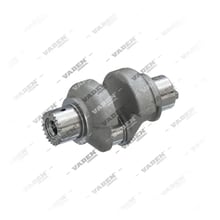
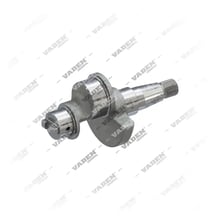
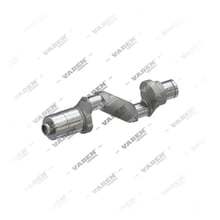
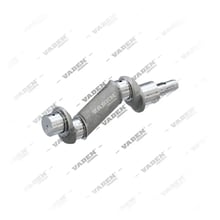
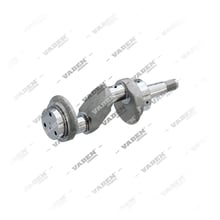
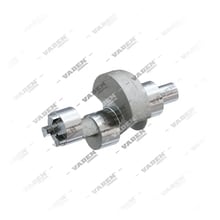
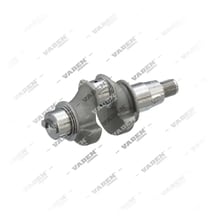
What Is Compressor Parts Crankshaft?
Compressor Parts Crankshaft is the subcategory covering the crankshaft that rotates inside the air brake compressor's crankcase, along with the bearings and seals it needs to operate. Part of the Compressor Parts chain under Air Brake Compressors, this group includes the crankshaft itself, crankshaft repair kits, the crank flange, main bearings, connecting-rod bushings, oil seals and shim rings. In the workshop these same parts are simply called the compressor crank or crankshaft. Because the compressor turns continuously with the engine, the crankshaft assembly is among the highest-cycling components in the pneumatic brake system; the category serves workshops that would rather rebuild a compressor economically than replace the whole unit.
How Does Compressor Parts Crankshaft Work?
The crankshaft assembly is the first link in the chain that turns engine motion into compressed air. Drive taken from the gear, pulley or clutch reaches the crankshaft, then passes through the connecting rod to the piston.
- Taking up the drive: The gear, pulley or clutch on the drive end picks up motion and sets the compression cycle's timing.
- Converting to linear motion: Because the crank pin sits off-centre from the main axis, every turn of the shaft becomes a piston stroke.
- Compression stroke: As the piston nears top dead centre it compresses the air, pushed through the delivery valve to the dryer and on to the tanks.
- Bearing support and balance: Main bearings, bushings and counterweights damp vibration and keep the shaft axis stable.
- Lubrication and sealing: Oil galleries in the shaft carry pressurised oil to the bearings, while the seal and flange assembly keeps it from escaping.
Compressor Parts Crankshaft Technical Specifications
Compressor crankshafts are typically forged steel or spheroidal graphite iron castings, with journal surfaces induction-hardened and precision-ground. That sequence is what allows an unbroken oil film to form and keeps the bearing material from fatiguing prematurely. Hardening depth matters just as much as surface hardness — a shaft hardened too shallow loses its hard layer on the first regrind.
Sizing is built around main journal diameter, crank pin diameter and stroke, with drive-end type and shaft length making each part number unique. Once a shaft has been reground, undersize grades apply, and bearings must be selected in the matching grade. Clearances are held to hundredths of a millimetre and torques vary with fastener diameter — which is why the vehicle manufacturer's current service manual remains the reference.
Compressor Parts Crankshaft Types and Subgroups
The category is made up of complementary component families. Depending on the fault, sometimes only the seal and gasket need renewing, and sometimes the shaft and bearing set are replaced together.
- Complete crankshaft: fitted in place of a shaft worn beyond repair, cracked, or running out of true.
- Crankshaft repair kits: bundle the shaft, bearings or bushings, seal and gasket so the whole motion assembly is renewed in one job.
- Main bearings, connecting-rod bearings and bushings: form the shaft's running surface, supplied in standard and undersize grades.
- Crank flange and drive assembly: provide the shaft's connection on the engine side, varying by interface type.
- Oil seals and shim rings: prevent oil leakage and restore end-float to the specified value.
How to Choose the Right Compressor Parts Crankshaft
The starting point is the OE number and type plate on the compressor housing. Because the same vehicle model can carry different compressor types depending on the engine option, choosing by make and model alone leads to the wrong part.
Selection and compatibility criteria for the compressor crankshaft assembly| Criterion | How is it verified? | Why does it matter? |
|---|
| OE / OEM number | Read from the housing plate and casting number | The same engine can carry more than one variant |
| Compressor type | Check whether it is single- or twin-cylinder | Stroke and journal dimensions differ |
| Drive-end interface | Check whether the connection is tapered, keyed or flanged | The wrong interface prevents fitment |
| Size grade | Measure journal diameter with a micrometer | Bearing and shaft must be the same grade |
| Oil gallery layout | Compare hole positions with the old part | A mismatched gallery cuts off lubrication |
| Vehicle application | Confirm the Mercedes-Benz, MAN, Scania, Volvo, DAF or Iveco variant | Confirming it upfront reduces downtime |
Compressor Parts Crankshaft Maintenance and Key Points to Watch
How long the crankshaft assembly lasts depends largely on lubrication quality and installation discipline. Since the compressor's oil supply comes from the engine's own circuit, any lapse in maintenance intervals shows up directly in the crankshaft bearings.
- Clean the crankcase before assembly: leftover bearing debris and sludge score the new shaft's surface and undo the rebuild.
- Confirm the oil path: check with compressed air that the feed line and the shaft's galleries are clear.
- Work to measured clearances: check radial and end-float clearance with a dial gauge, and don't overlook ovality or taper.
- Apply torque in stages: tighten the connecting-rod and cap bolts in a crossing sequence with a torque wrench.
- Renew the seal at every rebuild: a seal removed once loses its lip profile and starts leaking soon after.
Common Faults and How to Fix Them
Crankshaft faults usually reach the workshop as a brake complaint — the driver reports slow pressure build-up or noise from the compressor. Reading the symptom correctly avoids an unnecessary unit swap.
- Rhythmic knocking from the crankcase: caused by increased connecting-rod bearing clearance; measure, then fit the correct grade bearing, replacing the shaft if needed.
- Oil leaking from the drive end: caused by a worn seal or a blocked crankcase breather; renew the seal and clear the breather.
- Excessive oil consumption: increased bearing clearance carries too much oil into the cylinder; the motion assembly needs a full rebuild.
- Slow pressure build-up: shaft and bearing wear reduces compression efficiency; check the crankshaft assembly along with the valve plate.
- Overheating and bearing seizure: caused by insufficient oil pressure or a blocked gallery; flush the line and renew any shaft or bearings showing seizure marks.
Why VADEN ORIGINAL?
VADEN is a manufacturer specialised in air brake compressors and their components. Its crankshaft assembly products are built around the dimensional and material logic of the original unit.
- Manufactured to OE dimensions: journal diameters, stroke, drive interface and oil gallery layout match the original part's dimensional logic.
- Broad OEM coverage: cross-references are provided for Mercedes-Benz, MAN, Scania, Volvo, DAF, Iveco and BMC applications.
- Graded size options: correct bearing matching is available for shafts ground to standard as well as undersize grades.
- Kit integrity: shaft, bearing, seal and gasket are supplied together in the same kit, cutting the risk of a second strip-down.
- Export to over a hundred countries: field feedback from a wide range of climates and load profiles feeds back into the product.
Conclusion
Compressor Parts Crankshaft is the motion assembly that determines an air brake compressor's ability to produce air, and choosing it correctly delivers a far more economical rebuild than replacing the whole unit. The path to the right part starts with the OE number and continues through confirming journal size, drive interface and size grade. Keep cleanliness and torque discipline during assembly, and the crankshaft group will deliver a long service life.
Frequently Asked Questions (FAQ)
What happens when a compressor crankshaft wears out?
As the journal surface wears, bearing clearance grows and a rhythmic knocking noise starts coming from the crankcase. As the clearance increases, more oil gets carried into the cylinder, the air tank takes longer to fill, and oil starts collecting in the air line. When these symptoms appear, shaft and bearing dimensions should be checked, and the motion assembly rebuilt completely if needed.
Should I buy a crankshaft repair kit or a complete crankshaft?
If the journal surfaces are within tolerance and free of scoring, ovality or cracks, a repair kit containing the bearings, seal and gasket is usually enough. If the shaft has gone below its regrind limit, runs out of true, or shows seizure marks, the complete crankshaft should be replaced. Before deciding, measure the shaft at several points and in two axes.
How do I identify the correct crankshaft part?
The most reliable method is cross-referencing the OE number on the compressor housing. You then need to confirm whether the compressor is single- or twin-cylinder, its drive-end interface, journal diameter and size grade. Because the same vehicle model can use different compressor types depending on the engine variant, make and model information alone is not enough.
When is an undersize crankshaft bearing used?
If the crankshaft has been reground before, its journal diameter has dropped below the standard size, and in that case an undersize bearing or bushing in the matching grade must be used. Fitting a standard bearing onto a reground shaft opens up excessive clearance, drops oil pressure, and produces knocking within a short time. Shaft diameter must always be measured with a micrometer before assembly.
What torque and clearance values apply when assembling the crankshaft?
Clearance and tightening torque vary with compressor type, fastener diameter and manufacturer specification, so quoting a general figure would be misleading. Radial and end-float clearances are held within a very narrow band, and measurement is done with a dial gauge. For exact figures, the vehicle manufacturer's current service manual is the reference.
Related technical guide: Compressor Crankshaft & Drive Assembly: Failure & Replacement Guide