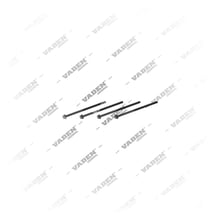
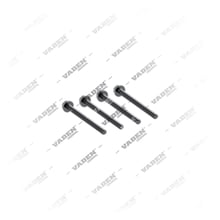
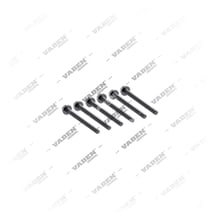
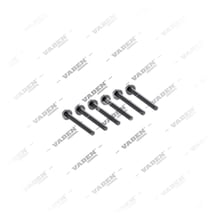
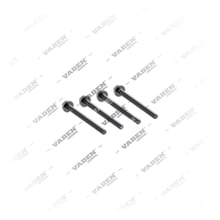
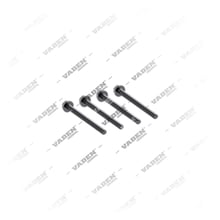
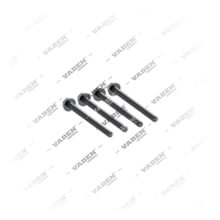
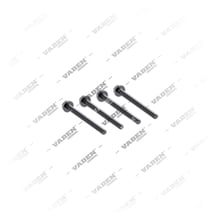
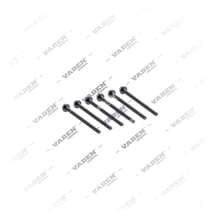
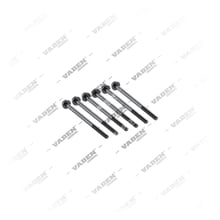
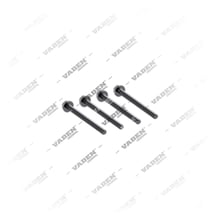
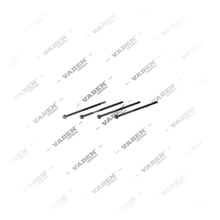
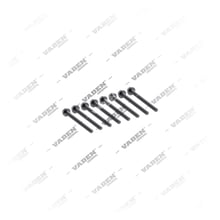
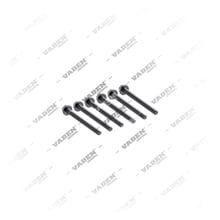
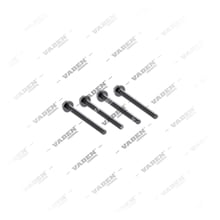
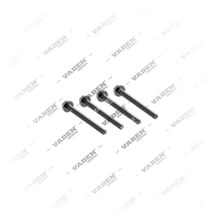
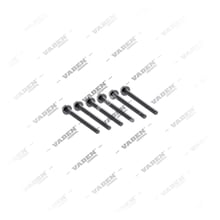
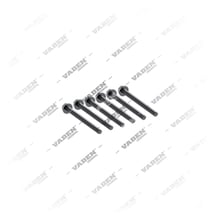
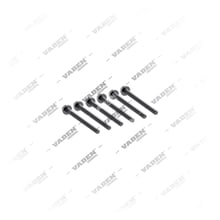
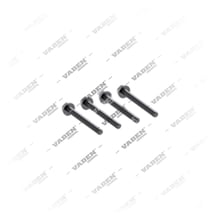
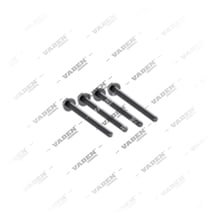
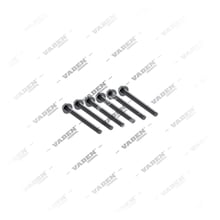
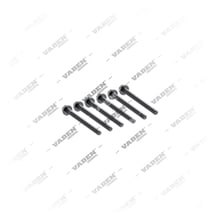
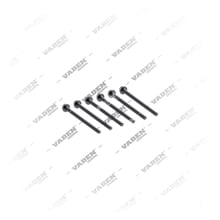
What Is a Compressor Parts Bolt Kit?
A Compressor Parts Bolt Kit bundles the bolts, studs, nuts and washers used to fasten an air brake compressor's housing, cylinder head, valve plate, crankcase and drive flange assemblies together. In the field it is also called a bolt set or fastener kit. Every fastener removed during an overhaul has already stretched once under torque and carried the sealing load ever since. Unlike chassis bolts, these operate under constant pressure pulses, high heat and vibration. The category holds 97 products covering different compressor housings.
How Does a Compressor Parts Bolt Kit Work?
During tightening, a bolt stretches elastically, and the resulting preload clamps two surfaces together — in a compressor, the only force keeping the gasket and valve plate sealed.
- Building preload: The torqued fastener stretches, squeezing the gasket between head and plate at a calculated pressure.
- Absorbing pressure pulses: On the compression stroke, internal pressure tries to lift the head; while preload stays high, the gasket face stays sealed.
- Resisting loosening: Vibration on an under-preloaded joint creates slip that backs off the threads.
- Compensating for thermal expansion: The head and housing expand at different rates; fastener length and grade keep preload in band.
- Distributing load: Washers spread clamping force evenly across the head face, preventing local leaks.
Compressor Parts Bolt Kit Technical Specifications
These fasteners are chosen for the compressor's temperature and pressure profile. Figures below are for guidance only; for exact torque, sequence and reuse limits, the vehicle manufacturer's current service manual is authoritative.
- Strength class: Grade 8.8 and 10.9 steel is common on the head and valve plate, 12.9 for demanding applications; class is confirmed from the head marking.
- Surface finish: Zinc plating, Dacromet or an equivalent coating suits the condensation-prone zone and also changes friction.
- Sizing logic: Head and plate use small-to-medium metric threads, housing and flange larger sizes; length follows head thickness.
- Engagement depth: Stud engagement into the housing must be deep enough to prevent stripping.
- Compatibility criterion: Matching relies on the compressor's own OE number and housing type; bolt patterns can vary across production revisions.
Compressor Parts Bolt Kit Types and Subgroups
- Cylinder head bolt kit: Clamps the head onto the valve plate and housing; sequence and preload balance determine sealing.
- Valve plate fasteners: Position the plate for the intake and discharge valves; small, high-temperature duty.
- Crankcase and bottom cover bolts: Fasten the oil sump and bottom cover, sealing against oil leakage at a lower torque band.
- Stud and nut sets: Protect the housing thread on repeatedly removed connections.
- Drive flange and pulley fasteners: Connect the compressor to the engine drive; carrying torque, they need a higher class.
- Mounting foot and housing bolts: Fix the compressor to the engine block or bracket, carrying the highest vibration load.
- Washers, spacers and locking elements: Distribute load and secure the joint against loosening.
How to Choose the Right Compressor Parts Bolt Kit
Selection starts with the compressor's own OE number, since the same model can use different compressors by engine option. Next, confirm the housing type and head bolt pattern, then verify the thread size and strength class of the fastener being removed.
Compressor Parts Bolt Kit selection and compatibility criteria| Fastener group | Typical class | Selection criterion | Reuse |
|---|
| Cylinder head | 10.9 or 12.9 | Head thickness and gasket crush allowance | Not recommended |
| Valve plate | 8.8 or 10.9 | Plate bolt pattern and length tolerance | Not recommended |
| Crankcase and bottom cover | 8.8 | Oil sealing and lower torque band | Possible if undamaged |
| Drive flange | 10.9 or 12.9 | Torque transfer and centering bore | Not recommended |
| Mounting foot | 8.8 or 10.9 | Vibration load and bracket thickness | Possible if undamaged |
| Stud and nut | 8.8 or 10.9 | Housing thread engagement depth | Nut should be renewed |
Compressor Parts Bolt Kit Maintenance and Key Precautions
- Always use a torque wrench: Preload must stay within a narrow band; tightening by feel crushes the gasket or causes a leak. Follow the vehicle manufacturer's service manual for the value.
- Follow the tightening sequence: Head and valve plate bolts are tightened center-out, criss-cross and staged; jumping straight to full torque in one pass warps the head.
- Clean the thread surfaces: Debris, rust or oil change friction; even at the same torque, preload drifts off target.
- Do not reuse a stretched fastener: On head and flange joints, a removed fastener may already be near its elastic limit.
- Do not mix classes and lengths: Swapping fasteners between positions leads to thread stripping; sort by position when removing.
- Recheck after the first run: Once the compressor has heated and cooled, recheck head torque if the manual calls for it.
Common Faults and Solutions
- Air leak around the head: A hissing sound and slow pressure build-up point to uneven preload or a stretched bolt; renew the fasteners and tighten in sequence.
- Repeated gasket failure: Points to a warped head face or mixed fastener use; check flatness and renew the group as a kit.
- Bolt breakage or thread stripping: Over-torquing, insufficient engagement depth or a dirty thread surface; check the housing thread and switch to a stud if needed.
- Fasteners loosening on their own: Preload loss under vibration from a missing washer or locking element; install the correct washer arrangement.
- Seizure from corrosion: A fastener with damaged coating can gall to the housing; use penetrating fluid and fit a new, coated one.
- Oil seepage from the crankcase: Tightening the bottom cover outside its torque band or a missing fastener causes leaks.
Why VADEN ORIGINAL?
- Manufactured to OE dimensions: Thread size, length, head type and strength class match the original fastener.
- Broad OEM matching: Cross-referenced options cover Wabco- and Knorr-Bremse-type housings on Mercedes-Benz, MAN, Scania, Volvo, DAF, Iveco and Renault Trucks vehicles.
- Kit completeness: Everything needed for an overhaul — bolts, studs, nuts and washers — comes in one set, cutting service downtime.
- Corrosion-resistant coating: Delays corrosion in the condensation zone and eases removal.
- Consistency across the family: Order alongside gasket, piston, ring and valve plate groups.
- Wide export network: VADEN ORIGINAL products are used in over 100 countries, across many climates and road conditions.
Conclusion
The Compressor Parts Bolt Kit gets the least thought during an air brake compressor overhaul, yet has the most direct bearing on the outcome. Even the best gasket cannot hold a seal without the right fasteners, tightened in the right sequence, at the right torque. Choosing by OE number and following the vehicle manufacturer's current service manual for tightening values extends compressor service life and protects braking reliability.
Frequently Asked Questions (FAQ)
Can the fasteners in a compressor bolt kit be removed and reused?
On high-preload joints such as the cylinder head, valve plate and drive flange, reusing removed fasteners is not recommended; these fasteners have already stretched elastically under torque and cannot deliver the same preload on a second tightening. On lower-load connections such as the crankcase and mounting bracket, reuse may be possible if the thread and head face are undamaged. The vehicle manufacturer's current service manual is authoritative for this decision.
What torque should compressor head bolts be tightened to?
Because torque depends on the compressor model, the fastener's strength class, thread size and coating type, giving a single general figure would be misleading. Head connections are generally brought to final value in a criss-cross sequence from the center outward, in stages. The vehicle manufacturer's current service manual is authoritative for the exact torque and tightening sequence.
Which compressors does the Compressor Parts Bolt Kit fit?
Compatibility is determined by the compressor's own OE number and housing type rather than by vehicle brand alone. Since the same vehicle model can use a different compressor depending on engine option, the number on the compressor should be read before ordering. The category includes cross-referenced options corresponding to Wabco- and Knorr-Bremse-type housings.
If there is an air leak from the compressor, is simply tightening the bolts enough?
If it is only a slight loosening, a torque check performed in the correct sequence can stop the leak. But once the gasket has already crushed or the head face has warped, retightening is not a permanent fix and the leak will return quickly. In that case, the head should be removed, the gasket renewed, and the fasteners replaced as a full kit.
Can standard hardware-store bolts be used on a compressor?
This is not recommended. Compressor connections operate under pressure pulses, high temperature and constant vibration; a fastener with unknown strength class, length tolerance and coating cannot maintain preload, creating a risk of thread stripping or breakage. Using a kit manufactured to OE dimensions protects both the seal and the reliability of the brake system.
Related technical guide: Compressor Connection Hardware: Faults, Replacement, Care