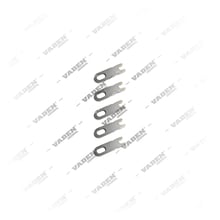
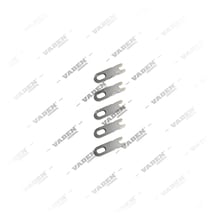
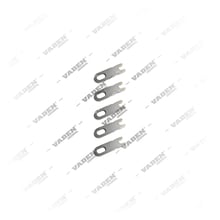
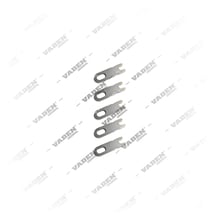
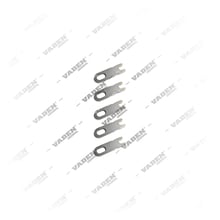
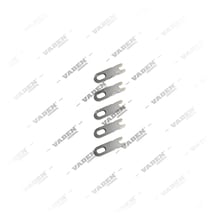
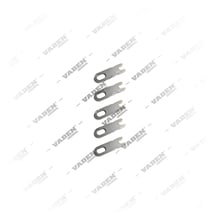
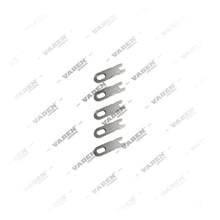
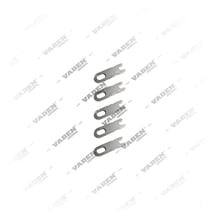
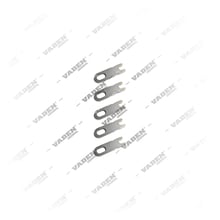
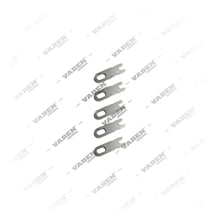
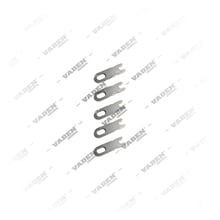
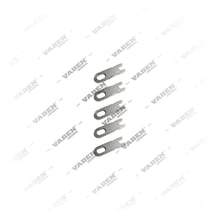
What Is a Valve Adjusting Shim?
A valve adjusting shim is a precision-ground steel spacer, made to an exact thickness, used in heavy commercial vehicle diesel engines to bring valve clearance back to the manufacturer's specified tolerance. Part of the Engine > Valve Train group, it sits between the rocker arm, valve bridge, cam follower, or valve stem and the surface it contacts, so the valve seats fully on every cycle. In the field it's also called a "valve lash shim," "valve clearance shim," or "tappet adjusting disc." It's used in truck, tractor unit, bus, and heavy equipment engines, particularly in shim-adjusted cylinder head designs rather than threaded adjusting screws.
How Does a Valve Adjusting Shim Work?
As the engine heats up, the valve stem, rocker assembly, and cylinder head expand at different rates. Valve clearance is the controlled gap that lets the valve still close fully despite this expansion. A shim sets this gap by adding measured thickness into the chain between cam and valve; thicker reduces clearance, thinner increases it.
- Measurement: The cylinder is set to top dead center; with valves closed, clearance is measured with a feeler gauge.
- Difference calculation: The gap between measured and target value is added or subtracted from the fitted shim's thickness.
- Selecting the grade: Shims are graded in hundredth-millimeter steps, so the closest ready-made shim to the calculated value is chosen.
- Verification: Once fitted, clearance is measured again.
Target clearance varies by engine family, intake versus exhaust valve, and cold versus hot measurement; the manufacturer's current service manual sets the applicable value.
Valve Adjusting Shim Technical Specifications
Valve adjusting shims are made from case-hardened or heat-treatable steel, then hardened and ground for dimensional consistency to withstand continuous impact loading. Critical dimensions are outer diameter, inner diameter or center hole, thickness, and tolerance; grades progress in hundredth-millimeter steps, usually stamped onto the shim.
Surface hardness and parallelism matter as much as thickness. A softly machined shim deforms under the cam follower and clearance drifts out of spec quickly; if parallelism is off, the valve runs under side loading. Since these values depend on engine family, base selection on the OE part number.
Valve Adjusting Shim Types and Subgroups
- Disc-type adjusting shims: Round discs atop the cam follower bucket; in direct contact with the cam, they carry the highest surface hardness of the group.
- Washer-type (bored) adjusting shims: Shims with a center locating hole that fit over a stem or dowel pin, with low risk of shifting during assembly.
- Valve bridge adjusting shims: Used in twin-valve heads to balance the height difference between bridge and rocker arm, so both valves open equally.
- Rocker shaft and bearing shims: Correct assembly geometry via bearing height, compensating for height lost after resurfacing a cylinder head.
- Shim sets and grade kits: Service kits covering a range of thicknesses, making it easier to find the correct grade on the first attempt.
How to Choose the Right Valve Adjusting Shim
The most reliable approach is starting from the OE part number of the removed shim or cylinder head. If unreadable, identify the engine type and valve train layout, then calculate the thickness difference by measuring clearance.
Valve adjusting shim selection and compatibility criteria| Criterion | How to verify it | Why it matters |
|---|
| OE part number | Cross-reference from the removed shim or engine number | Avoids application errors |
| Thickness grade | Micrometer measurement and the stamp on the shim | Wrong grade binds the valve or leaves excess play |
| Outer and inner diameter | Caliper measurement against the seat | A poor-fitting shim shifts and scores surfaces |
| Valve position | Separate target values for intake and exhaust | Exhaust side expands more and needs a different value |
| Measurement temperature | Cold or hot condition as stated in the manual | Wrong temperature invalidates the whole adjustment |
| Engine and make application | Mercedes-Benz, MAN, Scania, Volvo, DAF, Iveco engine code | Dimensions can differ by code within the same series |
| Surface condition | Checking for pitting and bluing marks | Worn surfaces drift out of adjustment quickly |
The criteria above are general guidance; for exact values and tolerances, the vehicle manufacturer's current service manual is authoritative.
Valve Adjusting Shim Maintenance and What to Watch For
- Follow the interval: Check valve clearance at the mileage or operating-hour interval the manufacturer sets; neglect wears the contact surfaces rapidly.
- Measure every valve individually: Don't assume one cylinder's value applies to another; each valve may need its own grade.
- Fit it clean and lubricated: Clean the shim seat and lightly oil it before assembly; a dry fit leaves scoring marks on first start-up.
- Never grind a shim: Sanding removes the hardened layer and shortens shim life; always fit a ready-made shim of the correct grade.
- Verify after adjustment: Re-measure all clearances before fitting the cover, and renew the cover gasket in the same visit.
Common Faults and How to Fix Them
- Tapping noise when cold: Clearance is above target; the shim is worn or the wrong grade was fitted. Re-measure and step up to a thicker shim.
- Rough idle and loss of power: Clearance has shrunk or closed up; the valve can't fully close and compression leaks past. Fit a thinner shim to restore range.
- Burnt exhaust valve: A persistently tight exhaust valve burns its seating face; check the valve and seat along with the shim adjustment.
- Adjustment drifting out quickly: A low-hardness shim, worn cam follower, or loose rocker connection all produce this pattern; renew the shim to OE dimensions.
- Uneven opening in a twin-valve head: The bridge shim is worn or the wrong thickness; inspect bridge and shim together and replace as needed.
Why VADEN ORIGINAL?
- Manufactured to OE dimensions: Thickness, diameter, and parallelism match original part dimensions; the ground surface keeps the adjustment stable.
- Heat-treated material: Hardened steel resists deformation and pitting under the continuous impact load beneath cam and rocker.
- Broad OEM matching: Common thickness and diameter grades cross-reference to OE numbers, with intermediate grades kept in stock.
- Exported to over 100 countries: A wide service and distribution network backs the range, so availability keeps fleet downtime to a minimum.
Conclusion
Despite its small size, the valve adjusting shim has a direct effect on engine performance, fuel consumption, and cylinder head life. The correct thickness lets the valve close fully; the wrong choice leads to problems ranging from tapping noise and lost compression to a burnt exhaust valve. Base selection on the OE part number and consult the manufacturer's current service manual for exact values.
Frequently Asked Questions (FAQ)
What does a valve adjusting shim do?
A valve adjusting shim is a precision-ground steel spacer plate that brings an engine's valve clearance to the value specified by the manufacturer. By adding a measured thickness into the mechanical chain between the cam and the valve, it ensures the valve closes fully on every cycle. This preserves compression and protects the valve seating face from burning.
How is the thickness of a valve adjusting shim calculated?
First the relevant cylinder is brought to top dead center and, with the valves closed, the existing clearance is measured with a feeler gauge. The difference between the measured value and the target value in the service manual is added to or subtracted from the thickness of the shim currently fitted. A ready-made shim of the resulting thickness is then installed; a shim should never be thinned by sanding.
What are the symptoms of an engine with incorrect valve clearance?
Excess clearance produces a metallic tapping noise that's most noticeable when the engine is cold, while insufficient clearance causes rough idle, loss of power, and hard running. If left unaddressed for a long period, the exhaust valve can burn and the cylinder head can suffer damage that requires repair. As soon as symptoms appear, clearances should be measured without delay.
Does a valve adjusting shim need to be replaced at every service?
A shim is replaced when the measured value can't be brought within target clearance, or when its surface shows pitting, bluing, or deformation. If the clearance is within tolerance and the surface is sound, the existing shim can continue in service. For the inspection interval, the vehicle manufacturer's current service manual is authoritative.
Which engines are VADEN ORIGINAL valve adjusting shims compatible with?
Thickness and diameter grades are available for the Mercedes-Benz, MAN, Scania, Volvo, DAF, Iveco, and Renault Trucks diesel engines commonly found in heavy commercial vehicles. Compatibility is confirmed by cross-referencing the OE part number of the removed shim or cylinder head, since dimensions can differ by engine code within the same model series.
Related technical guide: Engine Valve Train & Adjustment Shim: Faults, Replacement, Care