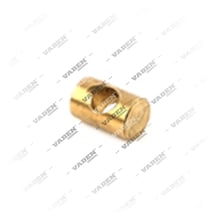
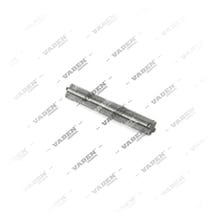
What are the functions of the Actuating Lever Pin?
- Forming the rotation axis: Defines the fixed axis around which the actuating lever rotates inside the caliper body.
- Sustaining force transmission: Ensures the force coming from the pushrod is transmitted to the mechanism without loss.
- Radial and axial retention: Prevents lateral movement or axial slippage of the lever, maintaining correct contact angle.
- Repeatable motion: Guarantees the lever moves along the same trajectory over thousands of braking cycles.
- Load distribution: Distributes the force generated during braking evenly across the caliper body, reducing point loading.
What are the symptoms of a faulty Actuating Lever Pin?
- Metallic rattling during braking: When the pin wears, play develops along the lever axis, and a rattling sound can be heard with each brake application.
- Delayed brake response: Excessive play can cause the force from the brake chamber to be transmitted to the mechanism late and incompletely.
- Irregular pad wear: Slippage in the lever axis can prevent the pad from contacting the disc surface evenly, causing uneven wear.
- Lever stiffening or not fully returning: A corroded pin can restrict free movement of the lever, causing brake drag (the pad not fully separating from the disc).
- Visible wear marks: Scoring, loss of surface shine or rust can be observed on the pin surface when the caliper is opened.
How is the Actuating Lever Pin inspected?
For inspection, the brake chamber and actuating lever connection are disconnected to free the lever. The lever is rotated by hand and released to test for stiffness, binding or excessive play without resistance. The pin surface is visually inspected for scoring, notching or rust. The lever's axial and radial play is checked with a measuring tool where possible and compared to the manufacturer's tolerance. The retaining elements at both ends of the pin, and the seal/dust boot if present, should be checked for damage; a damaged seal allows dirt and moisture into the pin bearing.
What should be considered when replacing it?
During replacement, the lever and pin seat should be cleaned, with old grease and dirt fully removed. Before fitting the new pin, the lever bore and the bearing surface in the caliper body should be checked for wear, and the lever replaced too if necessary. The pin should be lubricated with the type and quantity of high-temperature grease recommended by the manufacturer. If a dust boot or seal is present, it must always be renewed, never reused. After installation, the lever's free rotation through its full angle and, if a spring is present, its correct return should be tested; for exact assembly steps, the vehicle's current OE service manual is the authoritative source.
How to choose the right Actuating Lever Pin?
Since caliper mechanisms use different pin diameters, lengths and retaining systems depending on the model, the caliper type and OEM number must be verified together for correct selection.
Selection criteria for Brake Caliper Actuating Lever Pin| Criterion | Why it matters |
|---|
| Caliper type / OEM number | Pin diameter and length are specific to the mechanism |
| Surface hardness | Insufficient hardness leads to rapid wear and play |
| Coating quality | A corrosion-resistant coating extends service life in moist environments |
| Seal/dust boot compatibility | An incompatible sealing element allows dirt and moisture ingress |
| Tolerance precision | Incorrect tolerance causes the lever to bind or have excessive play |
Maintenance and service life
Because the actuating lever pin is subjected to repeated swinging motion with every brake application, it is one of the most heavily loaded small parts in the caliper mechanism. Its service life largely depends on lubrication frequency and exposure to dirt and moisture from the environment. During periodic brake maintenance, the lever and pin area should be opened to refresh the grease and the sealing elements checked. On vehicles that go long periods without lubrication, corrosion can start on the pin surface; addressing this early protects other mechanism components.
VADEN Brake Caliper Actuating Lever Pin
VADEN manufactures actuating lever pins for heavy-duty commercial vehicle disc brake calipers to OE diameter, length and surface hardness specifications. Correct tolerance and coating quality support robust, quiet and repeatable lever movement.
Frequently Asked Questions (FAQ)
Is the Actuating Lever Pin the same part as the Caliper Mechanism Pin?
No, they serve different positions. The actuating lever pin forms the rotation axis of the lever that transmits force from the brake chamber to the mechanism; the caliper mechanism pin connects other moving parts within the mechanism.
Why can a worn pin cause brake drag?
A corroded or deformed pin can prevent the lever from fully returning; in this case the pad cannot fully separate from the disc, resulting in continuous light contact, known as brake drag.
Should the dust boot also be renewed during replacement?
Yes, a damaged or hardened dust boot allows dirt and moisture into the pin bearing; renewing it together with the pin is recommended.
Does lever stiffness always originate from the pin?
Usually yes, but dirt buildup in the spring mechanism or connected parts can also cause stiffness; the mechanism should be opened and inspected for a definitive diagnosis.
Are actuating lever pins interchangeable across different caliper models?
Generally no. Diameter, length and retaining/sealing element compatibility are specific to the mechanism; replacement should not be done without verifying the OEM number.