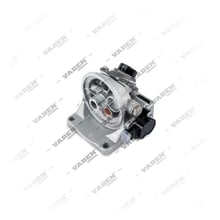
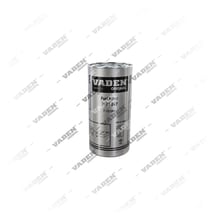
What Is a Fuel Filter Water Separator?
A Fuel Filter Water Separator is the filter assembly in a heavy commercial vehicle's diesel fuel circuit that removes free water and moisture from the fuel before it reaches the injection system, while also capturing coarse solid contaminants. It sits early in the fuel line, between the tank and the transfer pump, keeping water away from the injection system's precision components. On the shop floor it is also called a water separator filter, fuel/water separator, diesel water trap, or fuel pre-filter. It is standard on trucks, tractors, buses, trailer units, and heavy construction machines, all far more exposed to condensation from frequent refuelling and wide temperature swings.
How Does a Fuel Filter Water Separator Work?
Water separation relies on three principles: velocity reduction, droplet coalescence, and gravity settling from the density difference between water and diesel. Separated water sinks into the lower bowl and is emptied through the drain valve. The steps below outline a typical cycle.
- Velocity reduction: Fuel enters the housing, flow slows as the cross-section widens, and heavier water droplets fall out of suspension.
- Coalescence: The water-repellent filter media pulls scattered micro-droplets of water together into larger, heavier droplets.
- Settling: Because water is denser than diesel, coalesced droplets drop into the lower bowl and separate from the fuel stream.
- Particle capture: The same element traps rust, sand, and tank sediment, protecting the injection assembly downstream.
- Warning and drain: A sensor signals the dashboard once water reaches a set level, and the drain plug is opened to empty it.
Fuel Filter Water Separator Technical Specifications
These filters use materials engineered to withstand fuel-line pressure and diesel's chemical action over long service intervals. The housing is typically deep-drawn steel or aluminum, the bowl is clear polymer or metal, and the seals are elastomers resistant to diesel and biodiesel blends. The element is cellulose, glass fiber, or layered synthetic media with a water-repellent surface treatment, coarser at the first stage and progressively finer at the final one.
Decisive compatibility criteria are cartridge diameter and height, thread size, seal diameter, port location, and the water sensor socket. For working pressure, temperature range, tightening torque, and change interval, the vehicle manufacturer's current service manual is the authoritative source; catalog figures are general guidance only.
Types and Subgroups of Fuel Filter Water Separators
- Spin-on type: Replaced as a complete unit with its own metal housing; quick to install, common on conventional trucks and construction equipment.
- Cartridge (element) type: Only the element and seals are replaced; the housing stays on the vehicle. Low waste volume, favored on newer Euro-emission vehicles.
- Clear-bowl type: The lower bowl is see-through, so accumulated water is checked visually — useful for fleets refuelling with variable-quality diesel.
- Sensored and heated type: Adds a water-level sensor and an electric pre-heater; delays paraffin (wax) clogging in cold weather.
- Auxiliary parts: Covers the filter head, drain valve, o-ring kit, bowl seal, and sensor connector.
How to Choose the Right Fuel Filter Water Separator
The most reliable path is to base the selection on the OE reference number of the filter fitted to the vehicle. Because the same model series can use different filters by engine option and emission level, make-and-model alone is not enough — connection type and sensor socket must match too.
Fuel Filter Water Separator selection and compatibility criteria| Criterion | Why it matters | How to verify it |
|---|
| OE reference number | Most precise match; eliminates application errors | Cross-reference the number stamped on the removed filter |
| Connection type | Spin-on and cartridge types are not interchangeable | Check the filter head design and existing housing shape |
| Thread size and seal diameter | Wrong thread or seal causes a direct fuel leak | Compare the old part with the new one |
| Height and outer diameter | Determines mounting clearance on the chassis | Take measurements at the installation location |
| Water sensor socket | Mismatched socket disables the dashboard warning | Compare pin count and socket geometry |
Fuel Filter Water Separator Maintenance and Points to Watch
- Do not neglect water drainage: Empty the bowl more often in winter and humid climates; once the level reaches the element, water passes into the injection line.
- Stick to the change interval: Even a clean-looking filter reaches saturation; shorten the interval where fuel quality is poor.
- Wet the seal, tighten correctly: Wet the new seal with clean fuel, hand-tighten until seated, then turn the fraction the manufacturer specifies. Over-tightening crushes the seal; a loose fit lets air in.
- Do not pre-fill the filter: Filling the cartridge with tank fuel beforehand carries unfiltered dirt to the clean side. Bleed the line with the system's own priming pump instead.
- Check for leaks: After replacement, inspect the connection area, drain valve, and sensor socket; an aged o-ring on the filter head will keep seeping.
Common Faults and Their Solutions
- Water warning on the dashboard: The bowl has filled or the sensor is fouled. Drain the water first; if the warning persists, check the sensor and socket.
- Power loss and misfiring at higher revs: A saturated element reduces fuel flow. Replace the filter and inspect tank sediment and the supply line.
- Hard starting, rough idling: An aged seal or loose fit drawing in air is typical; check the seal and bleed the line.
- Leakage around the filter: Wrong seal diameter, over-tightening, or a cracked bowl causes leaks. Fit the correct reference and inspect the bowl.
- No start in cold weather: Paraffin crystals clog the element, or water in the bowl freezes. Use the heated version with winter-grade fuel and drain more often.
Why VADEN ORIGINAL?
- Built to OE dimensions: Housing size, thread standard, seal diameter, and port locations match the original part exactly.
- Broad OEM cross-matching: Options are cross-referenced against Mercedes-Benz, MAN, Scania, Volvo, DAF, Iveco, and Renault Trucks part numbers.
- Modern fuel compatibility: Seal and element materials withstand diesel and biodiesel blends.
- Controlled production: Leak-tightness and flow testing are built into series production, with batch-level traceability.
- Exported to 100+ countries: Supplied through a sales and service network spanning more than a hundred countries.
Conclusion
The Fuel Filter Water Separator is one of the lowest-cost yet highest-protection-value parts in a diesel fuel system. The service life of costly components such as the injection pump and injectors depends on choosing the right filter, replacing it on schedule, and regularly draining the bowl. Basing the choice on the OE reference number and confirming sensor compatibility eliminates almost every application error.
Frequently Asked Questions (FAQ)
What does a fuel filter water separator do?
It separates free water and moisture mixed into diesel fuel and collects it in a lower bowl, while also trapping solid contaminants such as rust and sediment. This protects the transfer pump, injection pump, and injectors from corrosion and wear. In heavy commercial vehicles it is considered the fuel system's first line of defense.
How often should the water separator's bowl be drained?
General practice is to drain it during scheduled maintenance and whenever the dashboard warning appears. Drain frequency should be increased in humid climates, during winter months, and on routes where fuel quality is uncertain. For the exact interval, the vehicle manufacturer's current service manual is the authoritative source.
What is the difference between a water separator and a regular fuel filter?
A regular fuel filter primarily traps solid particles, while a water separator additionally coalesces water and separates it out by density difference, collecting it in a sump. In most heavy commercial vehicles the two filters work together at different stages, with the water separator usually positioned earlier in the line.
Is it correct to pre-fill the filter with fuel before installing it?
This is not correct practice. Filling it with fuel drawn from the tank lets unfiltered dirt pass straight through to the clean side and on into the injection system. Air should instead be bled from the line using the vehicle's own priming pump or priming mechanism.
How do I choose the correct water separator filter?
The most reliable method is to base the choice on the OE reference number printed on the filter removed from the vehicle. You should also verify whether the connection type is spin-on or cartridge, along with the thread size, seal diameter, height and outer diameter, and compatibility of the water sensor socket. Engine variant and emission level can call for a different filter even within the same model.
Related technical guide: Fuel Water Separator Filter: Symptoms, Replacement & Care