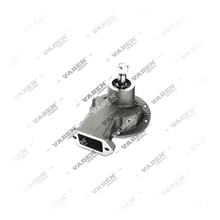
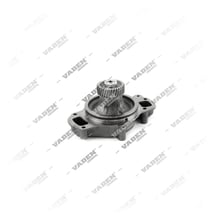
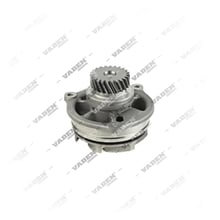
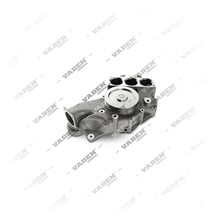
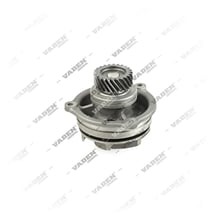
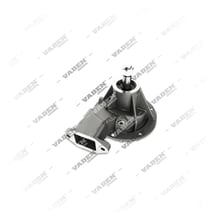
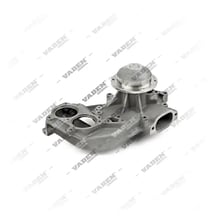
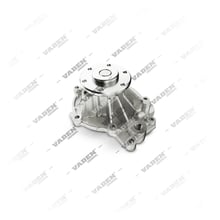
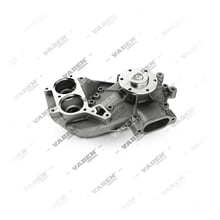
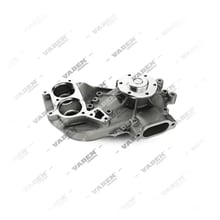
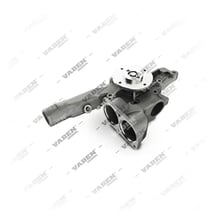
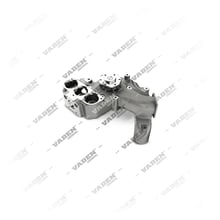
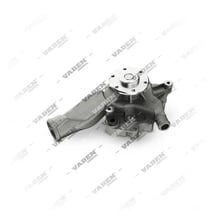
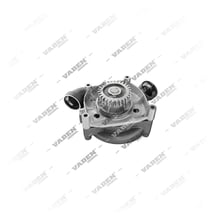
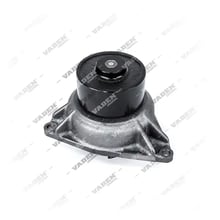
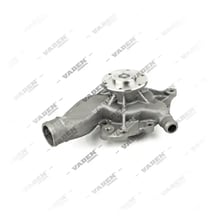
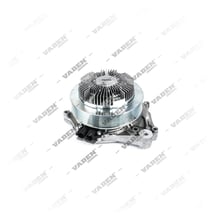
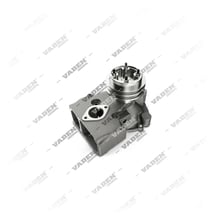
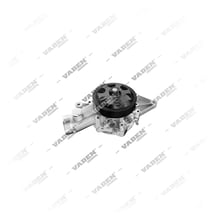
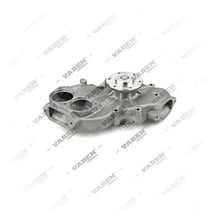
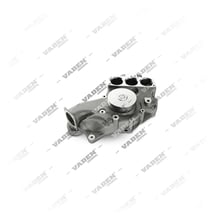
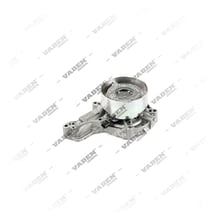
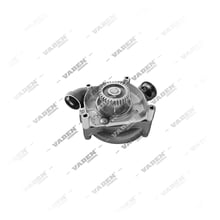
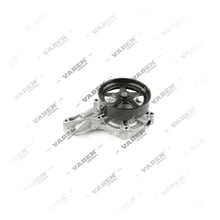
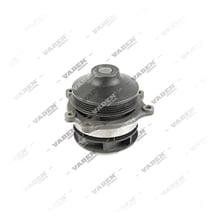
What is a water pump?
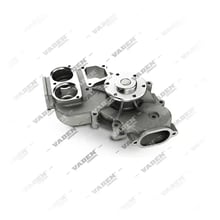
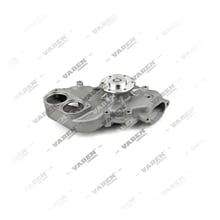
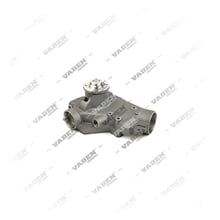
Structurally the water pump consists of four main components: the pump housing, the pump shaft and bearing group, the impeller, and the mechanical seal. As the impeller connected to the shaft rotates, it flings the coolant from the center outward; the volute channel in the housing converts this speed into pressure and sends the water to the engine water jacket. The mechanical seal is the critical sealing element that prevents water from passing to the bearing side; a large portion of water pump failures begins with the fatigue of this seal.
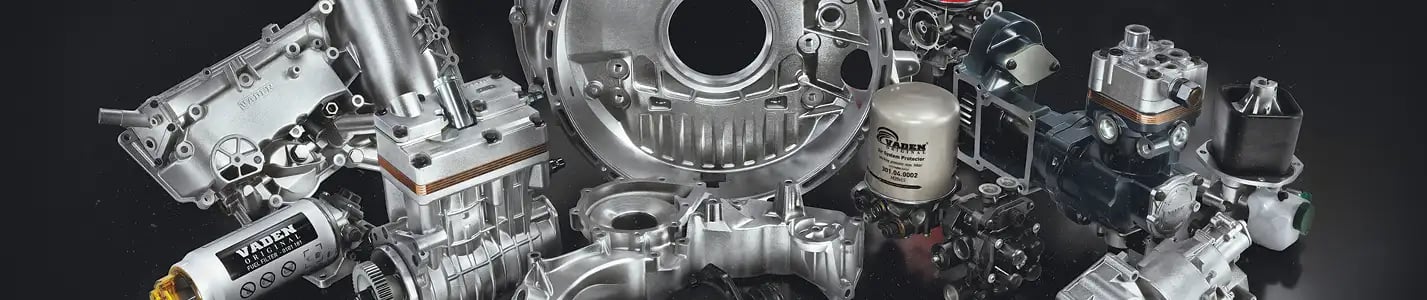
In heavy-duty applications the water pump serves continuously under high load, wide temperature differences, and long operating hours. For this reason, heavier housing casting/aluminum structures, larger bearing sets, and seal materials resistant to high temperature are used compared to passenger vehicle equivalents. In the VADEN product group, cooling system water pump references are listed with pulley, pulley-less, gear-driven, and integrated-housing options according to different engine families.
What are the functions of the water pump?
The water pump is not merely a part that "circulates water"; it is one of the main actors establishing the engine's thermal balance. Its main functions are:
- Providing circulation: Continuously removes heat around the combustion chamber by carrying coolant from the engine water jacket to the radiator and back to the engine.
- Producing flow and pressure: Produces sufficient flow rate depending on engine speed; operates with an impeller geometry that maintains minimum circulation even at idle when speed drops.
- Preventing hot-spot formation: Prevents material deformation at locally overheating points such as the cylinder head, exhaust valve seats, and turbo area by sustaining flow.
- Supplying auxiliary circuits: The oil cooler, EGR cooler, cabin heater core, and in some applications the retarder cooling line are fed by the water pump's flow.
- Preserving system sealing: Ensures the pressurized cooling circuit remains closed via the mechanical seal; in the event of a leak, system pressure and boiling point drop.
- Shortening warm-up time: Provides circulation via the short-circuit line while the thermostat is closed, helping the engine reach operating temperature evenly.
When any of these functions is disrupted, the result is directly reflected in engine temperature. Even a several-tens-of-percent drop in water pump flow can rapidly turn into overheating during heavy-load climbing, hot climate conditions, or high-speed running.
What are the symptoms of a water pump failure?
In the field, water pump failure is usually diagnosed not from a single symptom but from several signs appearing together. Main symptoms the technician should watch for:
- Dripping from the drain hole: Coolant seepage from the weep hole in the pump housing is the clearest indicator that the mechanical seal has failed its job. Dry residue, green/red/blue-colored deposit, or a limescale mark should be looked for.
- Shaft play and noise: Axial or radial play felt when grasping the pulley by hand, and a hum, rattle, or metallic squeal heard while the engine is running, indicate bearing damage.
- Rise in engine temperature: Especially the gauge needle rising above normal during loaded climbing, at idle with A/C engaged, or in slow traffic.
- Continuous drop in coolant level: Reduction of the expansion tank level without a visible external leak.
- Drop in heater performance: Lack of hot air in the cabin is a classic indicator of low flow.
- Belt marks and vibration: Due to worn bearing, the pulley goes off-axis; side wear, dust, heating, and belt throw-off can be seen on the belt.
- Air/bubbles in the expansion tank: Cavitation or air mixing on the intake side causes erosion on the impeller blades.
If these symptoms are neglected, the outcome is not limited to just water pump replacement; it lays the groundwork for far more costly failures such as cylinder head warping, gasket burnout, and ring/liner damage.
How is the water pump checked?
Cooling system water pump inspection is done with a cold engine, the vehicle safely secured and the parking brake applied. The radiator cap must never be opened on a hot engine.
- Visual leak check: The pump housing, drain hole, gasket/O-ring surface, and hose connections are examined with lighting. Dry coolant residue is also counted as an active leak.
- Mechanical play check: After loosening the belt, the pulley is held at the 12 and 6 o'clock positions and rocked; if there is noticeable play or stiffness/sticking, the pump should be replaced.
- Rotation freedom: When the pulley is turned by hand, there should be no catching, roughness, or grinding sound.
- Pressure test: The system is pressurized at the test pressure permitted by the manufacturer and pressure drop is monitored; this test distinguishes whether the leak is from the pump or from a hose/radiator.
- Temperature differential measurement: The temperature difference between radiator inlet and outlet lines is observed with a thermometer/infrared; if the difference is lower than expected, insufficient flow is considered.
- Coolant quality: If there is rust, oil mixing, sludging, or scaling, impeller erosion and seal wear have accelerated.
- Drive element check: Belt tension, tensioner bearing, pulley surface, and, for gear-driven types, gear backlash are evaluated together.
Test pressure, belt tension, and system filling procedure vary by engine family; the vehicle's current OE service manual is authoritative for these values.
What should be watched for during replacement?
Water pump replacement requires correct installation discipline as much as the correct part. The most common cause of a new pump failing early is not part quality but installation error and a dirty system.
- Clean the sealing surface: Old gasket residue on the block is cleaned using a method that leaves no scratches; scraping tools that damage the surface should not be used.
- Gasket/O-ring selection: The gasket or O-ring supplied with the pump is used. Paper gasket must not be mixed up with O-ring; unnecessary liquid gasket application can block channels.
- Bolt torque and sequence: Bolts are tightened in stages, in cross order, at the value given by the manufacturer. Over-tightening cracks the aluminum housing; under-tightening causes leaks. The vehicle's current OE service manual is authoritative for exact torque.
- Flush the system: If the old pump had disintegrated, metal shavings and residue may have been carried to the radiator; the new pump must not be installed without flushing the circuit.
- Coolant and mix ratio: The approved antifreeze type (organic/hybrid) for the engine is used; different technologies must not be mixed. The mix ratio is generally kept in the 40-60 percent range; the final ratio is determined per the OE manual.
- Bleeding: The system is filled and bled using the method described by the manufacturer. Air remaining in the circuit creates cavitation and local overheating.
- Evaluate auxiliary parts together: Thermostat, belt, tensioner bearing, hoses, and clamps are checked in the same service; those that have used up their economic life should be replaced together.
- Do not force the impeller: The pump shaft or pulley must not be hammered; suitable tools should be used for types requiring press-fit installation.
- First-run check: After the engine is started, temperature, leak, and noise are observed once more at idle; level is topped off after cooling.
How is the water pump selected?
Engine brand is not the sole determinant in correct cooling system water pump selection. Even within the same engine family, pulley diameter, blade count, inlet/outlet direction, flange hole pattern, and drive type can differ. Therefore selection should be made based on the vehicle's OE number and cross reference, not aftermarket brand name.
The technical criteria to check during selection are summarized in the table below. Table values are for general classification purposes; the vehicle's current OE service manual is authoritative for each application.
Water pump selection and inspection points| Inspection point | What is checked | General assessment |
|---|
| OE reference number | Engine type label and number on old part | Primary matching criterion; number, not brand name, is authoritative |
| Drive type | Belt-pulley, gear-driven, or integrated housing | A type difference makes installation impossible, must always be verified |
| Pulley diameter and channel count | V-belt / poly-V channel count | Wrong channel count causes belt throw-off and premature wear |
| Impeller type | Sheet, cast, or composite; blade count and direction | Blade direction must match rotation direction |
| Flange pattern | Bolt count, hole angle, and centering diameter | Even a single hole difference means incompatibility |
| Inlet/outlet direction | Hose nozzle angle and position | Hose must seat without being forced |
| Seal and bearing set | Sealing material, bearing size | High temperature resistance is decisive in heavy vehicles |
| Thermostat/housing integration | Housing or cover supplied with the pump | In integrated types, the part is replaced as one housing |
| Gasket set | Paper gasket, O-ring, or metal-clad gasket | The gasket supplied with the set is used |
The VADEN cooling system water pump group offers numerous options for different engine families, including references such as 525.25.0001, 525.25.0002, 525.04.0026, 525.01.0047, 525.02.0050, 525.02.0051, 525.06.0027, and 525.06.0029. It is recommended that you search by OE number to determine the appropriate reference for your vehicle and obtain verification from our technical team.
Maintenance and service life
The water pump is typically a part replaced on a condition basis rather than periodically; however, the factors determining its life are largely tied to maintenance discipline. In heavy commercial vehicle use, the headings directly affecting pump life are:
- Coolant change interval: Corrosion-inhibiting additives deplete in antifreeze that has reached the end of its life; a fluid that becomes acidic erodes the seal and impeller.
- Correct antifreeze type: Mixing fluids of different technologies creates gelling and sediment, narrowing flow.
- Belt tension: An excessively tight belt puts continuous radial load on the pump bearing and noticeably shortens life.
- System cleanliness: Weld residue, silicone particles, rust, and scale erode the impeller blades and reduce flow.
- Thermostat health: A thermostat that stays continuously open or opens late subjects the pump to unusual temperature cycling.
- Cavitation prevention: Low system pressure and incompletely bled air create typical cavitation pits on the impeller surface.
The practically recommended approach is to make checking for leaks, noise, and shaft play around the water pump a routine part of every major service. If the engine front is already disassembled for a belt, tensioner bearing, or thermostat replacement, replacing a pump nearing the end of its life in the same operation provides notable labor savings.
VADEN water pump
The VADEN cooling system water pump product group is developed with the continuous high-load operating conditions of heavy commercial vehicle engines in mind. Housing machining tolerances, bearing set, and mechanical seal selection are determined taking high temperature, vibration, and long service hours into account. The product group includes pulley, pulley-less, gear-driven, and integrated-housing options. You can search for the appropriate reference for your vehicle via OE number, and consult our technical team with engine type information and the old part number if you have any doubt about compatibility.
Frequently Asked Questions (FAQ)
How often should the water pump be replaced?
The water pump is not tied to a fixed mileage interval; it is a part replaced on a condition basis. Its life varies according to coolant quality and change interval, belt tension, system cleanliness, and operating conditions. A common field practice is checking for leaks at the drain hole, pulley play, and bearing noise at every major service; if the engine front is already disassembled for a belt or thermostat replacement, replacing a pump nearing the end of its life in the same operation. For an exact replacement interval, the vehicle's current OE service manual is authoritative.
How can I tell the water pump is faulty?
The clearest indicator is antifreeze dripping from the drain (weep) hole in the pump housing, or dried antifreeze residue. In addition, axial/radial play felt at the pulley, a hum or metallic squeal heard while the engine is running, rising engine temperature during loaded climbing, a drop in coolant level without a visible leak, decreased heater performance, and side wear marks on the belt point to water pump failure. If several of these symptoms appear together, the pump must be verified with a pressure test.
Should the thermostat also be replaced when replacing the water pump?
It is not mandatory but is strongly recommended in the field. The thermostat and water pump work in the same cooling circuit and generally the same parts are removed to reach both. A thermostat that opens late or stays continuously open subjects the newly installed pump to unusual temperature cycling and shortens its life. Also checking the belt, tensioner bearing, hoses, and clamps in the same service prevents paying labor a second time.
When choosing a water pump, should brand or OE number be the basis?
Selection must always be made based on the vehicle's OE number and cross reference. Even within the same engine family, pulley diameter, belt channel count, impeller blade count and direction, flange hole pattern, inlet/outlet direction, and drive type (belt, gear, integrated housing) can differ. Therefore matching the information on the engine type label with the number on the removed part eliminates the risk of the wrong part and repeat labor.
Why should the system be bled after replacing the water pump?
Air remaining in the cooling circuit causes cavitation in the water pump impeller; cavitation opens pits in the impeller blades, reducing flow and shortening pump life. Also, air bubbles create local hot spots inside the engine, laying groundwork for cylinder head and gasket damage. Therefore filling should be done per the manufacturer's described bleeding procedure, temperature, leak, and noise should be checked after the engine is started, and the level should be topped off again after the engine cools.