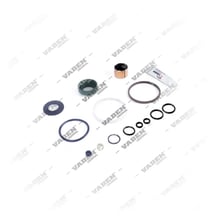
What is the gear selector cylinder repair kit?
Modern manual and automated (AMT) transmissions usually have more than one selector cylinder, each controlling a different gear group (for example the main group, range group or splitter group). For this reason, the cylinder's position and function within the transmission should also be considered when choosing the correct repair kit.
What are the functions of the gear selector cylinder repair kit?
The parts in the repair kit restore the cylinder's air-tightness and movement precision.
- Sealing: Renews the seals and o-rings that prevent air leaks between the piston and the body.
- Movement precision: Ensures the piston moves inside the cylinder without friction or play.
- Gear shift speed: Proper sealing supports gear shifts occurring at their designed speed.
- Corrosion and dirt barrier: The dust boot and seals prevent moisture and dirt from entering the cylinder.
What are the symptoms of a faulty gear selector cylinder?
Wear in the selector cylinder is felt directly during gear shifts.
- Delayed gear shifts: Air leakage due to worn piston seals causes a delay between the command and the actual movement.
- Audible air leak: A hissing sound from the cylinder body is a typical symptom.
- Harsh or incomplete gear engagement: If the piston cannot complete full stroke, the gear may not fully engage.
- Vibration or knocking: Worn bushings or seals cause irregular piston movement, resulting in knocking.
- Oil/moisture leakage: Damaged outer seals may cause moisture buildup around the body.
How is the gear selector cylinder inspected?
Inspection is carried out separately under pressurized and depressurized conditions.
- Air leak test: Apply soap solution over the cylinder body and connection points to check for leaks.
- Stroke check: Measure whether the piston completes its full stroke distance.
- Visual inspection: Check the dust boot for tears and the body for cracks or excessive corrosion.
- Function test: Issue a gear command and evaluate the cylinder's response time and shift firmness.
- Connecting elements: Check for play in the linkage and pin connections.
What should be considered when replacing it?
The repair kit must be installed in a clean environment and in the correct sequence.
- Depressurize the system: The air circuit must be completely emptied before disassembly.
- Surface cleanliness: Clean the piston and inner body surface without scratching, and remove old seal residue.
- Correct lubrication: New seals should be lubricated with the manufacturer-recommended special grease before assembly.
- Sequential assembly: Fit the seal, o-ring and dust boot in the correct order without damaging them.
- Leak test: After installation, pressurize the system and verify sealing without fail.
- Linkage check: Also check for play or wear at the linkage points where the cylinder connects to the shift fork.
How to choose the right gear selector cylinder repair kit?
Choosing the correct repair kit requires clearly identifying the cylinder model and transmission type. The table below summarizes the main criteria.
Gear selector cylinder repair kit selection criteria| Criterion | Description |
|---|
| Cylinder model | Match against the original selector cylinder code |
| Transmission type | Compatibility with manual or automated (AMT) transmission |
| Kit contents | Piston seal, o-ring, dust boot, bushing if required |
| Material | Synthetic rubber seals resistant to oil and heat |
| Packaging integrity | Seals stored undeformed in original packaging |
Maintenance and service life
The service life of the selector cylinder depends on the cleanliness of the air system and its moisture/oil content. Regular maintenance of the air dryer reduces system moisture and extends seal life. Periodic visual inspection of the dust boot and external connection points is recommended. Inspection intervals should be shortened for vehicles with frequent gear shifting, such as urban distribution or tractor operations. Regularly greasing the linkage and pin points connected to the cylinder also has a positive effect on the service life of both the cylinder and the shift fork connection. Regularly checking transmission oil level and quality indirectly supports healthy operation of the selector mechanism.
VADEN gear selector cylinder repair kit
VADEN offers repair kits consisting of original-dimension seals, o-rings and dust boots for the selector cylinders used in heavy commercial vehicle transmissions, providing an economical and fast repair option compared to the cost of a complete cylinder. The rubber components in the kit are produced from a synthetic compound designed to withstand moisture and temperature fluctuations in the air system, and are molded to match the original geometry exactly. In fleet maintenance planning, stocking this repair kit periodically for distribution vehicles and tractor units with frequent gear shifting reduces service downtime caused by sudden failures. VADEN dispatches every kit after dimensional measurement and material testing, so service teams do not face recurring leakage after installation.
Frequently Asked Questions (FAQ)
When is a selector cylinder repair kit sufficient?
If there is no crack or deep wear in the cylinder body, leakage and stiffness complaints can usually be resolved by replacing the seals and o-rings. If the body is damaged, complete cylinder replacement is required.
Does installing the repair kit require special tools?
A piston removal/installation pliers and a seal installation tool are recommended. Assembly without the correct tools can damage the seals and cause leakage to recur.
Is delayed gear shifting always caused by the selector cylinder?
No, delay can also originate from air supply, an electronic valve or the ECU. However, if there is audible air leakage from the cylinder, it is the primary suspect.
How often should the seals in the repair kit be replaced?
An exact service life depends on operating conditions; the periodic maintenance table in the vehicle's current OE service manual should be followed. Early replacement is recommended once leakage symptoms appear.
How is a leak-free system guaranteed after kit installation?
After installation, the system should be brought to operating pressure and tested with soap solution, and function should be verified through several complete gear-shift cycles.