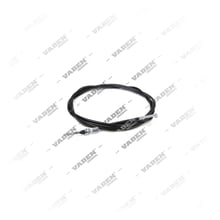
What is a Cabin Panel Lock Cable?
Although it may look like a secondary mechanical part, the panel lock cable matters for service access and for keeping panels securely closed; a broken cable can cause a panel to open while driving, or conversely make it impossible to open at all. These cables usually run through a path exposed to frequent vibration and engine heat, between the hood and the front cab panel, which is why the heat and vibration resistance of the sheath material directly affects cable life. On some cab designs, the same cable connects to a distribution mechanism that synchronizes multiple lock points from a single control lever, meaning one cable failure can cause access problems on more than one panel.
What are the functions of the Cabin Panel Lock Cable?
The cable's functions within the panel locking system can be summarized as follows.
- Motion transfer: Carries mechanical motion from the control lever to the locking tongue.
- Unlocking: Allows the panel to be opened for service or maintenance.
- Secure closing: Helps keep the panel firmly closed while driving.
- Flexibility: The wire inside the sheath routes the distance between the panel and the control point along a curved path.
- Return support: Works together with a spring mechanism to help the lock return to its normal position.
What are the symptoms of a faulty Cabin Panel Lock Cable?
When the cable fails, the most obvious sign is that the control lever becomes stiff or feels loose; if the panel does not open when the lever is pulled, the cable may have snapped or jammed inside the sheath. Abnormal noise, squeaking or binding may be felt while opening or closing the panel. In some cases the panel does not lock fully and moves slightly while driving, causing a vibration noise. Visual inspection may reveal crushing or cracking of the cable sheath, or rust at the wire end. In advanced cases the wire snaps completely and the panel gives no response to the control lever at all. In some operations this fault goes unnoticed for a long time because the panel in question is rarely opened; the broken cable only comes to light when needed urgently, such as during an emergency repair, which can extend service time — so regular testing is recommended.
How is the Cabin Panel Lock Cable checked?
For inspection, the control lever should be pulled and released a few times to observe how smoothly it moves. The cable sheath should be traced by hand along its length to look for crushing, cracking, or points of excessive bending. The locking tongue at the panel side should be checked to see whether it moves fully when the cable is pulled. The connection clips at the ends of the sheath should be checked for looseness. The wire strand at the cable end should be visually examined for breakage or fraying. During inspection, all mounting clips along the cable's route should also be reviewed; a displaced clip can let the cable sag and contact moving parts or hot surfaces, leading to premature damage.
What should be considered during replacement?
Before replacement, it is recommended to secure the panel in a safe open or closed position, otherwise it may swing uncontrollably and cause injury. When removing the old cable, its routing and connection points should be noted. The new cable must be routed along the original path, secured away from sharp edges or moving parts. The adjustment nut or clip at the cable end should be set so there is no slack but the cable is not overtensioned. After installation, the control lever should be tested several times to confirm the panel opens and closes fully. During the test, the panel should be held at different angles to confirm the control motion transfers smoothly in every position, paying particular attention to binding at the points where the sheath bends the most.
How is the Cabin Panel Lock Cable selected?
Selection is determined by cable length, end-connector type and sheath material. The table below summarizes the selection criteria.
Cabin Panel Lock Cable selection criteria| Criterion | Description |
|---|
| Cable length | Must exactly match the distance between the control point and the lock |
| End connector type | Must have the correct fitting for the control lever and the lock |
| Sheath material | A coating resistant to moisture and friction is preferred |
| Wire thickness | Must have tensile strength sufficient for the lock resistance |
| Vehicle fitment | Should be confirmed against the OE reference for the cab model |
Maintenance and service life
Cable life depends on frequency of use and environmental conditions; the sheath and wire should be visually checked at periodic maintenance. Connection points that need to stay dry should not be over-lubricated; the dry-type lubricants recommended by the manufacturer should be preferred. In harsh winters, corrosion can accelerate due to salt and moisture, so check frequency can be increased during that period. Adding an open-close test of cabin panels to the fleet maintenance plan ensures the fault is caught during scheduled maintenance rather than at a critical moment.
VADEN Cabin Panel Lock Cable
VADEN manufactures panel lock cables for heavy commercial vehicle cabins to OE dimensions and durability standards. The right routing and material selection provides a long-lasting, reliable control solution.
Frequently Asked Questions (FAQ)
Can the panel be opened if the lock cable breaks?
If mechanical access to the lock is possible, it can sometimes be opened manually; but the safe solution is to replace the cable.
Is lubrication enough when the cable stiffens?
For mild stiffening, a suitable dry-type lubricant can offer a temporary fix, but if the sheath is damaged, replacement is required.
How often is the panel lock cable replaced?
There is no fixed interval; it depends on frequency of use and environmental conditions, so periodic visual inspection is recommended.
Does replacing the cable require removing the panel?
In most cases yes, the relevant panel or trim must be partially removed to access the cable's route.
Does cable failure increase in wet weather?
Yes, if moisture and salt reach the wire inside the sheath, corrosion accelerates, increasing the risk of stiffening or breakage.