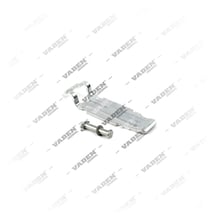
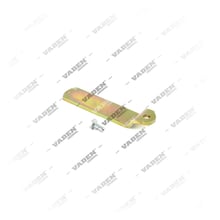
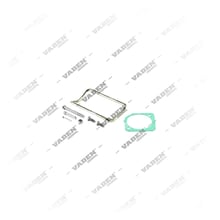
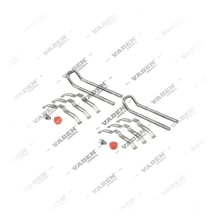
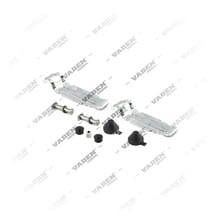
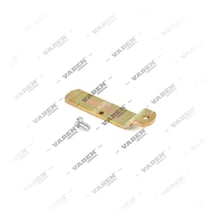
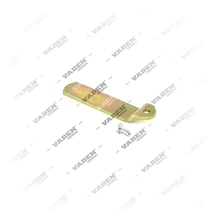
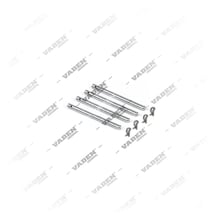
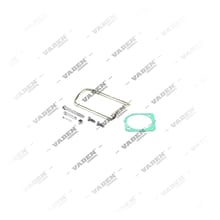
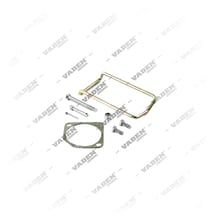
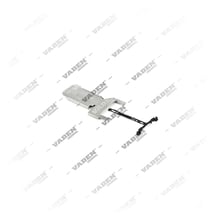
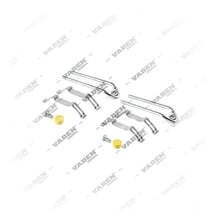
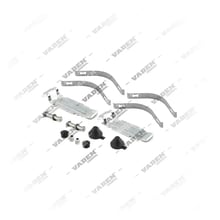
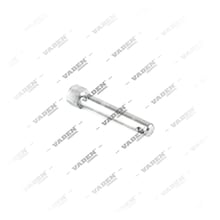
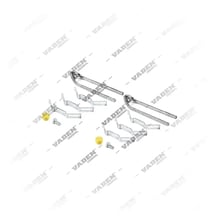
What Is a Brake Pad Retainer Repair Kit?
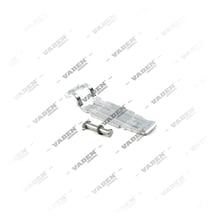
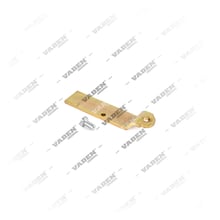
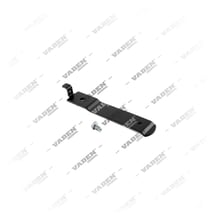
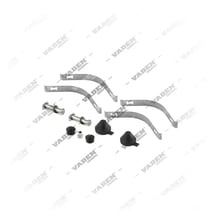
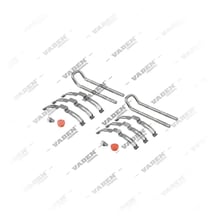
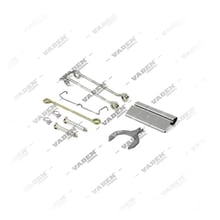
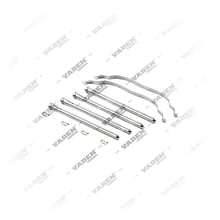
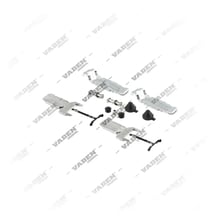
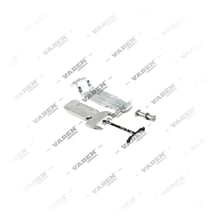
A Brake Pad Retainer Repair Kit is a service set that brings together the retaining bridge, pressure spring, retaining pin, and locking elements that hold the brake pads firmly in their seat inside heavy commercial vehicle disc brake calipers. In the field this group is also known as the pad retainer bridge, pad pressure spring set, or caliper pad retainer kit. Listed under the Pad Retainer subcategory of the main Brake Caliper group, these kits leave the caliper body and piston assembly untouched and instead allow only the worn retaining components to be renewed. They are used in the disc brake calipers of truck, tractor unit, bus, and trailer axles, and are a consumable group recommended for renewal alongside every pad change.
How Does a Brake Pad Retainer Repair Kit Work?
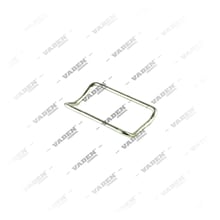
In a disc brake caliper, the pads sit loosely in their seat along the axial direction while transferring braking force to the disc; they must be held in place radially. The retaining bridge and pin grip the pad from above, while the pressure spring pushes the pad down against the base of the seat to take up the clearance. This way, when the brake is released the pad retracts cleanly without dragging on the disc, and it does not shift or rattle under vibration while driving.
- Radial retention: The retaining bridge and pin keep the pad centered in its seat and prevent it from working its way out.
- Preload: The pressure spring applies a constant force to take up clearance, reducing noise and rattling.
- Free movement: The pad is allowed to slide along its axis, preventing seizure and continuous dragging.
- Locking: A circlip, clip, or locking pin stops the retaining pin from working loose under vibration.
- Even wear: Correct preload helps the pad's inner and outer surfaces wear evenly.
Technical Specifications of the Brake Pad Retainer Repair Kit
The kit's components are subjected to high-cycle fatigue and to the heat generated in the brake area, which is why spring steel and heat-treated alloys are the preferred materials. The springs are made from surface-protected spring steel, while the pins are hardened and coated steel. Sizing is built around pin diameter, pin length, bridge width, and spring free height; these dimensions vary by caliper type, and parts that look alike are not necessarily interchangeable. The reliable way to confirm compatibility is the caliper type label and the OE reference number; for torque and installation values, the vehicle manufacturer's current service manual is the authoritative source.
Types and Subgroups of Brake Pad Retainer Repair Kits
- Bridge-type retainer kits: Consist of a bridge that sits over the pad and the pin that secures it; common on heavily loaded tractor and trailer axles.
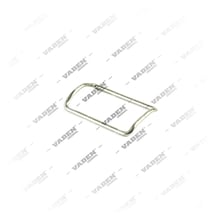
- Spring-loaded pressure kits: Include a single- or double-leaf pressure spring; press the pad into its seat to eliminate clearance and rattling.
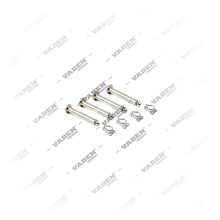
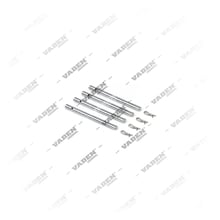
- Pin and circlip sets: Economical service packages covering only the pin, locking circlip, and clips.
- Complete retainer kits: Include the bridge, spring, pin, and all locking elements together, allowing full renewal in a single job.
- Caliper-type-specific sets: Kits whose dimensions are dictated by the caliper type, differing between single-pin and double-pin designs.
How to Choose the Right Brake Pad Retainer Repair Kit
The starting point when choosing a kit is always the OE number of the original part being removed. If the number cannot be read, the next step is to work from the caliper type label, axle make, and pad dimensions. Because the same vehicle model can be fitted with calipers from different suppliers, make and model information alone is not sufficient. The table below summarizes the verification criteria used in the field.
Selection and compatibility criteria for the Brake Pad Retainer Repair Kit| Criterion | What to check | Why it matters |
|---|
| OE reference | Removed part or caliper label | The most reliable way to cross-match |
| Caliper type | Type label on the caliper body | Pin diameter and bridge width vary by type |
| Axle position | Front, rear, or trailer axle | Different kits may be used depending on the axle |
| Pin count | Single- or double-pin retention layout | Locking logic and kit contents depend on this |
| Pad dimensions | Pad height and backing plate | Spring preload must match the pad geometry |
| Vehicle application | Mercedes-Benz, MAN, Scania, Volvo, DAF, Iveco | Caliper architecture determines kit contents |
| Kit contents | Number of bridges, springs, pins, and clips | Incomplete contents lead to mismatched parts |
Maintenance and Points to Watch for the Brake Pad Retainer Repair Kit
This group is a consumable set that should be renewed together with the pads during every pad change. Reusing fatigued springs and worn pins quickly comes back as noise and uneven pad wear. Before fitting, the caliper seat, pad contact surfaces, and pin bores must be cleaned of rust and debris. Grease must not come into contact with friction surfaces; only manufacturer-approved high-temperature assembly paste should be applied, and only at the points where it is permitted.
- Replace the kit as a complete set: The spring, pin, and locking elements should all come from the same kit.
- Clean the seat: Rust and debris block the pad's free movement and lead to continuous dragging.
- Do not skip the locking element: If the circlip is left out, the pin can work loose and the pad can come out of its seat.
- Confirm spring orientation: Pressure springs can be directional; fitting one backwards loses the preload.
- Inspect it alongside the pads: The condition of the retainer group should be assessed at every pad change.
Common Faults and Their Solutions
- Repeated rattling on rough roads: A fatigued or broken pressure spring; the pad shifts in its seat and the spring-and-pin set must be renewed.
- Dragging and overheating after the brake is released: A rusted seat or a seized pin prevents the pad from retracting; the seat should be cleaned and the kit replaced.
- Uneven or tapered pad wear: A deformed bridge or insufficient preload seats the pad at an angle; the retainer group must be renewed as a complete set.
- A pin that has worked loose: A missing or fatigued locking circlip lets the pin slip out; the group must be renewed immediately and the pad seating checked.
- Difficulty removing corroded parts: Moisture and road salt can effectively weld the pin into its seat; the seat should be cleaned and a new, coated kit fitted.
Why VADEN ORIGINAL?
VADEN ORIGINAL pad retainer repair kits are manufactured based on the dimensions and material logic of the original part; spring force, pin diameter, and bridge geometry are engineered to match the removed component. The product group is catalogued with extensive OEM reference cross-matching. VADEN is a manufacturer that exports heavy-duty brake and pneumatic components to more than 100 countries.
- Manufactured to OE dimensions: Spring preload and pin tolerances are set using the original part as the reference.
- Corrosion protection: Surface-coated pins and springs resist road salt and moisture.
- Complete kit contents: The bridge, spring, pin, and locking elements are all supplied together.
- Extensive OEM matching: Cross-referenced compatibility for truck, bus, and trailer caliper types.
- Reliable supply: Stock depth that reduces vehicle downtime during fleet maintenance.
Conclusion
The Brake Pad Retainer Repair Kit is a small but decisive group that keeps the pad correctly positioned, quiet, and free to move within the disc brake caliper. A fatigued spring or a seized pin quickly turns into uneven pad wear and lost braking performance. For this reason, renewing the kit as a complete set at every pad change is the correct approach. To choose the right product, verify the caliper type and OE reference, and rely on the vehicle's current service manual for installation values.
Frequently Asked Questions (FAQ)
What does a brake pad retainer repair kit do?
It holds the pad firmly in its seat inside the disc brake caliper and takes up the clearance in the seat so the pad does not shift under vibration. The pressure spring pushes the pad against the base of the seat while the retaining pin and bridge keep it from working its way out. As a result, the brake operates quietly and the pad wears evenly.
Should the pad retainer repair kit be renewed at every pad change?
Yes, this group should be treated as a consumable item. Removed springs may already be fatigued, and pins may be worn or corroded; reusing them quickly leads to rattling and uneven wear. Renewing the kit as a complete set together with the pads is the safest approach.
Can a rattling noise from the brake area be caused by the pad retainer?
A repeated metallic rattle over rough roads is often a sign of a fatigued or broken pressure spring. Once the spring loses its preload, the pad moves in its seat and produces an impact noise. The caliper should be opened so the spring, pin, and locking elements can be inspected, and any suspect parts replaced.
How do I find the right pad retainer repair kit for my vehicle?
The most reliable method is to match the OE reference number found on the removed part or the caliper type label. Axle position, caliper type, pin count, and pad dimensions should also be confirmed. Because the same vehicle model can be fitted with calipers from different suppliers, make and model information alone is not enough.
What should be checked when installing a pad retainer kit?
Before installation, the caliper seat and pin bores must be cleaned of rust and debris, and grease must not come into contact with friction surfaces. The pressure spring's orientation and the full seating of the locking circlip should be checked. For tightening values and installation sequence, the vehicle manufacturer's current service manual is the authoritative source.
Related products — Air Disc Brake Caliper: Pad Holder (view all)
Related technical guide: Brake Caliper Rubber Repair Kit: Failure & Replacement Guide