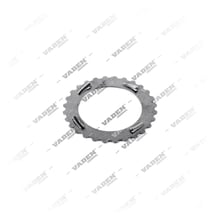
What is a Transmission Gearbox Washer?
This part is typically manufactured from steel or brass in a range of thicknesses and is selected during gearbox overhaul to set the tolerance between the gear set and bearings with fine precision. If the wrong washer thickness is fitted, gear tooth contact is disturbed, bearing preload becomes incorrect, and the service life of the gearbox is shortened.
What are the functions of a Transmission Gearbox Washer?
The functions of a transmission gearbox washer go beyond simply filling a gap; the part performs several mechanical roles at once to keep the gearbox operating correctly.
- Axial clearance adjustment: Keeps the axial play between the gear shaft and the housing or cover within the manufacturer's tolerance.
- Bearing preload: Ensures tapered or ball bearings seat with the correct preload, preventing premature wear.
- Gear contact alignment: Sets the axial position of mating gear pairs, controlling tooth contact pattern and noise level.
- Sealing support: At certain mounting points it works together with a gasket to form a contact surface that reduces the risk of oil leakage.
- Manufacturing tolerance compensation: Balances out small dimensional differences arising from manufacturing tolerances by selecting the appropriate thickness.
- Vibration and shock distribution: Acts as a thin buffer layer between metal surfaces, helping to distribute impact loads.
What are the symptoms of Transmission Gearbox Washer failure?
Wear, incorrect thickness, or deformation of the transmission gearbox washer produces clear and progressively worsening symptoms in the gearbox, typically showing up in shifting behavior and gearbox noise.
- Whining or humming noise from the gearbox: Incorrect axial clearance disturbs gear contact, producing a speed-dependent whining noise.
- Difficulty shifting gears: Play in the gear shaft can prevent synchronizer components from engaging correctly.
- Vibration at the gearbox housing: Loss of correct bearing preload creates vibration that becomes more noticeable as the vehicle accelerates.
- Oil leakage at the cover or flange area: A deformed or excessively thin washer can leave a gap in the sealing surface.
- Abnormal bearing overheating: Incorrect preload causes bearings to run hotter than normal and leads to premature failure over time.
- Metal particles in the transmission oil: At an advanced stage, metal debris from worn gear or bearing surfaces can be detected in an oil analysis.
How is a Transmission Gearbox Washer checked?
The condition of the transmission gearbox washer and whether it has the correct thickness are assessed through a systematic inspection during gearbox overhaul or scheduled maintenance.
- Visual inspection: The washer surface is examined with magnification for scoring, crushing, discoloration, or uneven thickness.
- Thickness measurement: A micrometer is used to measure the current thickness and compare it against the manufacturer's reference table.
- Axial clearance measurement: A dial indicator is used to measure the axial play of the gear shaft or bearing.
- Bearing preload check: Rotational torque is measured with a torque wrench to confirm the preload falls within the manufacturer's specified range.
- Surface flatness check: The washer's seating surface is checked against a flat reference for warping or waviness.
- Oil analysis: Metal particle concentration in the gearbox oil gives indirect information about the condition of the washer and related components.
What should be considered when replacing it?
Replacing the transmission gearbox washer requires precise measurement and correct sequencing; selecting the wrong thickness quickly leads to a repeat failure.
- Correct thickness selection: The required thickness should be based on the measured axial clearance, not on the thickness of the washer that was removed.
- Stepped trial fitting: The clearance should be brought progressively within the manufacturer's tolerance by trying washers of different thicknesses.
- Clean, undamaged seating surfaces: Housing and cover surfaces must be completely cleared of old gasket and washer residue before assembly.
- Evaluation together with bearings: Washer thickness should be set together with bearing preload, checking both clearance and preload, not clearance alone.
- Correct tightening torque: Cover and flange bolts should be tightened to the manufacturer's torque value and in the specified sequence.
- Final verification: After assembly, axial clearance and rotational torque should be measured again to confirm the values are within tolerance.
How to choose the right Transmission Gearbox Washer?
Selecting the correct transmission gearbox washer starts with verifying the OEM reference against the vehicle's chassis number or gearbox type code. Because thickness tolerances vary between manufacturers, parts should not be replaced without measurement; the vehicle's current OE service manual remains the authoritative source.
Transmission gearbox washer — general selection and application criteria| Criterion | Description |
|---|
| Material | Steel or brass-based, corrosion-resistant shim |
| Thickness range | Varies by model; typically supplied in graduated sets from a few tenths of a millimeter up to several millimeters |
| Application point | Gear shaft end, bearing seat, cover and flange connections |
| Compatibility | OEM reference comparison based on gearbox type code and chassis number |
| Verification method | Thickness measurement with a micrometer and axial clearance verification with a dial indicator |
Transmission gearbox washers in the VADEN product range are manufactured to OE dimensions and tolerances; for exact thickness and torque values, reference to the vehicle's original service documentation is recommended.
Maintenance and service life
The transmission gearbox washer is not a wear part with a fixed replacement interval; its service life depends largely on the cleanliness of the gearbox oil, bearing condition, and assembly quality. A washer fitted with the correct thickness on clean, undamaged surfaces can remain in service for the entire life of the gearbox. However, whenever a gearbox overhaul, bearing replacement, or gear set service is carried out, the washer thickness should be re-measured and replaced with a new one if necessary. Changing the transmission oil at the manufacturer's recommended intervals reduces the buildup of abrasive particles on the washer and bearing surfaces, indirectly extending the life of both the part and the gearbox as a whole.
VADEN Transmission Gearbox Washer
For heavy commercial vehicle gearboxes, VADEN bases its gearbox washers and related adjustment shims on OE dimensions and tolerance standards. The product range is planned to offer thickness options suited to different gearbox type codes. For correct part selection, comparing the chassis number or gearbox type code with the VADEN catalog reference is recommended, and during installation the manufacturer's torque and clearance values should be followed.
Frequently Asked Questions (FAQ)
What is the difference between a transmission gearbox washer and a gasket?
A washer is primarily a mechanical shim used for axial clearance adjustment, while a gasket is mainly used for sealing. At some mounting points the washer also contributes indirectly to sealing, but its primary function is dimensional adjustment.
What happens if the wrong washer thickness is installed?
The axial clearance falls outside tolerance, disturbing gear contact and bearing preload. This can cause noise and vibration in the short term and bearing or gear damage over time.
Does the transmission gearbox washer need to be replaced at every overhaul?
Not necessarily; if the washer is undamaged and its thickness is within tolerance it can be reused. However, when bearings are replaced or the gear set is serviced, the thickness should be re-measured and renewed if needed.
How is the correct washer thickness determined?
The required thickness is calculated from the axial clearance measured with a dial indicator, not from the thickness of the removed part, and confirmed through stepped trial fitting.
How can a washer-related failure be recognized?
Whining or humming noise from the gearbox, difficulty shifting, vibration, and oil leakage at the cover area are typical symptoms; a definitive diagnosis requires measuring axial clearance and bearing preload.