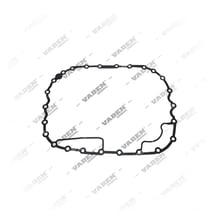
What Is a Transmission Housing Gasket?
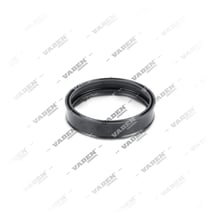
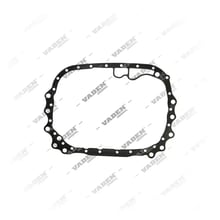
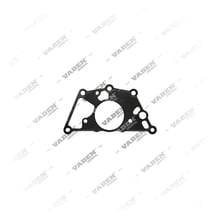
A transmission housing gasket is a single, static sealing component fitted between the mating surfaces of a heavy-duty commercial vehicle's gearbox housing, at its cover joints and enclosure connections. In the field it is also called a "transmission case seal," "gearbox gasket," or "transmission housing seal"; what is discussed here is not a multi-piece kit but a standalone gasket sold on its own. The transmission housing contains the gear set, shafts, and lubrication system that convert the engine's rotational motion into the appropriate torque and speed ratios; serving at every fixed joint of the housing, this gasket keeps gear oil from leaking out and keeps dust, water, and road grime from getting in. Used at the housing body, upper cover, side covers, sensor bores, and shaft outlets, it is one of the fundamental requirements for the transmission's long service life and loss-free operation.
Transmission Housing Gasket Functions and Operating Principle
- Sealing Barrier: When compressed between two metal surfaces, it fills the microscopic irregularities of the mating surface and forms a permanent barrier.
- Preventing Oil Loss: It keeps the gear oil inside the housing from leaking out, even under the pressure created as the oil heats up and expands.
- Contamination Barrier: It stops dust, water, and road grime from entering the housing and damaging the gear surfaces and bearings.
- Vibration Damping: It acts as a slight buffer between housing components, preventing direct metal-to-metal contact and the wear that would follow.
- Pressure Equalization Support: It flexes under the clamping force applied by the housing bolts, maintaining a consistent sealing level.
Transmission Housing Gasket Technical Specifications
Three criteria determine the right transmission housing gasket: the geometry and outer dimensions of the mating surface, the material's resistance to temperature and oil, and an exact match between bolt-hole count and spacing and the housing. The material may be a paper-cork composite, a synthetic-rubber-coated metal (elastomer-coated steel), or, for liquid-gasket applications, a dedicated silicone-based compound; the choice depends on the mating surface and the temperature it faces. Rather than citing an exact torque, installation should always follow the torque table and tightening sequence in the vehicle's original service manual; incorrect or uneven tightening causes the gasket to deform prematurely and leads to oil leakage.
Transmission Housing Gasket Types and Subgroups
- Main Case Split Gasket: Seals the large surface between the housing's two main case halves, exposed to the highest oil volume.
- Upper Cover Gasket: Provides sealing between the housing and the upper cover to which the shift lever mechanism attaches.
- Side Cover and Inspection Cover Gasket: Used on side covers opened frequently for maintenance, made from a material suited to repeated reassembly.
- Output Shaft and Bearing Bore Gasket: Supports sealing where the shaft exits the housing, between the rotating component and the stationary case.
- Sensor and Gear Switch Bore Gasket: Provides small-scale sealing around gear-position sensors and electrical connections.
- Liquid Gasket (Silicone-Based) Applications: On housings without a standard cut gasket, sealing is achieved with a liquid gasket applied to factory tolerances.
How to Choose the Right Transmission Housing Gasket
Choosing the right transmission housing gasket starts with verifying the model from the vehicle's chassis number or transmission type plate; since different transmission variants can be fitted to the same vehicle body, the vehicle model alone is not enough. Next, the mating point the gasket belongs to must be identified and matched against the OEM reference number. The table below summarizes the key selection criteria.
Transmission Housing Gasket Selection Criteria| Criterion | Why It Matters |
|---|
| Transmission brand and model | Wabco, Knorr-Bremse, ZF, and Eaton housings each have different geometry and bolt patterns |
| Mating point type | Main case, upper cover, side cover, and shaft outlet gaskets are not interchangeable |
| Gasket material | Paper-cork, elastomer-coated steel, or liquid gasket; varies with temperature and oil |
| Thickness and compression allowance | Wrong thickness creates either a gap between surfaces or excessive compression |
| OEM reference number | Visual similarity is not enough; an exact fit requires a matching part number |
Transmission Housing Gasket Maintenance and Key Precautions
- Remove the Old Gasket Completely: Leftover material on the housing surface prevents the new gasket from seating properly and leads to leaks within a short time.
- Dry the Surfaces: Before installation, clear surfaces of oil and dirt residue, and position the gasket on a clean, dry surface.
- Tighten Bolts in Stages: Bolts should be tightened progressively, following the sequence and torque values in the service manual, never with excessive torque all at once.
- Observe the Curing Time: With liquid-gasket applications, the vehicle must not return to service before the curing time specified by the manufacturer has elapsed.
- Monitor the Oil Level: Transmission oil level and color should be checked periodically, and the gasket replaced without delay at the first sign of a leak.
Common Failures and Solutions
- Oil leaking from a housing joint: Caused by a hardened, cracked, or improperly installed gasket; clean the surface and fit a new gasket.
- Continuous drop in transmission oil level: Points to micro-leaks at the shaft outlet or sensor bore gasket; check all mating points in turn.
- Oil stain around the upper cover: Results from loosened cover bolts or a worn cover gasket; check the bolts and renew the gasket if needed.
- Leak recurring shortly after installation: Usually caused by an incorrect tightening sequence, a contaminated surface, or mismatched gasket thickness; review the installation procedure.
- Leak from a liquid gasket before curing: Results from putting the vehicle into service too soon; observe the manufacturer's curing time.
Why VADEN ORIGINAL?
- OE Dimensions and Tolerances: VADEN ORIGINAL transmission housing gaskets are made to original housing dimensions and material tolerances.
- Broad OEM Coverage: Wide compatibility with Wabco, Knorr-Bremse, ZF, and Eaton transmission housings makes it easy to find the correct gasket quickly.
- Batch-Level Quality Control: Every batch is inspected for thickness, hardness, and dimensional accuracy before shipment.
- International Quality Standard: Exported to more than 100 countries, this manufacturing quality delivers long-lasting sealing.
Conclusion
Despite its small size, the transmission housing gasket is a critical sealing component that directly affects the transmission's oil-retention capacity and, in turn, its service life. Choosing a gasket that matches the correct mating point, material, and OEM reference prevents unnecessary disassembly and oil loss. With VADEN ORIGINAL transmission housing gasket products, heavy-duty commercial vehicles achieve long-lasting, reliable sealing performance.
Frequently Asked Questions (FAQ)
What is the difference between a transmission housing gasket and a transmission housing gasket set?
A transmission housing gasket is a single part belonging to one mating point, for example just the upper cover gasket or the main case gasket. A gasket set, on the other hand, is a kit that includes gaskets for every mating point on the housing. A single gasket is the right choice when only one specific point is leaking; a full set is preferred when a complete overhaul is being carried out.
When should a transmission housing gasket be replaced?
The gasket should be inspected and replaced if necessary whenever visible oil leakage appears at a housing joint, the transmission oil level drops unexplainably, or an oil stain appears around a cover. The relevant gasket should also be renewed every time the transmission housing is opened, since a removed gasket generally cannot be reused.
What material is a transmission housing gasket made from?
Materials used include paper-cork composite, synthetic-rubber-coated metal (elastomer-coated steel), or, for liquid-gasket applications, dedicated silicone-based compounds. The choice of material depends on the type of mating surface, the temperature it is exposed to, and its contact with gear oil.
What is the most common mistake made when installing a transmission housing gasket?
The most common mistake is failing to fully remove the old gasket residue from the housing surface, and tightening the bolts without following the sequence and torque values given in the service manual. These errors prevent the new gasket from seating properly and lead to a recurring leak within a short time.
Which transmission brands do VADEN ORIGINAL transmission housing gaskets fit?
VADEN ORIGINAL transmission housing gaskets are manufactured to fit transmission housings from Wabco, Knorr-Bremse, ZF, and Eaton. Before ordering, it is recommended to verify the transmission brand, model, and OEM reference number with technical support.