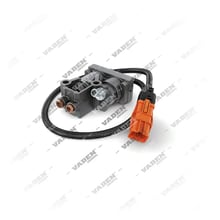
What is an Exhaust Manifold Valve?
The Exhaust Manifold Valve in the VADEN range is manufactured to original geometry and material specifications, designed for reliable operation under high temperature and vibration conditions.
What are the functions of the Exhaust Manifold Valve?
This valve performs several functions to keep the engine exhaust system running efficiently and under control.
- Gas flow control: Regulates the direction and flow rate of exhaust gas within the manifold.
- Exhaust brake support: In the closed position, it builds back-pressure in the exhaust line, increasing engine brake effect.
- Turbo/EGR integration: Contributes to correct-condition operation of turbocharger boost pressure or EGR flow rate.
- Temperature management: Helps keep exhaust gas temperature in the range suitable for the catalytic converter or SCR system.
- Emission compliance: Supports efficient operation of emission control systems through correct gas routing.
What are the symptoms of Exhaust Manifold Valve failure?
Valve failures typically cause visible problems in engine performance and the exhaust system.
- Weakened exhaust brake: When the valve fails to close fully, engine brake effect is noticeably reduced.
- Power loss or smoking: Sticking of the valve mechanism adversely affects exhaust back-pressure, causing performance loss.
- Abnormal exhaust noise: Incorrect valve position can change exhaust sound.
- Fault code/warning light: On electronically/pneumatically actuated valves, a position sensor fault triggers a dashboard warning.
- Exhaust system gas leak: A cracked valve gasket or body causes exhaust odor and leakage.
How is the Exhaust Manifold Valve inspected?
Inspection should be carried out with the engine cold, using diagnostic equipment where required.
- Visual inspection: Check the valve body and manifold connection for cracks, soot buildup, or gas leak traces.
- Movement test: With the actuator disengaged, move the valve lever by hand to check for sticking or stiffness.
- Actuator test: Test whether the pneumatic/electronic actuator can move the valve to full open and closed positions.
- Fault code reading: Use a diagnostic tool to check fault codes related to the exhaust valve position sensor.
- Leak check: With the engine running, check by listening/smelling for exhaust gas leaks around the valve.
What should be considered during replacement?
Since replacing the Exhaust Manifold Valve involves a component operating at high temperature, the following points apply.
- Let the engine cool: The job should only be done once the engine is fully cooled, to avoid burn risk.
- Correct reference: Select a valve matching the engine type and emission standard (Euro level).
- Gasket renewal: The gasket between valve and manifold must always be replaced with a new one; an old gasket causes gas leaks.
- Actuator connection: The pneumatic hose or electrical connector must be connected correctly and sealed.
- Torque values: Connection bolts should be tightened to manufacturer torque; the vehicle's current OE service manual governs the exact value.
- Function test: After installation, run the engine to confirm valve open/close movement and absence of fault codes.
How to choose the right Exhaust Manifold Valve?
Selection should consider engine type, emission level, and actuator type together.
Exhaust Manifold Valve selection criteria| Criterion | Description |
|---|
| Engine type | Must fully match the vehicle's engine code and displacement |
| Emission standard | EGR/turbo integration correct for the Euro level |
| Actuator type | Correct connection for pneumatic or electronic control |
| Material | High-temperature-resistant cast iron or stainless steel |
| Gasket set | Preferably supplied together at original dimensions |
Maintenance and service life
Since the Exhaust Manifold Valve is constantly exposed to high temperature and vibration, soot buildup and mechanical fatigue can occur over time. Regularly checking valve movement is important, especially on vehicles that use exhaust brake frequently. Excessive soot buildup can restrict valve movement, so periodic cleaning is recommended. Service life varies with operating conditions, but proper maintenance and timely gasket replacement can ensure long, reliable operation.
VADEN Exhaust Manifold Valve
VADEN supplies the exhaust manifold valve to original specifications for heavy commercial vehicle engines. Its high-temperature resistance and precise dimensional fit support reliable operation of exhaust brake and emission systems for fleets and workshops, minimizing performance loss and unplanned downtime. In hilly and heavy urban traffic conditions where exhaust brake is used frequently, a healthy valve also indirectly benefits fuel consumption and service brake lining life, so it should not be neglected during periodic maintenance.
Frequently Asked Questions (FAQ)
What does an Exhaust Manifold Valve do?
It directs exhaust gas flow to support correct operation of the exhaust brake, turbocharger, and EGR systems.
What happens when an Exhaust Manifold Valve fails?
The exhaust brake weakens, engine power can drop, and a fault code with a dashboard warning light may appear.
What should be done if the valve doesn't close fully?
Check the actuator and movement mechanism, clean any sticking or soot buildup, and replace the valve if necessary.
Should the gasket be replaced when changing the Exhaust Manifold Valve?
Yes, the gasket between the valve and manifold must always be renewed to prevent gas leaks.
What should be considered when choosing an Exhaust Manifold Valve?
Select the original reference matching engine type, emission standard, and actuator type (pneumatic/electronic).