What are the functions of the EBS Relay Valve?
- Converting electronic command into pneumatic pressure: Directly converts the signal from the control unit into proportional air pressure.
- Fast filling and venting: Fills the brake cylinders quickly with a large air volume and vents rapidly on release, shortening response time.
- Pressure feedback: Its integrated pressure sensor reports the actual pressure to the control unit, enabling closed-loop regulation.
- Backup operation: In the event of an electronic fault, it maintains basic braking function through a pneumatic backup circuit.
- ABS/ASR integration: Can independently modulate pressure to prevent wheel lock-up or regulate traction.
What are the symptoms of a faulty EBS Relay Valve?
- EBS/ABS warning light on the dashboard: When the sensor or modulator fails, the control unit logs a fault code and the warning light illuminates.
- Delayed or harsh brake response: When the modulator does not open or close fully, airflow to the brake cylinder becomes irregular.
- Vehicle pulling to one side: If the relay valve cannot keep the pressure distribution between axles balanced, the vehicle can pull to one side under braking.
- Air leak noise: Wear of the seal or diaphragm inside the valve body causes a continuous hissing sound.
- Brake pedal pressure not reflected in vehicle behavior: If electronic control is disabled, brake response relies solely on the pneumatic backup circuit and becomes delayed.
How is the EBS Relay Valve inspected?
Before inspection, the vehicle should be connected to a diagnostic tool to read EBS fault codes and determine which wheel or circuit is affected. The area around the valve body is scanned for air leaks using a soap-bubble test. Electrical connectors are inspected for corrosion, looseness or cable damage. The value produced by the pressure sensor is compared with live data on the diagnostic tool to check for deviation. The modulator's response speed to electronic commands is tested to detect delayed or unresponsive operation. Because it is an electronic component, it cannot be disassembled and inspected visually like mechanical parts; most faults are identified through diagnostic tools and pressure measurement.
What should be considered when replacing it?
Before replacement, the air system must be fully drained and the electrical connection disconnected. When fitting the new valve, ensure the air inlet/outlet lines are connected to the correct ports; an incorrect connection can render the system completely non-functional. The connector must seat fully, with no moisture or dirt ingress. After installation, a calibration/adaptation procedure must always be carried out with a diagnostic tool, followed by a brake test. For bolt torque values and electronic calibration steps, the vehicle's current OE service manual is the authoritative source.
How to choose the right EBS Relay Valve?
Since EBS systems have different software/hardware architectures depending on manufacturer and version, the chassis number and EBS control unit version must be verified when selecting the correct valve.
Selection criteria for EBS Relay Valve Complete Assembly| Criterion | Why it matters |
|---|
| Chassis number / EBS control unit version | Different versions may use incompatible connectors or protocols |
| Connector pin count and layout | An incorrect connector completely interrupts electronic communication |
| Pressure sensor range | An incorrect measurement range leads to inaccurate brake pressure readings |
| Air port diameters | An incorrect diameter causes flow loss or installation incompatibility |
| Axle position (front/rear) | On some vehicles, front and rear axle relay valves have different calibrations |
Maintenance and service life
Since the EBS relay valve combines electronic and pneumatic components, the most important factors affecting its service life are moisture, contaminated air and vibration. Regular maintenance of the air dryer prevents moist air from entering the valve, protecting the electro-pneumatic modulator from corrosion. Keeping connectors clean and tightly seated periodically reduces intermittent faults caused by connection interruptions. Pressure sensor and modulator performance should be monitored through periodic EBS diagnostic scans, with early intervention when deviation is detected.
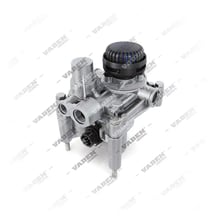
VADEN EBS Relay Valve Complete Assembly
VADEN manufactures relay valve complete assemblies for EBS-equipped heavy-duty commercial vehicles to OE electronic and pneumatic specifications. Correct connector design, pressure sensor accuracy and air flow preserve original brake response time and safety.
Frequently Asked Questions (FAQ)
What is the difference between an EBS relay valve and a conventional pneumatic relay valve?
A conventional relay valve operates purely on a pneumatic signal; the EBS relay valve converts a signal from the electronic control unit into pressure and provides closed-loop feedback via its pressure sensor, giving a much faster response time.
Can the vehicle still be driven when the EBS warning light is on?
For a short distance the pneumatic backup circuit may still provide basic braking, but since electronic stability/ABS functions may be disabled, diagnostics at an authorized service center should be arranged as soon as possible.
Why is calibration required after replacing the relay valve?
The new valve must be calibrated so it matches with the control unit and the pressure sensor reference values are read correctly; without calibration, brake distribution may be incorrect.
Does an air leak sound always originate from the relay valve?
Not always, but a continuous hissing sound is a common symptom of seal or diaphragm wear inside the valve body; the entire circuit should be scanned with a soap-bubble test to locate the source.
Are front and rear axle EBS relay valves interchangeable?
Generally no. On many vehicles, front and rear axle valves have different pressure calibrations and connector layouts; replacement should not be done without verifying the chassis number.