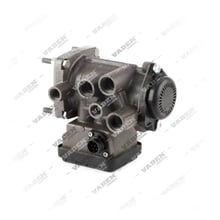
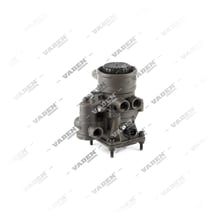
What is the EBS Brake Module (Complete)?
This part is the complete control unit that forms the brain of the vehicle's electronic braking system, combining electronic and pneumatic components in one assembly. When it fails, the entire module is replaced, since the electronic board and valve block structure inside are typically not separately repairable field parts. In the Vaden catalog, this category offers complete module variants for different EBS system types, matched to OEM references.
What are the functions of the EBS Brake Module (Complete)?
- Brake pressure calculation: determines the ideal brake pressure for each axle based on pedal command, load status, and wheel speeds.
- Slip prevention: detects wheel lock via the ABS function and adjusts pressure in real time.
- Inter-axle balance: maintains vehicle stability by balancing brake force between front and rear axles.
- System monitoring: continuously monitors sensor data and generates a warning in case of fault.
- Communication with other systems: exchanges data with the engine control unit and other electronic systems over the vehicle's CAN-bus network.
What are the symptoms of EBS Brake Module (Complete) failure?
When the module fails, the ABS/EBS warning light on the dashboard stays on continuously, and the vehicle typically enters a service mode where brake distribution reverts to the standard pneumatic system. Response to the brake pedal may be delayed, brake balance may be disrupted, or the vehicle may pull to one side during sudden stops. When electronic fault codes (DTCs) are read with a scan tool, communication error or sensor read error codes related to the module may appear. In severe cases where the module fails completely, the vehicle's brake system falls back to the emergency pneumatic backup, but ABS/EBS functions are disabled, which significantly extends stopping distance, especially on wet or slippery surfaces. On some vehicles, engine power may also be limited to prevent high-speed operation, showing that an EBS failure can affect overall vehicle performance beyond just the brake system.
How is the EBS Brake Module (Complete) inspected?
Inspection begins by reading fault codes with a vehicle diagnostic tool; module-specific codes help distinguish whether the issue is electronic or pneumatic. The module's electrical connector sockets are checked for corrosion, looseness, or pin damage, since connection problems can be mistaken for an actual module failure. Pneumatic connection points are checked for air leaks with a soap-water test. The module housing should also be visually assessed for physical damage, cracks, or signs of overheating. The vehicle battery and charging system should also be checked; low voltage or fluctuation can cause the module to malfunction temporarily and generate false fault codes.
What should be considered during replacement?
Before installing a new module, check the vehicle's software/calibration requirements, as some EBS modules require vehicle-specific parameter programming. Electrical sockets must be installed clean, dry, and in the correct orientation, without forcing. Pneumatic connections should be tightened in the sequence and torque specified by the manufacturer, and an air leak test must be performed after installation. After module replacement, confirm that the ABS/EBS warning light turns off and fault codes are cleared.
How to choose the right EBS Brake Module (Complete)?
Selection should be based on the vehicle's EBS system manufacturer, model code, and OE reference number, with the module's software/hardware version matching the vehicle's production year.
EBS Brake Module (Complete) selection criteria| Criterion | Description |
|---|
| OEM reference number | The number specified in the vehicle's current OE service manual is authoritative |
| System manufacturer/model | Must exactly match the manufacturer and model code, e.g. Wabco or Knorr-Bremse |
| Electrical connector type | Pin count and socket type must match the vehicle wiring harness |
| Software/calibration | May require parameter programming specific to the vehicle model |
| Number of pneumatic ports | Valve output ports must match the original layout |
Maintenance and service life
Although the EBS module is a maintenance-free electronic-pneumatic unit, regularly checking electrical connections and filtering moisture/dirt from pneumatic lines extends its service life. When washing the vehicle, high-pressure water should not be directed straight at the module connectors, as moisture ingress can cause electronic faults. Periodic diagnostic scans catch early warning codes before symptoms appear, preventing unexpected failures. Before operations such as welding on the vehicle's electrical system or a battery replacement, properly disconnecting the module's power supply prevents damage to the electronic board.
VADEN EBS Brake Module (Complete)
Vaden offers complete module variants for different EBS system types at OE tolerances. For correct brake balance and safety functions, the part should be selected according to the system manufacturer and model code.
Frequently Asked Questions (FAQ)
Does the vehicle lose braking entirely if the EBS module fails?
No, in a severe failure the system falls back to the standard pneumatic brake backup and the vehicle can still brake, but ABS/EBS electronic stability and slip-prevention functions are disabled, significantly reducing safety.
Is programming required after module replacement?
Some EBS modules require vehicle-specific software/calibration parameters; in that case, programming with an authorized diagnostic tool is required after replacement.
Does the ABS/EBS warning light always indicate a module failure?
No, environmental issues such as sensor wiring damage, connector corrosion, or air leaks can trigger the same warning; a fault code reading is required for a definitive diagnosis.
Why is the module replaced as a complete unit instead of being repaired part by part?
Because the electronic board and valve block structure inside are manufactured as an integrated assembly, field repair at the component level is generally not possible, making complete module replacement the standard practice.
What is the most critical mistake when installing a new module?
Selecting the wrong OEM reference or an incompatible software/hardware version is the most critical mistake, which can cause the system to fail entirely or result in incorrect brake balance.