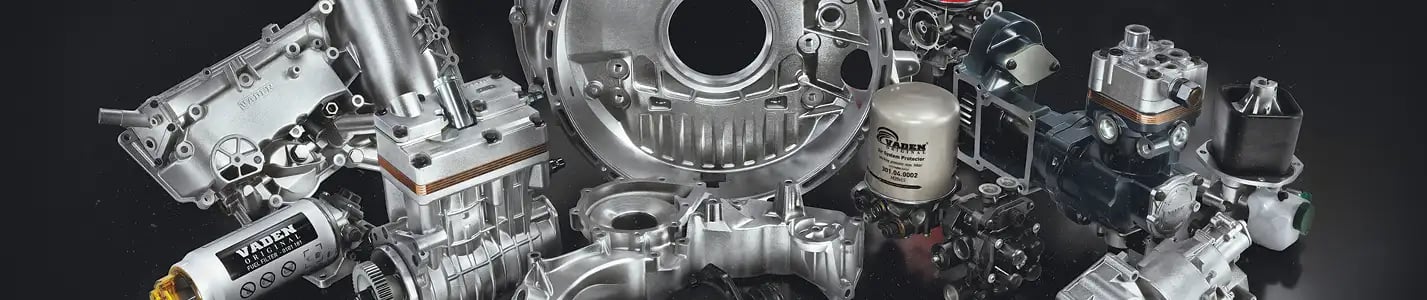
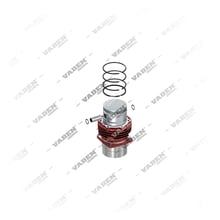
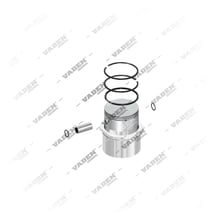
What Is a Compressor Parts Cylinder Liner Set?
A Compressor Parts Cylinder Liner Set is a service kit of the liner and sealing components that restore the cylinder bore in which the piston travels inside heavy-duty air brake compressors. Sitting under the Compressor Parts subheading of the Air Brake Compressors group, this set brings the compression chamber back to original dimensions without replacing the whole housing. In the field it is also known as a cylinder liner or compressor sleeve kit. When the liner in compressors fitted to trucks, tractor units, buses, and trailers wears down, the rings start to leak, and overhauling the unit with a liner set is the most sensible fix.
How Does a Compressor Parts Cylinder Liner Set Work?
The liner is pressed into the compressor housing and forms the cylindrical inner surface along which the piston moves. Compression depends on this surface's geometry: the piston rings ride against the liner wall, keep air from escaping into the crankcase, and pressurize intake air toward the valve plate.
- Forms the compression chamber: Together with the piston and rings, it defines the sealed volume where air is raised to reservoir pressure.
- Carries the ring seal: The honed inner surface lets the rings seat properly and holds the oil film on the wall.
- Conducts heat: Transferring compression heat into the housing keeps piston temperature within limits.
- Absorbs the wear: Since the liner is the surface that actually wears, the housing itself is protected.
- Restores dimensional accuracy: Returning an out-of-round cylinder to its nominal diameter brings air delivery back to normal.
Technical Specifications of a Compressor Parts Cylinder Liner Set
Liners are made from wear-resistant grey cast iron or alloyed cast material; the inner surface is honed at a cross-hatch angle so the oil film can cling to it. Cylinder bores typically run from around 70 to 95 mm depending on the application, while operating pressure usually falls between 8 and 13 bar; these are indicative values, and the vehicle manufacturer's current service manual takes precedence.
- Material: Wear-resistant cast liner; surface-treated variants exist depending on the application.
- Sizing logic: The nominal bore and outer press-fit diameter must match the housing bore within an interference-fit tolerance.
- Surface quality: Controlled roughness and the honing pattern determine how well the rings seat.
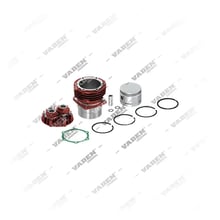
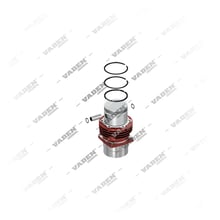
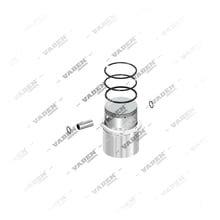
- Set contents: Besides the liner, the set includes a base gasket and O-rings.
- Compatibility criteria: The OE number, cylinder count, and cooling type must all be checked together.
Types and Subgroups of Compressor Parts Cylinder Liner Sets
This category covers several variants suited to different compressor architectures. Choosing the right variant determines how long the overhaul lasts; the wrong type of liner ends up loose in the housing.
- Single-cylinder liner set: Covers the liner and seals for single-cylinder compressors.
- Twin-cylinder liner set: Lets both liners in higher-output compressors be replaced together, preserving delivery balance.
- Combined liner-and-piston set: Includes a matched piston and ring assembly; preferred for heavily worn cylinders.
- Oversize liner sets: Offer an above-nominal outer diameter for housings whose bore has been machined out.
- Water-cooled housing sets: Come with extra O-rings that seal coolant passages in compressors with cooling jackets.
How to Choose the Right Compressor Parts Cylinder Liner Set
The most reliable approach is to start from the OE number stamped on the compressor, since the same vehicle model can use different compressors depending on engine option. Before ordering, measure the cylinder bore diameter and out-of-roundness, and confirm the housing bore itself is undamaged.
Compressor Parts Cylinder Liner Set selection and compatibility criteria| Criterion | How to verify | Application note |
|---|
| OE reference number | Read the number stamped on the housing | Most reliable way to cross-match |
| Cylinder count | Check the cover and piston arrangement | Single- and twin-cylinder sets are not interchangeable |
| Nominal bore diameter | Measure at three heights with a dial bore gauge | Replacement mandatory once limit is exceeded |
| Outer press-fit tolerance | Measure the housing bore with a micrometer | Without an interference fit, the liner moves and makes noise |
| Cooling type | Check for cooling fins or a water jacket | Water-cooled housings need additional sealing |
| Set contents | Compare the gasket and O-ring list | A missing component leaves the job incomplete |
| Assembly values | Check the torque table in the service manual | Cover torque and sequence affect how the liner seats |
Maintenance and Points to Watch for a Compressor Parts Cylinder Liner Set
Replacing the liner demands cleanliness and measurement discipline; most mistakes come from inadequate cleaning. Before disassembly, note the cover, valve plate, and gasket sequence; after assembly, verify build-up pressure time and sealing.
- Clean the bore: Residue and rust on the seating surface make the liner sit at an angle.
- Check the dimensions: After assembly, measure the bore diameter and piston clearance to confirm the ring gap.
- Fit with lubrication: Apply a thin film of assembly oil to the surface; a dry first start-up damages it.
- Renew the seals: Do not reuse the old gasket and O-rings; fit the new parts in the set.
- Follow the torque values: Tighten the cover bolts in a crossing, staged pattern; for exact figures, the service manual takes precedence.
- Check the intake side: A clogged filter or dirty intake line wears out a new liner quickly.
Common Failures and Their Solutions
Liner-related problems mostly show up as pressure loss, oil consumption, and noise. Reading the symptom correctly avoids replacing parts unnecessarily.
- Build-up pressure is slow: An out-of-round liner may be leaking past the rings; measure the bore and renew the set if the limit is exceeded.
- Oil in the air reservoir: A scored surface lets oil pass into the compression chamber; replace the liner and rings together.
- Metallic knocking noise: A loose or wrongly sized liner may be moving in its bore; check the press-fit tolerance.
- Overheating: Residue disrupting heat transfer raises liner temperature; check the housing bore and cooling circuit.
- Leak after assembly: Usually a reused gasket or wrong tightening sequence; renew the components.
Why VADEN ORIGINAL?
VADEN specializes in air brake compressors and compressor parts. Its cylinder liner sets are produced using the dimensional values of the original units as the reference.
- Manufactured to OE dimensions: Bore diameter, press-fit tolerance, and surface roughness are machined to original reference values.
- Broad OEM coverage: References cover Wabco- and Knorr-Bremse-type compressors fitted to Mercedes-Benz, MAN, Scania, Volvo, DAF, Iveco, and Renault Trucks vehicles.
- Complete set contents: The liner is supplied together with the required gasket and O-rings.
- Exports to 100+ countries: A production and supply base backed by an international service network.
- Full range coverage: Pistons, rings, valve plates, and gasket sets are available from the same category.
Conclusion
A Compressor Parts Cylinder Liner Set is the most economical way to restore an air brake compressor's pressure-generating capacity without replacing the entire unit. For the right result, weigh the OE number, cylinder count, bore diameter, and cooling type together, and follow cleanliness and staged-tightening discipline during assembly. For exact torque and tolerance values, the vehicle manufacturer's current service manual takes precedence.
Frequently Asked Questions (FAQ)
When should a cylinder liner set be replaced?
The liner set should be renewed when the compressor's build-up pressure time noticeably increases, when oil starts accumulating in the air reservoir, or when a measurement of the cylinder bore shows wear and out-of-roundness beyond the limit. If the surface shows deep scoring or piston scuffing marks, replacement is recommended even if the measurement is still within tolerance.
Should the piston and rings also be replaced along with the cylinder liner set?
Since the rings need to seat against a new surface once the liner is renewed, replacing the ring set at the same time is the correct practice. If the piston skirt shows wear or scoring, or the ring groove has widened, the piston should also be renewed as a matched pair with the liner.
How do I determine the correct liner set?
The most reliable method is cross-matching from the OE part number stamped on the compressor housing. Next, confirm the cylinder count, the nominal bore diameter, the housing's outer press-fit dimension, and whether the compressor is air-cooled or water-cooled.
What is the most common mistake made when installing a liner?
The most common mistake is not cleaning the housing bore thoroughly enough and fitting the liner over leftover old gasket residue. This causes the liner to sit at an angle, leads to an early air leak, and results in it leaking again within a short time.
What torque should I use for the cover bolts?
There is no single general figure, since torque depends on compressor type and manufacturer. Always tighten the bolts in a crossing pattern and in stages; for exact values, the vehicle manufacturer's current service manual takes precedence.