What Is a Caliper Cover?
A caliper cover is the sealing component that closes off the service openings on a heavy commercial vehicle's disc brake caliper body, shielding the automatic slack adjuster mechanism and guide pins from the outside environment. On the shop floor it also goes by "caliper plug," "adjuster cap," or "pin cap." It is a small but critical part: once a cover is missing or cracked, water, road salt, and brake-pad dust reach the caliper's internal mechanism directly. On the Knorr-Bremse and Wabco disc brake calipers common to Mercedes-Benz, MAN, Scania, Volvo, DAF, Iveco, Renault Trucks, BMC, and Ford heavy vehicles, caliper covers come in different geometries depending on caliper type.
What Does a Caliper Cover Do and How Does It Work?
A caliper cover is not a moving part; it does its job as a fixed barrier and sealing surface. The automatic adjuster mechanism that compensates for pad wear is serviced through an opening in the caliper body, and under normal operation that opening stays closed by the cover. The cover's gasket face or O-ring forms a water- and dust-tight barrier between the body and the cap. This keeps the mechanism running on its original grease fill and keeps the adjuster gear from corroding.
- Sealing: Keeps wash water, road salt, and moisture out of the caliper body.
- Grease retention: Stops grease from escaping the adjuster mechanism and the guide pin bushings.
- Mechanical protection: Acts as a physical shield against stone chips, sand, and brake-pad dust.
- Service access: Its removable design allows undamaged access during pad replacement.
- Heat and vibration resistance: Holds its position under the temperature and vibration loads found in the brake zone.
Caliper Cover Technical Specifications
Caliper covers are generally made from high-temperature engineering thermoplastic, and in some applications from aluminum alloy or coated steel. Thermoplastic suits adjuster caps because of its light weight, while metal covers go in areas exposed to impact. Sealing comes from an integrated lip, a separate O-ring, or a nitrile rubber gasket. Sizing logic follows the diameter of the body opening and the locking style: clip-fit covers seat into a groove, threaded covers are torqued into place. Torque values stay low and vary with diameter and material; for the exact diameter, gasket type, and torque, the vehicle and caliper manufacturer's current service manual is the governing reference.
Caliper Cover Types and Subgroups
- Adjuster Mechanism Cover: Covers the automatic pad-adjuster gear set; the most frequently replaced type.
- Guide Pin Cap: Closes off the pin end, preventing pin grease from escaping and water from entering the bushing.
- Caliper Upper Body Cover: A gasketed metal or thermoplastic cover that closes the mounting openings on the body.
- Threaded (Screw-In) Cover: Seats on a screw thread and is torqued down; used in high-vibration applications.
- Press-Fit (Clip) Cover: A quick-service type that seats into a groove; renewal on every removal is recommended.
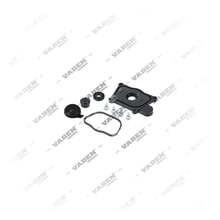
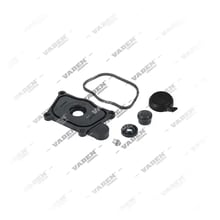
- Cover and Gasket Set: Includes cover, O-ring, and clip together; suitable for a complete renewal during pad replacement.
How to Choose the Right Caliper Cover
Caliper cover selection is determined more by caliper make and type than by vehicle brand. Since different axles on the same chassis can carry different caliper types, read the type and series marking on the body first, then confirm the match against the OEM number. Correct diameter alone is not enough; locking style, seating depth, and gasket type must also be compatible.
Caliper cover selection and compatibility criteria| Criterion | What to check | Why it matters |
|---|
| Caliper type | Type and series marking on the body | Geometry varies by caliper family |
| OEM number | OEM reference of the removed cover | Guarantees an exact match |
| Fitting style | Clip-fit, press-fit, or threaded seating | The wrong lock lets the cover work loose |
| Sealing | Integrated lip, O-ring, or flat gasket | Without a gasket, water and salt reach the mechanism |
| Material | Thermoplastic, aluminum, or coated steel | Heat and impact loads vary by location |
| Supply form | Single cover or complete gasketed set | The gasket is renewed along with it |
| Axle position | Front-axle or rear-axle caliper | Cover size can differ by axle |
Caliper Cover Maintenance and Precautions
A caliper cover is less a scheduled replacement item than a renewal item that accompanies pad and caliper service. At every pad change, check the covers visually for presence, cracking, and gasket condition. Reusing a removed clip-fit cover tends to cause a loss of sealing, so fitting a new one is preferred, and the seating surface should be cleaned before installation.
- Do not pry it off by force: Levering a cover out with a screwdriver crushes the seating groove.
- Do not lubricate the gasket face: Mineral oil and grease can swell the rubber gasket and break the seal.
- Do not exceed torque: Overtightening threaded covers strips the thread.
- Keep distance during pressure washing: Do not aim the water jet directly at the cover's gasket line.
- Do not run the vehicle with a cover missing: With the caliper uncovered, the adjuster mechanism can seize up within a short time.
Common Faults and Solutions
- Cover displaced or missing: Wrong cover type or a crushed groove; fit the correct OEM reference and check the body if the groove is damaged.
- Cover cracked or broken: Heat aging, impact, or incorrect removal; renew the cover with its gasket as a set.
- Water leaking around the cover: Aged O-ring or contaminated surface; clean and fit a new gasketed cover.
- Corrosion in the adjuster mechanism: Prolonged operation without a cover; renew with an adjuster repair kit if needed.
- One-sided pad wear: Guide pin binding from a missing pin cap; replace pin, boot, and cap together.
- No grease left in the mechanism: Washed out by lost sealing; replenish with the grease the manufacturer recommends.
Why VADEN ORIGINAL?
VADEN ORIGINAL caliper cover products are manufactured to OE dimensions; seating diameter, locking geometry, and gasket face are sized to match the original part. A wide OEM cross-reference list makes it fast to find the right cover for your caliper type, across the common disc brake caliper families used on heavy-duty trucks, tractor units, buses, and trailers. VADEN exports heavy vehicle spare parts to more than 100 countries.
- Manufactured to OE dimensions: Diameter, seating depth, and locking style match the original part.
- Material consistency: Engineering materials suited to the temperature and vibration load are used.
- Set option: Cover, gasket, and fastening elements are supplied together for complete servicing.
Conclusion
A caliper cover is a low-cost, high-impact part that protects the disc brake caliper's internal mechanism from water, salt, and abrasives. A missing or damaged cover can escalate into adjuster corrosion, one-sided pad wear, and ultimately a full caliper replacement. To choose the right product, confirm caliper type and OEM reference before vehicle model, and renew the cover together with its gasket whenever possible.
Frequently Asked Questions (FAQ)
What does a caliper cover do?
A caliper cover closes off the service openings on the disc brake caliper body, protecting the automatic pad-adjuster mechanism and guide pins from water, road salt, mud, and brake-pad dust. It also stops the grease fill inside the mechanism from escaping. It does not generate braking force directly, but it keeps the mechanism that does generate that force in good working order.
What happens if the caliper cover is missing or broken?
With the cover missing, water and abrasive dirt enter the caliper; the adjuster mechanism corrodes within a short time and loses its ability to compensate for pad wear. This can result in one-sided pad wear, brake imbalance, and caliper seizure. As soon as a missing cover is noticed, a new one should be fitted before the vehicle is driven.
What information determines the right caliper cover?
Selection is determined more by caliper make and type than by vehicle model. The type and series marking on the caliper body should be read first, then the match confirmed via the OEM number. Alongside diameter, the locking style, seating depth, and gasket type must also be compatible.
Can a removed caliper cover be reused?
With clip-fit and press-fit covers in particular, the locking lips can be permanently deformed during removal, which prevents a proper seal. For this reason, it is recommended to replace the removed cover with a new one, together with its gasket where possible. Metal threaded covers can sometimes be reused if the gasket is renewed.
How often should the caliper cover be checked?
At every pad change and during periodic brake service, the covers should be visually checked for presence, cracking, and gasket condition. Inspection frequency should be increased for vehicles exposed to road salt during winter months. For inspection intervals and torque values, the vehicle manufacturer's current service manual is the governing reference.
Related technical guide: Caliper Cover, Gasket & Plate: Faults, Replacement, Care