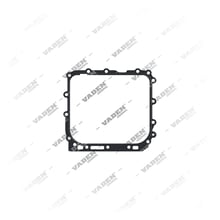
What are the functions of a Transmission Control Housing Gasket?
This gasket keeps transmission oil contained around the control housing area.
- Sealing: Prevents transmission gear oil from leaking at the housing cover joint surface.
- Surface tolerance compensation: Fills microscopic irregularities between two metal surfaces to ensure full contact.
- Vibration damping: Softens the effect of transmission operating vibration on the connection bolts.
- Dirt and moisture barrier: Prevents dust, water or dirt from entering the housing from outside.
- Pressure balancing: On some systems it helps maintain balanced air/oil pressure inside the housing.
What are the symptoms of a failing Transmission Control Housing Gasket?
Gasket failure usually shows up as oil leakage and a dropping transmission oil level.
- Oil leakage: Fluid staining or dripping is seen at the joint between the control housing and transmission body.
- Drop in transmission oil level: A faster-than-expected decrease at periodic checks indicates a leak.
- Difficulty in the shift mechanism: Advanced leakage can cause oil shortage, leading to stiffer gear shifts.
- Dirt buildup on the control housing: Leaking oil can attract dust on the outer surface, forming a thick layer of grime.
- Oil stain on the ground: An oil stain under the transmission while the vehicle is parked is a common symptom.
How is a Transmission Control Housing Gasket checked?
Inspection starts with a visual check from under the vehicle and continues with removal of the housing if needed.
- Visual inspection: Check around the control housing for oil traces, dirt buildup or moisture.
- Oil level measurement: Measure and record transmission oil level using the manufacturer's specified method.
- Bolt tightness: Check whether housing bolts are loose; looseness can trigger leaks.
- Gasket condition on removal: Once the housing is removed, examine the gasket surface for cracks, hardening or crushing.
- Housing surface check: If the gasket seating surface has scratches or irregularities, surface machining may be required.
What should be considered during replacement?
Surface cleanliness and correct tightening sequence are critical during replacement.
- Surface cleanliness: Fully remove old gasket residue, leaving no oil or metal particles on the surface.
- Correct gasket type: Use the cut gasket or liquid gasket type specified by the manufacturer; the two are not interchangeable.
- Tightening sequence and torque: Housing bolts must be tightened in the manufacturer's specified sequence, crosswise and in stages.
- Cure time: If a liquid gasket is used, do not refill with oil before the manufacturer's specified cure time has elapsed.
- Oil level check: After installation, top up transmission oil to the correct level and recheck for leaks.
How to choose the right Transmission Control Housing Gasket?
Selection is determined by transmission model, housing cover design and gasket thickness. Wrong thickness or material compromises sealing.
Transmission Control Housing Gasket selection criteria| Criterion | Description |
|---|
| Transmission model match | Must fully match the vehicle's transmission type |
| Gasket thickness | Must exactly match the thickness specified by the manufacturer |
| Material | Must resist transmission oil and operating temperature |
| Bolt hole alignment | Must seat precisely on the housing body's bolt holes |
| Reference verification | Confirm with OEM number and chassis data |
Maintenance and service life
The transmission control housing gasket can remain leak-free for many years when correctly installed; however, material hardening and bolt loosening over time increase leak risk. Periodic transmission oil level checks are the most effective method for early leak detection. Periodic torque checks on housing bolts also extend gasket life. Average service life depends on transmission operating conditions and maintenance discipline; the vehicle's current OE service manual is authoritative for the exact interval.
VADEN Transmission Control Housing Gasket
VADEN offers control housing gaskets manufactured to OE tolerances for heavy commercial vehicle transmissions. Correct thickness and material selection support reliable containment of transmission oil.
Frequently Asked Questions (FAQ)
Does transmission oil need to be drained to replace the control housing gasket?
Depending on the housing's position, lowering the oil level below the housing's lower edge is usually sufficient, but some designs may require a full drain; consult the vehicle service manual.
When should a liquid gasket be used instead of a cut gasket?
Whichever type the manufacturer specifies should be used; some housing designs are engineered to seal only with a liquid gasket, others only with a cut gasket.
What happens if the bolts are overtightened?
Overtightening can crush the gasket surface or crack the housing body, compromising sealing and creating a new source of leakage.
Can the vehicle keep being driven once a leak is noticed?
Short-term use may be possible with a minor leak, but oil level must be monitored regularly; if the level drops critically, the transmission can be damaged by insufficient lubrication.
How long should the area be monitored for leaks after gasket replacement?
The housing area should be rechecked during the first few days after installation and after the first long-distance drive to confirm there is no leakage.