What are connection components?
Connection components are the parts that link the cables, sockets, connectors and nipples in a heavy commercial vehicle's electrical system so that current flows without interruption. They belong to the electrical system group and are not engine parts; instead, they form the junction points for the lighting, sensor, charging and control circuits. On trucks, buses and tractor units, they keep connections tight and conductive under vibration and demanding operating conditions.
What do connection components do?
- Maintain current flow: Provide a low-resistance, uninterrupted path for electricity between cables and sockets.
- Secure the connection: Prevent connectors from working loose or backing out under vibration and impact.
- Protect the circuit: Insulate contact points against moisture, dust and corrosion to lower the risk of short circuits.
- Enable modular assembly: Let separate circuits be joined and disconnected quickly and correctly during service.
- Preserve signal integrity: Carry the low-current signals to sensors and control units without distortion or dropout.
Connection components technical summary
| Feature | Detail |
|---|
| Material | Conductive copper/brass terminals with heat- and chemical-resistant insulating plastic |
| Vehicle type | Trucks, tractor units, buses, trailers and heavy commercial vehicles |
| Compatibility | Mercedes-Benz, MAN, Scania, Volvo, DAF, Iveco, Renault, BMC and Ford electrical systems |
| System | Electrical system (lighting, sensor, charging and control circuits) |
| OE-equivalent approach | Designed to original-equipment dimensional and tolerance standards |
| Fitment | Push-fit or screw-type socket/connector joints; use the correct terminal and fit by a specialist |
| Maintenance | Periodic contact checks for corrosion and looseness |
What are the main types of connection components?
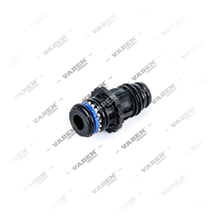
- Nipple: A fitting that secures cable and connection ends, providing a sealed, reliable contact point.
- Sockets: Push-fit male/female elements that let cables be plugged and unplugged quickly.
- Connectors: Multi-pin units that bring several cables together at a single junction point.
- Cable lugs and terminals: Conductive metal ends that carry the cable to its termination point.
- Sealing and retaining parts: Grommets, boots and clips that protect the joint against moisture and hold it in place.
What should you watch for when maintaining connection components?
- Regular inspection: Check sockets and connectors periodically for looseness and physical damage.
- Corrosion checks: Look for oxidation or green deposits building up on the contact surfaces.
- Correct terminal choice: Match the lug or nipple to the cable gauge to keep contact resistance low.
- Maintain the seal: Make sure grommets and boots seat properly and stay watertight.
- Choose genuine parts: Use OE-standard products such as VADEN ORIGINAL for dependable current transfer.
Common connection component problems and fixes
- Power loss or short circuit: Caused by a loose or oxidised connection; clean the contact or replace the connector.
- Lighting and signal faults: Result from a damaged socket or broken terminal; replace the connecting part.
- Connector overheating: High contact resistance and the wrong terminal are to blame; fit a correctly sized terminal.
- Moisture-driven corrosion: Comes from a lost seal; renew the grommet and use a waterproof connector.
- Vibration loosening: Poor retention lets the joint separate; secure it with a locking socket and clips.
Why choose VADEN ORIGINAL connection components?
- High conductivity: Quality copper/brass terminals deliver low-resistance, stable current transfer.
- Durable insulation: Made from materials that resist heat, moisture and vibration.
- OE-standard compliance: Manufactured to original-equipment dimensions and tolerances.
- Wide product range: Sockets, connectors and nipples to suit many heavy-vehicle makes and models.
- Technical support: Professional help with correct part selection and fitment.
Frequently Asked Questions (FAQ)
What are connection components used for?
They join the cables, sockets and connectors in a heavy commercial vehicle's electrical system so current is carried safely and without interruption.
Do connection components belong to the electrical system?
Yes. They are part of the electrical system group, forming the junction points for lighting, sensor, charging and control circuits. They are not engine connection parts.
What is a nipple connection component?
A nipple secures cable and connection ends while providing a sealed, reliable contact point. It is a sub-part within the connection components group.
What happens when a connector comes loose?
A loose connector can cause power loss, overheating or a short circuit. Clean the connection and, if needed, replace it with a locking socket.
Which vehicles do connection components fit?
There are options to suit the truck, bus and tractor-unit electrical systems of makes such as Mercedes-Benz, MAN, Scania, Volvo, DAF, Iveco, Renault, BMC and Ford.
Why do connection components corrode?
A lost seal and exposure to moisture cause oxidation on the contact surfaces. Using a waterproof connector and a sound seal prevents this.
Conclusion
Connection components are critical parts that underpin safe, uninterrupted current transfer throughout a heavy commercial vehicle's electrical system. Choosing the right socket, connector and nipple lowers fault risk and keeps lighting and sensor circuits working reliably. For long-lasting, dependable connections in your electrical system, choose VADEN ORIGINAL quality.