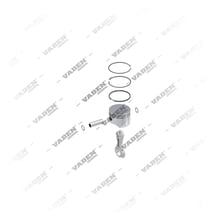
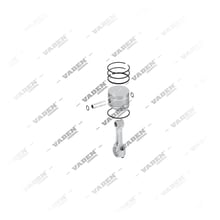
What Is Compressor Parts Connecting Rod & Piston?
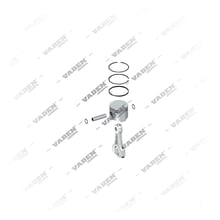
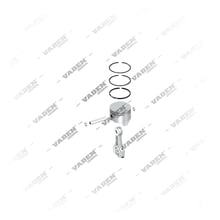
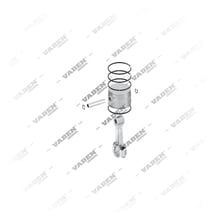
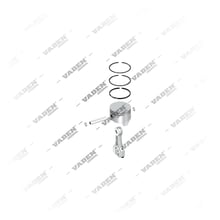
Compressor Parts Connecting Rod & Piston is the subcategory that brings together the connecting rods, pistons, piston pins and ring sets that make up the compression assembly of air brake compressors. It sits under the Compressor Parts heading within the Air Brake Compressors main group and covers the overhaul components aimed at rebuilding the inside of the compressor rather than replacing the complete unit. In the field this group is simply called the rod, con-rod kit, compressor piston, or rod-and-piston kit. In the pneumatic brake compressors fitted to trucks, tractor units, buses, trailers and heavy construction equipment, this is the mechanical core that actually generates air pressure; the compressor's output, quietness and oil consumption all depend directly on the condition of these parts.
How Does Compressor Parts Connecting Rod & Piston Work?
The rotary motion taken from the compressor crankshaft is converted into linear motion at the piston via the connecting rod. As the piston moves down inside the cylinder liner it draws in clean air through the intake valve; as it moves up it compresses that air and sends it through the discharge valve to the air dryer and reservoirs. The rings keep the compression chamber sealed, while the oil control ring limits oil from the crankcase passing through to the air side. This cycle repeats continuously for as long as the engine runs.
- Motion conversion: The connecting rod converts the crankshaft's rotary motion into the piston's linear stroke motion.
- Compression: As the piston approaches top dead center, the air in the cylinder is pressurized and delivered to the brake circuit.
- Sealing: The compression rings prevent pressure from escaping into the crankcase, while the oil ring prevents oil from passing to the air side.
Compressor Parts Connecting Rod & Piston Technical Specifications
Pistons are generally manufactured from heat-resistant aluminum alloy, while connecting rods are made from forged steel or high-strength alloys. Piston diameter must match the compressor's cylinder bore exactly; the number and height of the ring grooves must be identical to those of the original part. In heavy commercial vehicle compressors, piston diameters generally range from 60 to 100 mm; however, this is only an indicative range, and the exact bore, ring end gap, pin diameter and tightening torque are governed by the vehicle manufacturer's current service manual. For compatibility, piston diameter, pin diameter, rod center distance, bearing type and ring arrangement must all be checked together.
Compressor Parts Connecting Rod & Piston Types and Subgroups
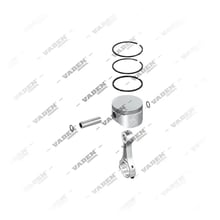
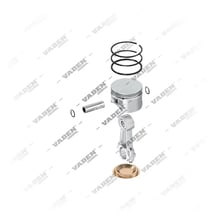
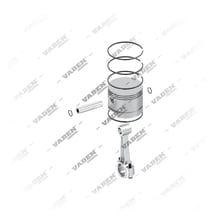
- Complete piston kit: The set most commonly chosen for overhauls, supplied with the piston, ring set, pin and retaining elements together.
- Piston ring set: Consists of compression and oil rings; the first step of intervention for units losing output while the piston dimensions are still within spec.
- Complete connecting rod: The group that renews the link between crankshaft and piston, supplied with the small-end bushing and big-end bearing.
- Bushing and bearing kit: Allows only the worn bearing elements to be replaced while the rod body itself remains sound.
- Piston pin and retainers: Small but critical parts that connect the piston to the rod, classified by pin diameter.
How to Choose the Right Compressor Parts Connecting Rod & Piston
Selection always starts with the OE number on the compressor housing; since different compressors can be used even on the same vehicle model depending on the engine variant, this is the most reliable way to match parts. Cylinder count, cooling type and piston size class are then verified. Fitting a standard-size piston into a compressor whose liner has been bored oversize causes the rings to seat poorly and leads to pressure loss within a short time.
Compressor Parts Connecting Rod & Piston selection and compatibility criteria| Criterion | What to check | Consequence if mismatched |
|---|
| OE / OEM number | Reference and variant code on the compressor housing | Wrong bore or rod length |
| Piston size class | Standard or oversize, whether the liner has been bored | Rings fail to seat, pressure drops, oil consumption rises |
| Ring arrangement | Number of grooves, ring height, oil ring position | Oil leaking to the air side, dryer saturation |
| Piston pin | Pin diameter, length and type of retaining element | Play during operation, knocking, damage to the pin bore |
| Rod center distance | Axis distance between small end and big end | Wrong stroke, valve plate contact |
Connecting Rod and Piston Maintenance and What to Watch For
The service life of this group depends largely on clean air and clean oil. A clogged intake filter forces the piston to operate under excessive vacuum, while dirty oil rapidly wears the bushings and bearings. During assembly, parts should be fitted wet with clean oil, ring gaps should be staggered relative to one another, and caps should be tightened progressively in a crossing sequence. Because tightening torque values vary by compressor model, the vehicle manufacturer's current service manual is authoritative.
- Measure the liner: When replacing the piston, measure the liner's ovality and wear; fitting a new piston into a worn liner is not a lasting fix.
- Renew as a set: Replace the piston, rings, pin and bushing all at once; mixing an old element with a new kit creates uneven wear.
- Measure the end gap: Seat the ring in the liner and measure the end gap with a feeler gauge, then compare it against the range given in the manual.
- Check the gasket and valve plate: With the piston assembly open, these parts should also be inspected and are usually renewed in the same overhaul.
Common Faults and Solutions
- Air pressure builds up slowly: Compression loss due to worn rings or piston skirt; renew the piston and ring set and verify liner dimensions.
- Oil accumulating in the lines and dryer: The oil ring is no longer doing its job; replace the ring set and check crankcase ventilation and the oil return line.
- Metallic knocking sound: Piston pin play or rod bushing wear; replace the rod kit and pin together, and measure the crank journal.
- Scoring and sticking on the piston skirt: Insufficient lubrication or dust ingress from the intake; check the lubrication circuit and replace the filter and the damaged piston.
- Frequent ring breakage: Wrong size class or incorrect assembly; verify the size and fit the rings with the correct tool.
Why VADEN ORIGINAL?
VADEN ORIGINAL connecting rod and piston products are manufactured on the basis of the original part's dimensions and tolerances; piston diameter, ring groove and pin bore are machined to match the original unit. The product range is cross-referenced against a large number of OE references, so a workshop can reach the correct kit starting from the number on the compressor in hand.
- Manufactured to OE dimensions: Piston, pin and rod tolerances are machined using the original part as the reference.
- Broad OEM coverage: A reference list spanning compressor architectures such as Wabco and Knorr-Bremse.
- Kit integrity: Piston, ring, pin and bushing are supplied in the same set, reducing the risk of mismatched parts.
- International distribution: A manufacturing and supply infrastructure exporting to more than 100 countries.
Conclusion
The Compressor Parts Connecting Rod & Piston group is the mechanical core that determines the air brake compressor's ability to generate pressure. Symptoms such as slow pressure build-up, oil showing up in the air line, or metallic knocking usually call for renewing this group rather than replacing the entire compressor. Choosing the correct size class, measuring liner condition and replacing parts as a complete set are what make the overhaul last; for assembly values, the vehicle manufacturer's current service manual is authoritative.
Frequently Asked Questions (FAQ)
What is included in the Compressor Parts Connecting Rod & Piston category?
This category contains the pistons, piston ring sets, piston pins, connecting rods, and connecting rod bushing-and-bearing kits that make up the compression assembly of the air brake compressor. Products are offered both as individual parts and as matched complete kits. In an overhaul, renewing the piston and rings together is usually the preferred approach.
Should I replace the connecting rod or the piston?
If there is a metallic knock and play in the pin bore, the problem is usually in the connecting rod bushing, and the rod kit should be renewed. If pressure builds up slowly and oil appears in the air line, the piston and ring group takes priority. Replacing both together while the compressor is already disassembled avoids a second round of labor cost.
What is the difference between a standard-size piston and an oversize piston?
Standard size is manufactured for the factory-diameter cylinder liner. If the liner has been bored oversize due to wear, an oversize piston matching that diameter must be used instead. Choosing the wrong size class causes the rings to seat poorly, leads to pressure loss, and increases oil consumption.
How do I determine the correct piston and connecting rod?
The most reliable method is to use the OE number on the compressor housing as the reference. You should also confirm that piston diameter, pin diameter, connecting rod center distance, ring arrangement and cylinder count match the original part. Even on the same vehicle model, different compressors may be used depending on the engine variant.
When should piston rings be replaced?
Air pressure building up more slowly than normal, the air dryer saturating frequently, and oil accumulating in the lines are typical signs of ring wear. As a rule, rings are renewed whenever the compressor is taken in for overhaul. It is recommended to measure the ring end gap before assembly and compare it with the range given in the service manual.