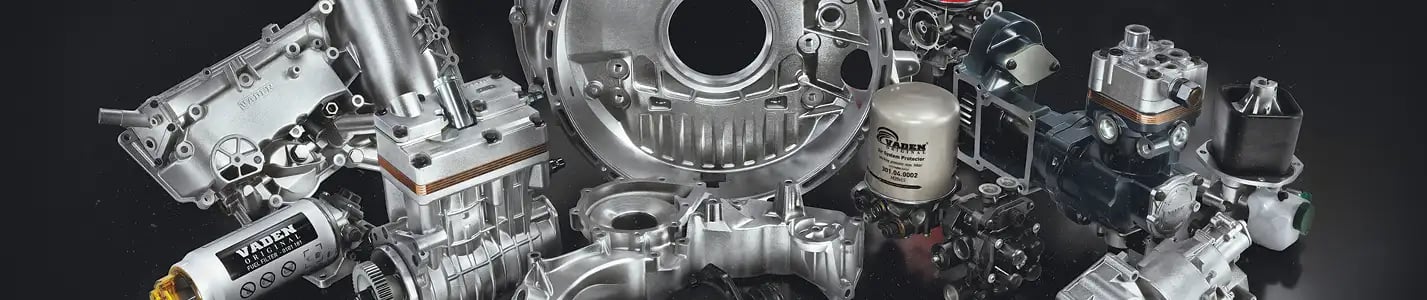
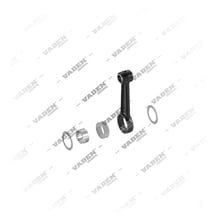
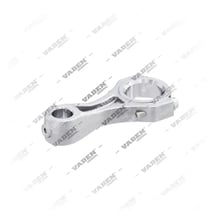
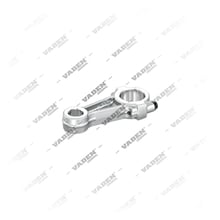
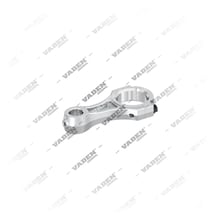
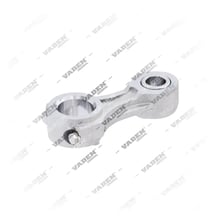
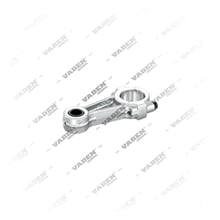
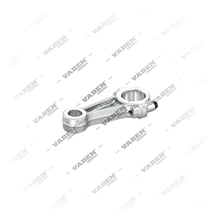
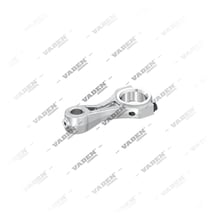
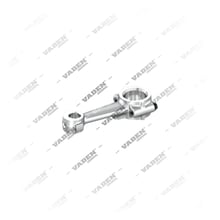
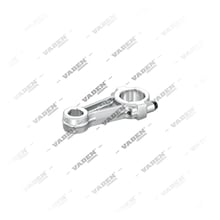
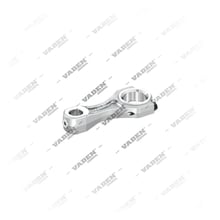
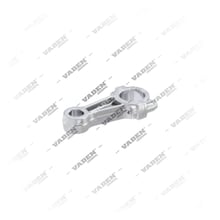
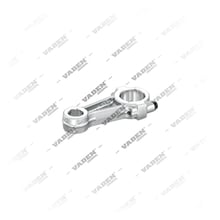
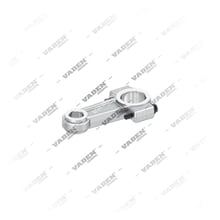
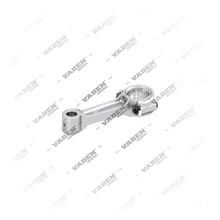
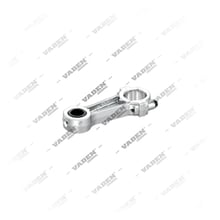
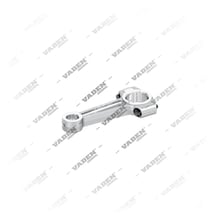
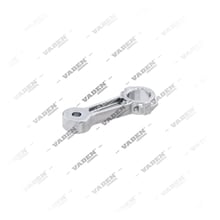
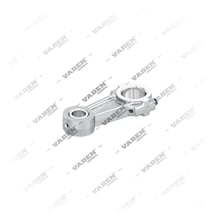
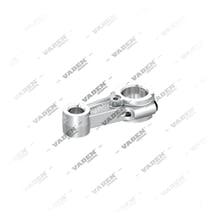
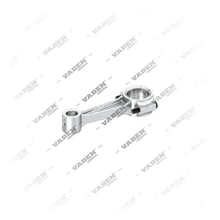
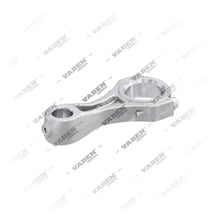
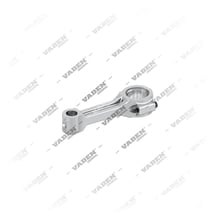
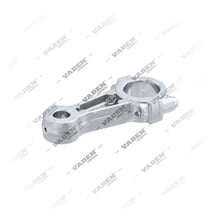
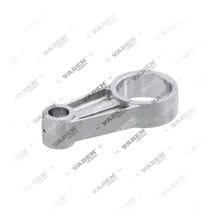
What Is a Compressor Parts Connecting Rod?
The Compressor Parts Connecting Rod is the link component inside an air brake compressor that joins the crankshaft to the piston, turning rotary motion into the piston's linear compression stroke. It belongs to the Compressor Parts subgroup of the Air Brake Compressors category and is one of the most critical parts in any overhaul performed without replacing the complete unit. In the field it is also called the con rod, piston rod, or compressor linkage arm. Since the compressor runs continuously, the rod endures high fatigue loads, so material quality directly affects brake system reliability.
How Does a Compressor Parts Connecting Rod Work?
The rod carries a different load at each end on every revolution. The big end grips the crank journal and picks up the rotary motion, while the small end, via the piston pin, converts that motion into up-and-down travel along the cylinder axis. Since this cycle repeats thousands of times per minute, a continuous oil film matters as much as the rod's mechanical strength.
- Motion conversion: Converts the crankshaft's circular motion into the piston's compression stroke; air output depends on this.
- Load transfer: Transmits the pressure force on the piston to the crankshaft and housing.
- Bearing support: The bearing shell and small-end bushing keep friction low.
- Oil distribution: In some designs, an internal passage carries oil to the piston pin area.
Compressor Parts Connecting Rod Technical Specifications
Connecting rods are typically made from forged steel or heat-treated alloy steel. The key dimensions are the big-end bearing bore, the small-end bushing bore, the center-to-center distance, and the side width. Since these are set by the stroke length and cylinder bore, a rod chosen by guesswork will throw off the compression ratio. Bearing clearances run to a few hundredths of a millimeter; exact figures vary by type, and the vehicle manufacturer's current service manual takes precedence.
- Material and process: Forged body with ground and surface-hardened critical surfaces.
- Bearing layout: A big end with a separable cap, or a monobloc design with a one-piece bushing.
- Fasteners: Cap bolts are usually tightened by the torque-plus-angle method and are single-use.
- Compatibility criteria: OE number, compressor type, cylinder count, and stroke must all be verified together.
Compressor Parts Connecting Rod Types and Subgroups
Products in this subcategory differ by compressor architecture. A single-cylinder unit uses one rod, a twin-cylinder unit runs two rods on the same crankshaft. For the correct variant, a direct comparison with the removed part is the safest approach.
- Rod with a capped big end: The big end splits in two, allowing the bearing shell to be replaced; common in overhauls.
- Rod with a one-piece bushing: A monobloc design using a bushing at the big end, requiring full crankshaft removal.
- Rod supplied with the piston assembly: A matched set of piston, pin, rings, and rod that lowers mismatch risk.
- Standard and repair-size rods: Selected by bearing size for compressors whose crank journal has been reground.
- Related components: Small-end bushing, bearing shell, connecting rod bolt, and piston pin circlip.
How to Choose the Right Compressor Parts Connecting Rod
The starting point is the OE number and type plate on the compressor housing. Cross-referencing this number is the most reliable way to tell apart variants supplied for the same model with different engine options. The removed rod's dimensions should be confirmed with a micrometer.
Compressor Parts Connecting Rod selection and compatibility checklist| Criterion | What to check | Why it matters |
|---|
| OE part number | Reference marking on the housing and the old rod | The most reliable matching method |
| Center distance | Distance between the two end centers | An incorrect measurement disrupts compression |
| Big-end bearing bore | Crank journal diameter and shell size | Excess clearance lowers oil pressure |
| Small-end bushing bore | Piston pin diameter and fit tightness | A loose bushing causes knocking |
| Compressor type | Single- or twin-cylinder, air- or water-cooled | Geometry and weight vary with the architecture |
| Make application | Mercedes-Benz, MAN, Scania, Volvo, DAF, Iveco | The compressor varies with the engine option |
| Bolts and tightening | Reusability and procedure | Incorrect application can lead to rod failure |
Compressor Parts Connecting Rod Maintenance and Key Considerations
The connecting rod is not a scheduled wear item; its service life depends on lubrication quality and operating temperature. Maintenance therefore focuses less on the rod itself and more on the oil circuit and intake air cleanliness. Every time the compressor is opened, the rod should be checked both visually and with measurement.
- Prioritize the oil circuit: A blocked line, dirty oil, or low oil pressure destroys bearing surfaces quickly.
- Do not neglect the intake filter: Dust passing the filter accelerates wear, and the resulting metal particles reach the bearings via the oil.
- Keep assembly clean: Even a single chip behind the bearing shell disrupts clearance and causes overheating.
- Follow the tightening procedure: Tighten bolts gradually in the specified sequence; confirm torque values against the service manual.
- A common mistake: Reassembling the rod and cap without matching their alignment marks ovalizes the bearing bore.
Common Faults and Solutions
Problems originating in the connecting rod first show up as noise and higher oil consumption; pressure loss appears only later. Reading the symptom correctly avoids an unnecessary complete unit replacement.
- Rhythmic knocking noise: Likely increased bearing clearance or bushing wear; measure clearances and renew the rod and bushings.
- Increased oil consumption: A worn bearing throws off piston alignment, compromising ring sealing; evaluate the assembly as a group.
- Slow air pressure build-up: Deviation in rod geometry reduces compression; reverify the part's OE dimensions.
- Discoloration on the bearing: Signals insufficient oil flow or too tight a clearance; clean the oil line and select the correct shell.
- Rod failure: Usually caused by a loosened or reused bolt; also inspect the housing and crankshaft.
Why VADEN ORIGINAL?
VADEN ORIGINAL connecting rods are made to OE dimensions and can be sourced from a single supplier alongside the other parts needed for an overhaul. Thanks to an extensive OEM reference list, workshops can quickly find the correct match from the old part's number.
- Manufactured to OE dimensions: Center distance, bearing bores, and weight balance follow original tolerances.
- Extensive OEM matching: A comprehensive cross-reference list covering common compressor types.
- A complete overhaul solution: Piston, rings, bushing, gasket, and valve assembly are available from the same range.
- International supply: Exports to more than 100 countries ensure strong parts availability.
Conclusion
The Compressor Parts Connecting Rod is an overhaul part that directly determines an air brake compressor's ability to generate air, and when chosen correctly it makes a complete unit replacement unnecessary. Verifying the OE number along with the center distance and bearing dimensions is decisive during selection, while cleanliness and correct tightening are decisive during assembly. For application-specific torque and tolerance values, the vehicle manufacturer's current service manual takes precedence.
Frequently Asked Questions (FAQ)
What does the Compressor Parts Connecting Rod do?
It connects the crankshaft to the piston inside the air brake compressor and converts the crankshaft's rotary motion into the piston's linear compression stroke. This is what allows the compressor to generate air and build up the pressure the brake system needs. When the rod wears, compression efficiency drops and air pressure builds up more slowly.
What are the signs that a connecting rod is worn?
The most typical sign is a rhythmic knocking noise coming from the compressor. This can be accompanied by increased oil consumption, oil showing up in the air line, and air pressure building up more slowly than normal. In this case the compressor should be opened up and the big-end bearing clearance and small-end bushing measured.
Should I replace the connecting rod on its own or as a set?
Rod wear usually also affects the bearing shell, the small-end bushing, and the piston rings. For this reason it is more reliable to renew the rod together with the piston assembly, bushing, gasket set, and, if needed, the connecting rod bolts. Replacing only the single part often means the compressor has to be opened again shortly after.
Can compressor connecting rod bolts be reused?
On many compressors, the connecting rod bolts are tightened using the torque-plus-angle method and are considered single-use fasteners. Reusing them can lead to loosening and rod failure. Whether a given bolt can be reused, and what tightening values apply, should be confirmed against the vehicle manufacturer's current service manual.
Which compressors are VADEN ORIGINAL connecting rods compatible with?
There is a broad application list covering the pneumatic brake compressor types commonly used on heavy commercial vehicles, including the compressors fitted to Mercedes-Benz, MAN, Scania, Volvo, DAF, Iveco, and Renault Trucks vehicles. To find the correct match, cross-reference the OE number marked on the compressor housing.