What are the functions of the Knorr-Bremse SK7 caliper body?
The caliper body converts the air pressure force generated when the brake pedal is applied into mechanical motion that presses the pads against the disc. Its functions can be summarized as:
- Force transfer: Passes the force coming from the brake chamber through the adjuster mechanism to the piston, and from the piston to the pad.
- Alignment: Houses the bearing surfaces that keep the pad seated evenly and parallel to the disc face.
- Heat dissipation: Helps dissipate the heat generated during braking through the body structure.
- Carrying and fixing: Houses sub-components such as the caliper slide pin, adjuster mechanism and dust boot.
What are the symptoms of a faulty Knorr-Bremse SK7 caliper body?
Structural or surface deterioration on the caliper body directly affects braking performance. Common symptoms include:
- Uneven pad wear: Play or wear in the body bearing surfaces causes the pad to press unevenly against the disc.
- Brake noise: Squealing, metal-on-metal friction or knocking sounds occur when body-to-piston contact is compromised.
- Pulling to one side: The vehicle pulling to one side under braking is often linked to a seized or deformed caliper body on that side.
- Visible cracks or corrosion: Pitting and rust can form on the body surface, especially in salted or humid climates.
- Leak traces: Wear on the piston seal seating surface can result in visible air leakage.
How is the Knorr-Bremse SK7 caliper body inspected?
Inspection should be performed with the vehicle raised and the wheel removed.
- Visual inspection: Check the body surface for cracks, breakage, excessive corrosion or deformation.
- Slide surface check: Measure play or wear in the bores where the guide pins travel.
- Piston bore check: Inspect the inner surface of the piston bore for scoring, pitting or corrosion.
- Mounting bolts: Check torque values and thread condition of the bolts connecting to the carrier.
- Function test: After installation, confirm smooth and symmetric piston travel under pedal pressure.
What should be considered when replacing it?
Replacing the caliper body is a precision operation that directly affects brake safety.
- Correct variant: Left (L) and right (R) bodies differ within the SK7 family; the correct part must be selected for the vehicle side.
- System bleeding: The brake air circuit must be safely depressurized before replacement.
- New seals: Wear items such as the piston seal and dust boot should be renewed at the same time.
- Torque value: Mounting bolts must be tightened to the value specified in the vehicle's current OE service manual; the exact figure should be confirmed with the manufacturer.
- Progressive test: After installation, perform a low-speed brake test to check for noise and pulling.
How to choose the right Knorr-Bremse SK7 caliper body?
Selection requires correctly matching the caliper family, carrier type and vehicle axle. The table below summarizes the main selection criteria.
Knorr-Bremse SK7 caliper body selection criteria| Criterion | Description |
|---|
| Caliper family | Knorr-Bremse SK7 type compatibility |
| Side | Left (L) / Right (R) mounting direction |
| Carrier fit | Mounting dimensions matching the existing carrier bracket |
| Axle position | Front or rear axle application |
| Material | Cast iron body, corrosion resistance |
| Additional parts needed | Pads, seals and dust boot must be sourced separately |
Maintenance and service life
Regular periodic maintenance is essential to extend the service life of the caliper body. It is recommended to grease the slide surfaces and pins, keep the dust boot undamaged, and clean the body bearing surfaces at every pad change. Average service life varies with duty cycle, road type and maintenance schedule; inspection intervals should be shortened for heavily loaded vehicles or those with frequent urban braking. Regular cleaning and moisture drainage against corrosion significantly extends the body's service life. Regularly inspecting the carrier bracket the caliper body is mounted to also helps keep the body correctly positioned and allows early fatigue signs to be caught in time. Tracking past inspection dates in service records makes it easier to plan the next maintenance interval.
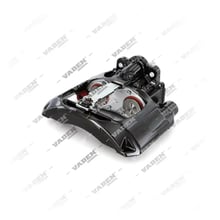
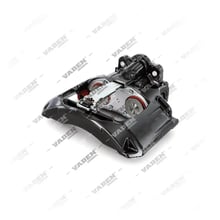
VADEN Knorr-Bremse SK7 caliper body
VADEN manufactures carrier-free, pad-free caliper bodies compatible with Knorr-Bremse SK7 type brake calipers, staying true to original dimensions and tolerance values. Left and right variants are offered under separate stock codes and are ready for direct replacement in heavy commercial vehicle workshops. During production, the cast iron body structure, guide pin bores and piston bore are machined to the original design tolerances, so the caliper's sliding motion after installation stays close to factory-level performance. This body type is commonly requested at service points and can also be stocked as part of preventive maintenance programs at fleet operators; for long-haul tractor units in particular, planned replacement reduces downtime caused by unexpected failures. Every part goes through VADEN quality control, including hardening, surface treatment and dimensional verification steps before delivery.
Frequently Asked Questions (FAQ)
Which vehicles use the Knorr-Bremse SK7 caliper body?
This body type is used on the front or rear disc brake groups of heavy commercial trucks, tractor units and buses fitted with the Knorr-Bremse SK7 caliper family. It must be compatible with the existing carrier on the vehicle side.
Does the body come with pads included?
No, this item is supplied carrier-free and pad-free. Wear items such as pads, the carrier bracket and piston seal must be sourced separately.
What is the difference between the left and right body?
Left (L) and right (R) bodies are mirror-symmetric in guide pin orientation and piston placement. Fitting the wrong side causes uneven braking, so the correct variant must be chosen for the vehicle side.
What should be done if corrosion is found on the caliper body?
Light surface rust can be cleaned and inspected, but if there is structural pitting or deep corrosion on the sliding surfaces, the body should be replaced. A corroded body negatively affects brake response time.
What torque value should be used when replacing the caliper body?
The exact torque value depends on the vehicle model and caliper variant. A general range can be used as reference, but the value stated in the vehicle's current OE service manual should always be followed.