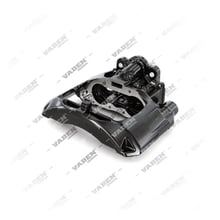
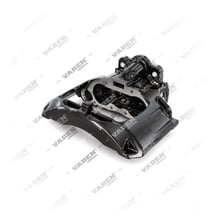
It is designed to withstand the high pressure and heat of heavy-duty service. The caliper manufacturer's casting molds are produced to tight tolerances, so critical dimensions such as piston bore diameter, pad pocket depth, and mounting hole position remain consistent across housings with the same model code. The SK7 series can have different housing variations depending on disc diameter and pad size, so two housings that look alike may not fit the same vehicle.
What is the Knorr-Bremse SK7 Caliper Housing (Empty)?
This part is the main casting that forms the skeleton of the Knorr-Bremse SK7 brake caliper. When a crack, severe corrosion, or bore scoring is found on the housing during caliper repair, replacing only the housing instead of the whole caliper significantly reduces labor and parts cost. In the Vaden catalog, this category offers left and right housing variants for the SK7 series, matched to OEM references.
What are the functions of the Knorr-Bremse SK7 Caliper Housing (Empty)?
- Pad retention: holds the brake pad blocks in correct position against the brake disc.
- Piston housing: contains the cylinder bores where hydraulic/pneumatic piston travel occurs.
- Force transfer: transmits the pressure force from the brake actuation system to the pads and disc.
- Structural support: allows the caliper to mount rigidly and securely to the carrier bracket.
- Heat dissipation: spreads part of the heat generated during braking through the housing mass.
What are the symptoms of Knorr-Bremse SK7 Caliper Housing (Empty) failure?
When the housing develops a crack, the most typical sign is brake fluid or moisture traces around the caliper, and at a later stage, brake sticking or incomplete release. Wear or scoring in the piston bore prevents smooth piston travel, causing uneven pad wear, steering wheel vibration, or the vehicle pulling to one side under braking. Loose or fractured mounting points on the housing produce metallic squealing, rattling, or the caliper shifting on the carrier during braking. In case of severe corrosion or cracking, braking performance drops critically from a safety standpoint and the housing must be replaced immediately. If housing distortion also disrupts the parallelism between the pad and disc, uneven disc surface wear and pedal vibration during braking can be added to the symptom list.
How is the Knorr-Bremse SK7 Caliper Housing (Empty) inspected?
Inspection starts with a visual check of the outer housing surface for cracks, corrosion staining, and casting defects. The inner surface of the piston bore is scanned visually and by touch for scoring, scratches, or rust; any roughness felt on the bore surface signals a risk to piston sealing. The bolt holes where the housing mounts to the carrier bracket should be checked for thread damage and ovalization. With the caliper removed, the housing can be placed on a flat surface to check for warping or distortion; even slight warp disrupts pad contact.
What should be considered during replacement?
Left (L) and right (R) housings are not interchangeable; the correct part number for the vehicle side must be confirmed before installation. When assembling onto the empty housing, the piston, seal, spring, and mechanism parts must be clean, undamaged, and installed to the correct torque values. After housing replacement, the brake system must be bled and pad-to-disc contact verified. Carrier bracket bolts must be tightened to the manufacturer-specified torque; under-torque risks loosening, over-torque risks cracking the housing. No impact should be applied to the housing surface during installation, since the casting is brittle and dropping or striking it can cause invisible micro-cracks.
How to choose the right Knorr-Bremse SK7 Caliper Housing (Empty)?
Selection should be based on the exact caliper model code (SK7) and the vehicle side (left/right), matched precisely to the housing OEM reference number.
Knorr-Bremse SK7 Caliper Housing selection criteria| Criterion | Description |
|---|
| Caliper model code | Must match the SK7 series exactly; mixed-series fitment is not possible |
| Vehicle side | Left (L) / right (R) housing must be selected per mounting orientation |
| OEM reference | The number specified in the vehicle's current OE service manual is authoritative |
| Piston bore dimension | Inner diameter and surface finish must match the original exactly |
| Material/casting quality | Must withstand heavy-duty pressure and heat conditions |
Maintenance and service life
The caliper housing has a long service life with correct assembly and regular brake maintenance; however, corrosion risk increases on vehicles operating in humid, salted environments. During periodic brake inspections, the housing surface should be cleaned and the piston bore kept free of grease and debris. Visually inspecting the housing during pad changes helps catch hidden cracks early. On vehicles operated in urban stop-and-go service with frequent braking, heat load is higher, so an annual visual scan of the housing surface for discoloration or micro-cracking is recommended.
VADEN Knorr-Bremse SK7 Caliper Housing (Empty)
Vaden offers left and right housing variants for the Knorr-Bremse SK7 caliper series at OE tolerances. Part selection should correctly match the model code and vehicle side.
Frequently Asked Questions (FAQ)
What does 'empty' housing mean?
It means only the bare cast housing is supplied without internals such as the piston, spring, or seal; the internal components must be sourced and installed separately.
Can left and right housings be used interchangeably?
No, the housings are produced as mirror images for each vehicle side and cannot be interchanged; the correct vehicle side must be confirmed before installation.
When is a housing-only replacement preferable to a full caliper replacement?
If the internal mechanism (piston, spring, seal) is sound and only the housing is cracked or severely corroded, replacing just the housing is more cost- and labor-efficient.
Should the housing be replaced for a light scratch in the piston bore?
It should be replaced if the surface damage is deep enough to compromise piston sealing; a superficial mark alone is not sufficient reason and requires technical assessment.
What torque values matter during housing replacement?
Carrier bracket bolts and piston/mechanism connections must be tightened to the manufacturer-specified torque; under- or over-torque can cause loosening or cracking, so the service manual should be followed.