What is a Brake Pad Retaining Spring?
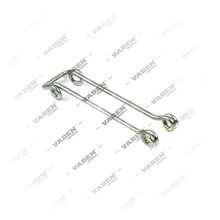
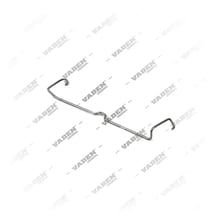
This spring is a pressing/retaining element, typically made of spring steel sheet, mounted on the top edge of the pad or in the caliper guide channel. It lightly presses the pad toward the guide channel to hold it in a fixed position and helps the pad retract a small distance from the disc when the brake pedal is released. This retraction reduces unnecessary friction and pad wear.
The spring must always be replaced together with new pads; a fatigued spring cannot generate sufficient retaining force.
What are the functions of a Brake Pad Retaining Spring?
- Positioning: Holds the pad in the correct, fixed position inside the guide channel.
- Vibration prevention: Prevents the pad from rattling and making noise while driving.
- Retraction support: Helps the pad move slightly away from the disc when the brake is released.
- Even pressure distribution: Ensures balanced contact of the pad on the guide surface, reducing uneven wear.
- Corrosion barrier: Some designs partially cover the guide channel, reducing dirt ingress.
What are the symptoms of a failing Brake Pad Retaining Spring?
When the spring fatigues or breaks, the pad becomes loose in the guide channel, causing metallic rattling or jingling noise while driving. Due to insufficient retraction force, the pad may remain in constant light contact with the disc, leading to premature pad wear and a light dragging sound. If the spring rusts or breaks, the pad may come out of the guide channel or sit crooked, causing uneven wear. If deformation, a broken tip, or excessive corrosion is found on the spring during visual inspection, replacement is required. In some cases, a weakened spring can allow the pad to shift slightly outside the guide channel, causing it to rub against the dust boot or adjacent rubber parts.
How is a Brake Pad Retaining Spring inspected?
Inspection requires opening the caliper and removing the pad and spring, then visually and manually assessing the spring's shape and retaining force. The spring ends are checked for breakage, deformation, or excessive corrosion. When the spring is reinstalled, check that it holds the pad tightly and firmly, without looseness. If rattling continues during a road test, spring replacement should be considered.
What should be considered during replacement?
- Set replacement: The spring must always be renewed together with pad replacement.
- Correct orientation: The spring must be installed in the direction and position specified by the manufacturer.
- Cleanliness: The guide channel should be cleaned of rust and dirt before installation.
- Free movement: After installation, verify the pad moves in the guide channel without sticking.
- Noise test: Verify during a road test that there is no rattling or squeaking noise.
- Retaining force: Check by hand that the spring presses the pad with sufficient force.
How to choose a Brake Pad Retaining Spring?
Selection should verify the caliper model, pad size and spring type (guide channel or top-hold). The vehicle's current OE service manual should be used as reference. Since spring steel thickness and retaining force can vary by manufacturer, choosing a product with characteristics closest to the original part is recommended.
Brake Pad Retaining Spring - General Information| Property | Description |
|---|
| Application | Disc brake caliper pad positioning and retraction |
| Material | Spring steel sheet |
| Function | Holds pad in place, prevents vibration and noise |
| Replacement rule | Replaced as a set together with the pad |
| Service interval | Visual inspection at every pad replacement |
Maintenance and service life
The service life of a pad retaining spring generally runs parallel to pad life; continuous heat-cooling cycles and exposure to road salt gradually reduce the spring's flexibility. Spring inspection should not be neglected during periodic brake service, and springs showing signs of corrosion should be replaced early. Metal fatigue in the spring can accelerate on vehicles operating in regions with large temperature swings between summer and winter, so increasing the inspection frequency is recommended for such fleets.
VADEN Brake Pad Retaining Spring
VADEN manufactures pad retaining springs for various caliper families to OE-equivalent material and form standards, supporting quiet and balanced brake performance through correct retaining force. Springs manufactured to the original steel thickness and form geometry keep the pad securely fixed in the guide channel, also reducing fleet maintenance costs.
Frequently Asked Questions (FAQ)
What does a brake pad retaining spring do
It holds the brake pad in a fixed position inside the guide channel and helps the pad move slightly away from the disc when the brake is released.
When should the pad retaining spring be replaced
It should be renewed together with the pad at every pad replacement, and also replaced if breakage, deformation or excessive corrosion is found.
What are the symptoms of a failing pad retaining spring
Metallic rattling or jingling noise while driving, uneven pad wear, and light dragging sound are typical symptoms.
Can a vehicle be driven without the pad retaining spring
No, without the spring the pad becomes loose, wears unevenly, and creates noise; brake performance can be adversely affected.
What should be considered when installing the spring
The spring must be installed in the manufacturer-specified direction, the guide channel cleaned, and free pad movement verified after installation.