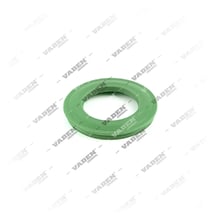
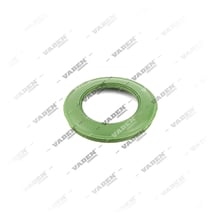
What is a Caliper Tappet Seal?
The Caliper Tappet Seal is a circular-section sealing element fitted into the tappet shaft's bore in the caliper housing, usually made from NBR or a similar oil- and heat-resistant rubber compound. Its dimensions and cross-section are precisely determined based on the tappet diameter and bore tolerance. The seal performs both a static and dynamic sealing function, forming a continuous barrier at the contact surface even while the tappet is moving.
What are the functions of the Caliper Tappet Seal?
- Grease retention: Prevents lubricant inside the tappet bore from leaking out.
- Contamination barrier: Prevents dust, water and road salt from reaching the tappet-to-bore contact surface.
- Corrosion prevention: Blocks moisture contact with the tappet surface, preventing rust.
- Correct positioning: Helps the tappet move in a centered and balanced way within the bore.
- Vibration damping: Partially absorbs small vibrations generated during brake application.
What are the symptoms of a Caliper Tappet Seal failure?
- Grease leakage or contaminated grease buildup around the tappet bore
- Stiffness, sticking or irregular movement felt in the tappet motion
- Uneven wear of the brake pads
- Visible rust or corrosion stains on the tappet surface
- Abnormal noise or vibration coming from the caliper mechanism
How is the Caliper Tappet Seal checked?
- Visual inspection: Check the seal surface for cracks, hardening or deformation.
- Grease condition: Evaluate the color and consistency of the grease around the seal for contamination.
- Tappet movement: Check by hand or during brake application whether the tappet moves freely within the bore.
- Bore surface: Inspect the bore surface where the seal seats for scratches, wear or corrosion.
- Pad wear pattern: Uneven wear on the pads can indicate a seal or tappet problem.
What should be considered when replacing it?
- Clean around the bore before removing the tappet, removing old grease and dirt residue.
- Before fitting the new seal, check the bore surface for corrosion or scratches; a damaged surface compromises sealing.
- Apply grease of the type and quantity recommended by the manufacturer; incompatible grease can cause the seal to swell or harden.
- Make sure the seal is not twisted and seats in the correct orientation during installation.
- Perform installation according to the vehicle's current OE service manual.
- After installation, test tappet movement to confirm it operates freely.
How to choose the right Caliper Tappet Seal?
Correct seal selection should be based on caliper model, tappet diameter and material compatibility.
Caliper Tappet Seal Selection Criteria| Criterion | Description |
|---|
| Caliper model | The seal must be fully compatible with the vehicle's caliper tappet type |
| Tappet diameter | The seal's inner diameter must precisely match the tappet dimension |
| Material resistance | Must use a rubber compound resistant to oil, heat and grease chemistry |
| Bore tolerance | The seal must seat exactly within the bore dimension in the caliper housing |
| OE reference cross-check | Verify by matching the OE number of the removed part |
Maintenance and service life
Despite its small size, the caliper tappet seal is critical to the long service life of the brake mechanism. It is recommended to visually inspect the tappet area and seal at every pad replacement. Seal life can be shortened on vehicles frequently exposed to road salt and moisture, making regular inspection important.
VADEN Caliper Tappet Seal
VADEN manufactures tappet seals compatible with OE references for heavy commercial vehicle brake calipers; products are tested for oil and heat resistance before release.
Frequently Asked Questions (FAQ)
Is replacing just the pads enough if the tappet seal is damaged?
No, replacing the pads alone is not enough; if the seal is damaged, grease leakage and contamination ingress continue, leading to premature wear of the tappet and mechanism.
Does the grease always need to be renewed when replacing the seal?
Yes, the old grease is usually contaminated or dried out; the bore should be cleaned and refilled with new grease as recommended by the manufacturer.
Is the tappet seal the same part as the dust boot?
No, the seal provides static/dynamic sealing between the tappet and the bore, while the dust boot protects the outer surface of the mechanism from contamination; the two complement each other.
Why does a hardened seal need to be replaced?
A hardened seal loses its flexibility and can no longer provide a full seal, leading to grease leakage and corrosion on the tappet surface.
Is the tappet seal sold on its own or as part of a kit?
It depends on the application; in some caliper models it is sold as a standalone part, in others it is included in a repair kit together with other seals.