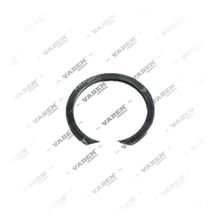
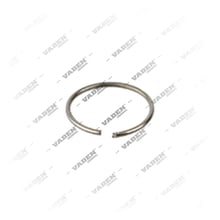
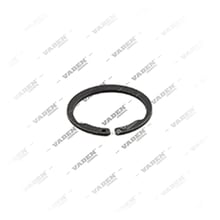
What is a Brake Caliper Pushrod Retaining Ring?
Although it may appear to be a small part, the retaining ring is structurally important for keeping the pushrod mechanism properly aligned and absorbing the axial forces generated during brake application; if it dislodges or breaks, adjacent parts can loosen and the mechanism's integrity can be compromised.
What are the functions of a Brake Caliper Pushrod Retaining Ring?
- Axial fixing: Keeps adjacent parts in the pushrod mechanism (bearing, retainer, boot holder) in their designated position.
- Groove locking: Seats into the groove under tension, forming a mechanical lock that resists self-removal after installation.
- Load distribution: Distributes the axial forces generated during brake application evenly against the adjacent surface, reducing local stress buildup.
- Serviceability: Allows the mechanism to be opened and closed in a controlled manner during service; the part is not permanently welded or pressed.
- Vibration resistance: With correct spring tension, it maintains its position without dislodging under vehicle vibration.
What are the symptoms of a failing Brake Caliper Pushrod Retaining Ring?
- Loose/play feeling in the pushrod: If the ring has weakened or partially dislodged, axial play may be felt in the pushrod mechanism.
- Abnormal metallic noise: A slight rattling or scraping sound during brake application can indicate the ring has shifted.
- Visible deformation: A removed ring may show tension loss, a crack, or a broken tip.
- Damage to adjacent parts: When the ring fails to do its job, parts such as the bearing or retainer can show premature wear or positional shift.
- Groove wear during installation: If the ring's seating groove is enlarged or deformed, even a new ring will not hold securely.
- Corrosion: In mechanisms exposed to moisture, rust on the ring's surface weakens its material structure.
How is a Brake Caliper Pushrod Retaining Ring inspected?
- Disassembled inspection: When the pushrod mechanism is opened, check that the ring is fully and firmly seated in its groove, with no deformation or breakage.
- Tension check: Lightly compress the ring with the correct pliers to assess whether it retains its original spring tension; a loose ring has lost its holding force.
- Groove inspection: Verify the retaining groove in the pushrod body shows no wear or enlargement.
- Adjacent part alignment: Confirm parts secured by the ring, such as the bearing/retainer, are in the correct axial position.
- Manual play test: With the mechanism assembled, apply light axial force and feel for abnormal play.
What should be considered during replacement?
- Correct OE number and size: Choose a ring that exactly matches the pushrod body diameter and groove width; an incorrect size will not provide sufficient hold.
- Use the correct installation tool: Install and remove the ring with the manufacturer-specified retaining ring pliers; do not force it with unsuitable tools such as a screwdriver.
- Groove cleanliness: Clean the groove surface of dirt and rust before installation; if the groove is found deformed, evaluate the affected part as a whole.
- Full seating check: After installation, visually verify the ring is fully seated in the groove and applies even tension around its circumference.
- Single-use approach: Do not reuse a removed ring due to tension loss risk; replace with a new one after every disassembly.
How to choose the right Brake Caliper Pushrod Retaining Ring?
Selection should be based on OE part number, not brand, determining the correct ring model for pushrod body dimension and caliper family.
Brake Caliper Pushrod Retaining Ring selection criteria| Criterion | Description |
|---|
| OE reference number | Exact match with the original part number specified by the caliper manufacturer |
| Ring diameter | Full match with the groove width in the pushrod body |
| Material hardness | Hardened steel that retains sufficient spring tension long-term |
| Corrosion resistance | Coating quality against rust formation in humid environments |
| Caliper family | Profile compatibility with mechanism type such as SB, SN, SK |
Maintenance and service life
The retaining ring is not directly exposed to wear, but it can lose tension through repeated assembly/disassembly cycles. For this reason, visual inspection of the ring at every pad or pushrod service is recommended, with replacement if tension loss is suspected. Vehicles operating in humid, salty environments carry a higher corrosion risk on the ring's surface; opening and inspecting the mechanism at regular intervals prevents damage from spreading to adjacent parts. A retaining ring with correct tension and correct dimensions supports years of trouble-free pushrod mechanism operation.
VADEN Brake Caliper Pushrod Retaining Ring
Within its brake caliper product range, VADEN offers pushrod retaining rings for common caliper families at OE dimensional and hardness standards, manufactured with correct spring tension and corrosion resistance.
Frequently Asked Questions (FAQ)
Can a removed retaining ring be reused?
Not recommended. Once removed, the ring loses some spring tension, weakening its holding force. Replacing it with a new ring after every disassembly is recommended for a secure installation.
What tool should be used to install the ring?
The manufacturer's recommended retaining ring pliers should be used. Working with unsuitable tools such as a screwdriver or regular pliers can deform the ring and cause it to seat incorrectly in the groove.
What symptoms appear when the ring loosens?
A slight play feeling in the pushrod mechanism, a rattling sound during brake application, and premature wear on adjacent parts can occur. The mechanism should be inspected if these symptoms are noticed.
Is a new ring enough if the retaining groove is worn?
No. If the groove is enlarged or deformed, even a new ring will not provide sufficient hold; in this case the pushrod part itself needs to be evaluated as a whole.
Is the same ring used across all caliper families?
No. Families such as SB, SN, and SK have different pushrod diameters and groove widths; the OE number should be the basis for correct selection.