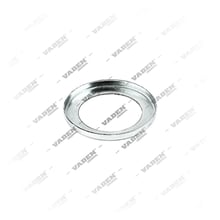
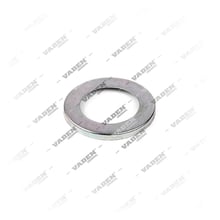
What are the functions of the Caliper Shaft Retaining Plate?
- Axial retention: Prevents the caliper shaft from sliding back and forth inside the housing, maintaining correct mounting position.
- Vibration damping: Reduces metal-to-metal impact noise and micro-vibration that can occur at the contact point between shaft and housing.
- Grease retention: Limits grease from escaping the shaft bearing, helping lubrication remain effective for longer.
- Dirt barrier: Partially blocks dust, water and road contamination from entering the shaft bearing.
- Assembly reference: Helps the shaft seat at the correct depth and angle during disassembly and reassembly.
What are the symptoms of a faulty Caliper Shaft Retaining Plate?
- Metallic rattling noise during braking: When the plate breaks or dislodges, the shaft moves freely inside the housing, producing a rattling sound.
- Irregular operation of the automatic adjuster mechanism: When there is play along the shaft axis, the pad-to-disc clearance cannot be adjusted correctly, causing the pad to wear early or late.
- Dirt/moisture entering the caliper: When the plate is damaged, its barrier function is lost and the shaft bearing can corrode over time.
- Vibration in the brake pedal: A loose shaft position can cause unstable operation of the caliper mechanism and vibration felt through the pedal.
- Visibly broken/bent plate: Cracking, breakage or deformation of the plate can be observed when the caliper is opened.
How is the Caliper Shaft Retaining Plate inspected?
For inspection, the caliper mechanism cover is removed and the shaft and surrounding plate are visually examined. The plate is checked for cracks, broken edges or excessive deformation. The shaft is gently moved by hand to check axial play; excessive movement indicates the plate is no longer performing its function. The shaft bearing is inspected for grease residue and dirt buildup, which is an indirect sign that the plate has lost its barrier function. The automatic adjuster mechanism is turned by hand to test for resistance-free or jerky movement.
What should be considered when replacing it?
During replacement, the caliper mechanism should be disassembled in a clean work area, and the shaft and bearing surfaces cleared of dirt and old grease. Before fitting the new plate, the shaft surface should be checked for scratches or wear, and the shaft replaced along with it if necessary. During assembly the plate must be positioned in the correct orientation and fully seated; reversed or incomplete seating leads to premature breakage. Grease of the type and quantity recommended in the vehicle's service manual should be applied to the shaft bearing. After installation, free and smooth operation of the automatic adjuster mechanism should be tested by hand; for exact assembly steps, the vehicle's current OE service manual is the authoritative source.
How to choose the right Caliper Shaft Retaining Plate?
Since caliper mechanisms have different dimensions and tolerances depending on manufacturer and model, the caliper type and OEM number must be verified together to select the correct plate.
Selection criteria for Caliper Shaft Retaining Plate| Criterion | Why it matters |
|---|
| Caliper type / OEM number | Plate size and thickness are specific to the caliper mechanism |
| Material hardness | Insufficient hardness leads to premature deformation and loss of function |
| Shaft bore compatibility | An incompatible bore increases axial play, causing rattling |
| Surface coating | A corrosion-resistant coating extends service life under moisture exposure |
| Mounting direction/geometry | Incorrect orientation causes assembly errors on non-symmetrical designs |
Maintenance and service life
The caliper shaft retaining plate does not directly carry braking load, but it is necessary for precise operation of the mechanism; its service life largely depends on the cleanliness of the shaft bearing and the condition of the grease. During periodic brake maintenance, the caliper mechanism should be opened to refresh the grease and the plate should be visually inspected. On vehicles exposed to heavy dust and water (construction, mining, rural routes), inspection intervals should be shortened. Early detection of a damaged plate prevents failure of the automatic adjuster mechanism and consequent premature pad/disc wear.
VADEN Caliper Shaft Retaining Plate
VADEN manufactures shaft retaining plates for heavy-duty commercial vehicle disc brake calipers to OE dimensions and material hardness. Correct geometry and surface coating support precise, quiet operation of the automatic adjuster mechanism.
Frequently Asked Questions (FAQ)
Does a broken caliper shaft retaining plate compromise brake safety?
It does not directly carry braking force, but it affects correct operation of the automatic adjuster mechanism; in the long term, incorrect pad-to-disc clearance can negatively affect brake performance, so it should be replaced once detected.
Is the retaining plate replaced alone or together with the shaft?
Usually both are replaced together if the shaft surface also shows wear. Renewing only the plate while the shaft surface is scratched can lead to play recurring in a short time.
If there is a metallic rattling noise from the caliper, is this the first suspect part?
A definitive diagnosis requires opening the caliper, but damage to the shaft retaining plate is one of the common causes; the pad, pushrod and dust boot should also be checked.
Should special grease be used when replacing the retaining plate?
Yes, grease resistant to high temperature and brake dust should be used; the type and quantity recommended in the vehicle's service manual should be followed.
Are retaining plates interchangeable across different caliper mechanisms?
Generally no. Plate size, thickness and mounting geometry are specific to the caliper type; replacement should not be done without verifying the OEM number.