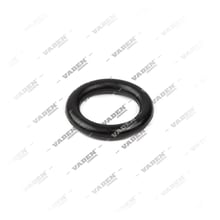
What is the Brake Caliper Shaft O-Ring?
Because the brake caliper shaft o-ring is constantly exposed to temperature fluctuation and mechanical movement, it is an elastomer part that hardens and loses its elasticity over time; for this reason, it is one of the items that should not be overlooked during brake maintenance.
What are the functions of the Brake Caliper Shaft O-Ring?
The main functions of the o-ring within the caliper mechanism are as follows.
- Sealing: Prevents grease inside the caliper housing from leaking out and blocks moisture and dirt from entering from outside.
- Shaft protection: Protects the moving surface of the caliper shaft from abrasive elements such as dust and brake pad wear particles.
- Providing movement resistance: Limits excessive free rotation of the shaft, ensuring controlled mechanical movement.
- Vibration damping: Its elastomer structure absorbs small impacts that occur during shaft movement.
What are the symptoms of a Brake Caliper Shaft O-Ring failure?
Damage to the o-ring element creates noticeable symptoms in the overall operation of the caliper mechanism.
- Stiffness in shaft movement: When the o-ring loses its function, drying and rust can form on the shaft, causing the movement to become stiff.
- Grease leakage: Oily traces or buildup may be seen around the caliper housing, especially at the shaft entry point.
- Abnormal squeal or squeak noise: A shaft surface left dry can produce a metallic squeaking sound during braking.
- Uneven pad wear: Disrupted shaft movement can prevent the pad from applying even pressure to the disc, causing wear on one side.
How is the Brake Caliper Shaft O-Ring checked?
Inspection should be carried out after disassembling the caliper and accessing the shaft mechanism.
- Visual inspection: The o-ring is examined for cracks, flattening, or cross-section loss.
- Flexibility test: The o-ring is gently flexed by hand to assess whether it has hardened.
- Shaft surface check: The shaft surface that the o-ring contacts is checked for scratches or rust.
- Movement test: The shaft is rotated by hand to observe its degree of freedom and check for abnormal resistance.
What should be considered during replacement?
The following points should be observed during o-ring replacement.
- Correct size: The o-ring's cross-section thickness and inner diameter must exactly match the caliper manufacturer's specification; an incorrect size leads to early leakage.
- Greasing: Suitable brake grease must be applied to the shaft surface before fitting the new o-ring.
- Surface cleanliness: The shaft and o-ring seat must be completely cleared of old grease residue and dirt.
- Damage-free installation: A suitable installation tool should be used to avoid cutting or twisting the o-ring during fitting.
How to choose a Brake Caliper Shaft O-Ring?
The following technical references should be considered for correct o-ring selection.
Brake Caliper Shaft O-Ring technical reference values| Property | Typical value / description |
|---|
| Application area | Disc brake caliper shaft sealing point |
| Material | NBR or FKM based heat-resistant elastomer |
| Temperature resistance | General range suited to brake area temperature conditions |
| Cross-section size | Specific to caliper type; general range, manufacturer data is authoritative |
| Grease compatibility | Must be compatible with the specific grease type recommended for brakes |
In the VADEN catalog, this o-ring is matched via OEM reference codes suited to Wabco, Knorr-Bremse, and Meritor type caliper families; for exact size and grease compatibility, the vehicle's service manual should be consulted.
Maintenance and service life
The service life of the caliper shaft o-ring varies depending on brake usage frequency and ambient temperature. Opening the caliper mechanism during pad replacement is a convenient opportunity to visually inspect the o-ring. Checking the grease condition of the shaft area during regular brake maintenance significantly extends the service life of both the o-ring and the shaft.
VADEN Brake Caliper Shaft O-Ring
VADEN bases the shaft o-rings it produces for heavy commercial vehicle disc brake calipers on OE-compatible material and dimensional standards. The product is designed to offer a reliable sealing solution at service points, together with the other components in the Brake Caliper > Caliper Shaft chain.
Frequently Asked Questions (FAQ)
What does the brake caliper shaft o-ring do?
It seals the point where the caliper shaft enters the housing, preventing grease from leaking out and blocking contaminants such as moisture and dust from entering.
What happens when the o-ring is damaged?
Symptoms such as stiffness in shaft movement, grease leakage, abnormal squeaking noise, and uneven pad wear can occur.
When should the o-ring be replaced?
It should be inspected and, if necessary, replaced when cracks, flattening, or hardening are detected during visual inspection, or when the caliper is opened during pad replacement.
What is the most critical point during installation?
Selecting the o-ring in the correct size, greasing the shaft surface with the appropriate grease, and fitting it without cutting during installation.
Should the o-ring be replaced at every pad change?
Not necessarily; but since the caliper is already open, it is a convenient time to check the o-ring's condition, and replacement is recommended if damage is found.