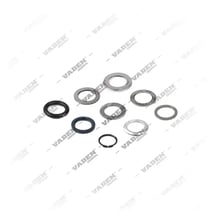
What is a Caliper Rubber Bushing Bearing?
This part is a composite bearing element consisting of a vulcanized rubber layer bonded between metal inner and outer races. It is used at moving mechanism points of the caliper, particularly at guide pin or actuating lever connections. Unlike conventional needle or ball bearings, the rubber layer has a certain flexibility that tolerates small deviations in installation tolerances, keeping the mechanism from stiffening during operation.
The rubber bushing bearing is not lubricated like conventional bearings; mineral oil-based grease must not contact the rubber surface, otherwise the rubber can swell and deteriorate prematurely.
What are the functions of a Caliper Rubber Bushing Bearing?
- Vibration damping: Absorbs shocks and vibrations generated during braking through the rubber layer.
- Limited movement: Allows the small angular/axial movement of the guide pin or actuating lever.
- Noise isolation: Prevents metal-to-metal contact, reducing mechanical noise from the caliper.
- Tolerance compensation: Compensates small deviations in installation and manufacturing tolerances through rubber flexibility.
- Corrosion barrier: Partially blocks direct contact of moisture and dirt entering between metal surfaces.
What are the symptoms of a failing Caliper Rubber Bushing Bearing?
When the rubber layer ages, cracks or delaminates, stiffness, delayed movement or metallic rattling appears in the caliper. Hardening of the rubber prevents the mechanism from damping shocks, causing vibrations to be transmitted directly to the caliper body. In advanced wear, the rubber can crumble and fall apart, causing the metal races to contact directly, leading to rapid wear and delayed brake response. A network of cracks or fading color on the rubber surface during visual inspection is a typical early symptom. If the rubber separates completely, noticeable excess play can be felt in the mechanism, which can cause the pad to apply uneven pressure during braking.
How is a Caliper Rubber Bushing Bearing inspected?
Inspection requires removing the relevant mechanism and visually examining the rubber bushing bearing for cracks, hardening or delamination. The bearing is moved by hand to check whether the expected flexibility and limited movement are present. Excessive stiffness or, conversely, excessive looseness is abnormal. If there is an oil stain on the rubber surface, the possibility of incorrect grease use should be evaluated.
What should be considered during replacement?
- Correct size: The bearing's inner/outer diameter and width must exactly match the relevant mechanism.
- Grease compatibility: Grease that will contact the rubber layer must be of a rubber-compatible type.
- Pressing operation: The bearing must be pressed into its bore with a suitable tool, without tilting or forcing.
- Visual check: Verify no damage has occurred to the rubber layer after installation.
- Function test: Check that the mechanism operates freely and without vibration.
- Chemical protection: After installation, make sure the rubber surface does not come into contact with solvent-based cleaning products.
How to choose a Caliper Rubber Bushing Bearing?
Selection should verify the caliper model, mounting location and bearing dimensions (inner/outer diameter, width). The vehicle's current OE service manual should be used as reference. Since rubber hardness (shore value) can vary between manufacturers, choosing a product with flexibility characteristics closest to the original part is important for vibration damping performance.
Caliper Rubber Bushing Bearing - General Information| Property | Description |
|---|
| Application | Disc brake caliper moving mechanism bearing |
| Structure | Vulcanized rubber composite between metal races |
| Function | Vibration damping and limited flexible movement |
| Lubrication | Rubber-compatible grease, kept away from mineral oil |
| Service interval | Visual inspection during periodic brake service |
Maintenance and service life
The service life of the caliper rubber bushing bearing depends on the rubber's exposure to UV light, heat, and incompatible chemicals. Direct contact of brake cleaner spray or solvent-based products with the rubber surface should be avoided. Periodic visual inspection for early crack detection prevents sudden mechanism failure. On vehicles operating in extremely hot climates, the rubber hardens faster, so shortening the inspection interval is recommended for such fleets.
VADEN Caliper Rubber Bushing Bearing
VADEN manufactures rubber-metal composite bearings for various caliper families to OE-equivalent material quality, supporting long-lasting operation of the caliper mechanism through vibration damping performance. With correct rubber flexibility and metal race tolerance, it contributes to quiet and balanced brake mechanism operation on heavy commercial vehicles.
Frequently Asked Questions (FAQ)
How does a caliper rubber bushing bearing differ from a conventional bearing
It has a vulcanized rubber layer between the inner and outer races, providing vibration damping and limited flexible movement, unlike conventional bearings designed for free rotation.
Can grease be applied to a rubber bushing bearing
Rubber-compatible special grease can be used; standard mineral oil-based greases can cause the rubber to swell and deteriorate prematurely.
What are the symptoms of a failing rubber bushing bearing
Stiffness in the caliper, delayed movement, metallic rattling, and cracks or fading on the rubber surface are typical symptoms.
What should be considered when replacing the rubber bushing bearing
Selecting the correct size, using rubber-compatible grease, and pressing the bearing in without tilting are important.
Can brake cleaner spray damage the rubber bushing bearing
Yes, solvent-based brake cleaner sprays can cause premature deterioration if they contact the rubber surface directly.