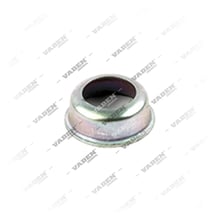
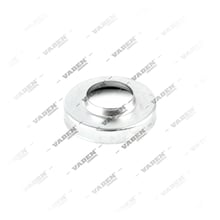
What is the caliper pin retaining plate?
Working together with other small caliper mechanism parts (spring, washer, bushing), the pin retaining plate is often overlooked during a pad change but has a noticeable effect on brake balance; for this reason it is recommended to inspect it separately during comprehensive caliper maintenance.
What are the functions of the caliper pin retaining plate?
The pin plate acts as a supporting element that preserves the mechanical integrity of the caliper.
- Retention: Prevents the caliper pin from coming out of its bore or shifting axially.
- Vibration damping: Reduces any looseness and rattling that can occur at the contact surface between the pin and the body.
- Correct alignment: Keeps the pin fixed along its sliding axis, supporting balanced caliper movement.
- Protection: Partially protects the pin surface from external factors and excessive load points.
What are the symptoms of a faulty caliper pin retaining plate?
A fault in this small part can be hard to notice but leads to significant symptoms.
- Metallic rattling noise: A light rattle heard especially on rough roads or during braking indicates the plate has loosened.
- Pin play: Noticeable axial play in the pin can be felt when the caliper is removed and checked.
- Uneven pad wear: When pin alignment is disturbed, the pad may not press evenly against the disc.
- Delayed brake response: A disrupted caliper sliding motion can slightly delay brake response.
- Visible deformation: Bending, breakage or rusting can be observed on the plate itself.
How is the caliper pin retaining plate inspected?
Inspection should be carried out in detail with the caliper removed.
- Visual inspection: Check the plate for cracks, deformation or excessive corrosion.
- Seating check: Assess whether the plate is fully seated in its bore and still maintains clamping force.
- Pin play test: Gently move the pin by hand to check for axial play.
- Contact surface: Inspect the contact surface between the plate and the pin for wear marks.
- Post-installation test: After the caliper is fitted, confirm the sliding motion is free and quiet.
What should be considered when replacing it?
Despite its small size, correct installation is important for brake performance.
- Correct orientation: The plate must be placed in the direction and position specified by the manufacturer's design.
- Cleanliness: The bore and pin surface must be free of dirt and rust residue before installation.
- Grease application: An appropriate high-temperature grease should be applied to the pin surface in a thin layer.
- Snug fit: Confirm the plate sits fully and without play in its bore and is not deformed.
- Function test: After installation, manually verify the caliper slides freely.
- Neighboring parts check: Also verify that parts working alongside the pin and plate, such as the spring, washer and bushing, are not worn; if any of these small parts is damaged, the whole system can become unbalanced again.
How to choose the right caliper pin retaining plate?
Selection requires correctly matching the caliper family and pin dimensions. The table below summarizes the main criteria.
Caliper pin retaining plate selection criteria| Criterion | Description |
|---|
| Caliper family | Full compatibility with the original caliper mechanism |
| Pin dimensions | Match with pin diameter and length |
| Material | Corrosion-resistant spring steel |
| Surface coating | Coated surface for rust and moisture resistance |
| Mounting location | Correct placement within the caliper mechanism area |
Maintenance and service life
The service life of the caliper pin retaining plate depends on regular greasing and the overall cleanliness of the caliper mechanism. Checking the pin and plate area during pad changes helps catch early wear signs. For vehicles operating in dusty or muddy conditions, frequent cleaning of the bore area is recommended, as buildup can prevent the plate from seating fully and lead to premature deformation. Periodically disassembling and thoroughly cleaning the entire caliper mechanism allows the condition of the pin plate along with surrounding small parts such as springs and bushings to be assessed together. This holistic maintenance approach extends the overall life of the caliper mechanism rather than addressing failures one at a time.
VADEN caliper pin retaining plate
VADEN manufactures pin retaining plates used in heavy commercial vehicle brake calipers to original dimensions and spring characteristics, offering this small but critical component for brake alignment with reliable material quality. The spring steel used in production retains its dimensional stability under repeated mechanical loading, and the surface coating provides additional corrosion resistance in humid or salted road conditions. Despite its low unit cost, this part directly affects the integrity of the caliper mechanism, so it is recommended that workshops performing pad changes include it in their standard inspection checklist. VADEN manufactures pin retaining plates to match the original OEM geometry exactly, and every batch undergoes dimensional measurement.
Frequently Asked Questions (FAQ)
Should the caliper pin retaining plate be replaced immediately when faulty?
Yes, once the plate deforms or breaks, pin retention is compromised and caliper alignment is affected. For brake safety, replacement is recommended as soon as it is noticed.
Should the pin plate be replaced on its own or together with the pads?
If the plate is not worn, it can be reused during a pad change; however, if deformation or corrosion is present, renewing it together with the pads is recommended.
Is rattling noise always caused by the pin plate?
No, rattling can also originate from the pad spring, dust boot or carrier connections. For an accurate diagnosis, the caliper should be removed and the whole mechanism area inspected.
Is grease necessary when installing the caliper pin retaining plate?
Yes, an appropriate high-temperature grease reduces friction and delays rust formation. However, excess grease can attract dirt and have the opposite effect, so a thin layer should be applied.
What happens if a damaged pin plate is left in place?
A damaged plate allows the pin to move axially, causing uneven caliper sliding, uneven pad wear and a gradual decline in brake performance over time.