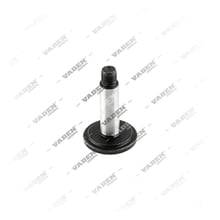
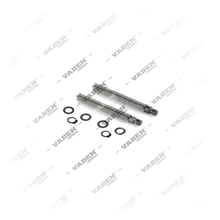
What are the functions of the Caliper Mechanism Pin?
- Providing a pivot connection: Forms the rotation axis between levers, gears or plates inside the mechanism.
- Force transmission: Transfers mechanical force from one element to another without loss.
- Motion limiting: Ensures the connected parts move only along the intended axis and distance, preventing lateral tilt or slippage.
- Position fixing: Helps mechanism components remain correctly aligned during assembly.
- Acting as a wear point: Concentrates system friction on itself, delaying premature wear of larger, more expensive parts (lever, gear).
What are the symptoms of a faulty Caliper Mechanism Pin?
- Metallic rattling or squeaking during braking: When the pin wears, play develops at the connection point, producing noise during movement.
- Uneven pad wear: Play in the pin disrupts smooth operation of the mechanism, causing one side of the pad to wear more than the other.
- Vibration in the brake pedal: A loose connection inside the mechanism can cause irregular vibration felt through the pedal.
- Caliper mechanism stiffening or binding: A corroded or deformed pin can prevent the connected part from moving freely.
- Visible wear marks: Scoring, notching or loss of surface shine can be observed on the pin surface when the caliper is opened.
How is the Caliper Mechanism Pin inspected?
For inspection, the caliper mechanism cover is removed, and the pin and its connected parts are visually examined. The pin surface is checked for notches, scoring or rust. The connected part is moved by hand to check axial and radial play; excessive play indicates the pin is worn. The pin diameter, if possible, is measured with calipers and compared to the original dimension. If there is surface corrosion, the mechanism is tested by hand for free movement. The retaining elements at both ends of the pin (circlip, clip) should also be checked for integrity.
What should be considered when replacing it?
During replacement, the pin's seat should be cleaned and old grease and dirt residue removed. Before fitting the new pin, the bore diameter and surface of the connected part should be checked for wear, and that part replaced too if necessary. The pin should be installed lubricated with the type and quantity of grease recommended by the manufacturer; the wrong grease type can dry out prematurely or attract dirt. Retaining elements (circlip/clip) must always be renewed, never reused. After installation, free movement of the mechanism should be tested by hand; for exact assembly steps, the vehicle's current OE service manual is the authoritative source.
How to choose the right Caliper Mechanism Pin?
Since caliper mechanisms use pins of different diameter and length depending on the model, the caliper type and OEM number must be verified together for correct selection.
Selection criteria for Caliper Mechanism Pin| Criterion | Why it matters |
|---|
| Caliper type / OEM number | Pin diameter and length are specific to the mechanism |
| Surface hardness | Insufficient hardness leads to rapid wear and play |
| Material coating | A corrosion-resistant coating extends service life under moisture exposure |
| Retaining element compatibility | An incompatible circlip/clip can allow the pin to dislodge |
| Tolerance precision | Incorrect tolerance causes the mechanism to bind or have excessive play |
Maintenance and service life
Because the caliper mechanism pin operates under continuously repeated motion and load, it is one of the most wear-prone small parts in the system. Its service life largely depends on lubrication condition and exposure to dirt and moisture. During periodic brake maintenance, the mechanism should be opened to clean the pin and its seat and refresh the grease. On vehicles operating in dusty or moist environments, inspection intervals should be shortened. Addressing early signs of pin wear protects other mechanism components (lever, gear) from damage.
VADEN Caliper Mechanism Pin
VADEN manufactures mechanism pins for heavy-duty commercial vehicle disc brake calipers to OE diameter, length and surface hardness specifications. Correct tolerance and coating quality support quiet, precise operation of the mechanism.
Frequently Asked Questions (FAQ)
Does a worn caliper mechanism pin reduce braking force?
It does not directly reduce braking force, but it disrupts mechanism precision, causing uneven pad wear and vibration; over the long term it negatively affects brake performance.
Should the connected part also be replaced when the pin is renewed?
Yes, if the connected part's bore surface shows noticeable wear, it should be replaced together with the pin. If only the pin is renewed while the bore is worn, play can recur in a short time.
Why does the grease type used on the pin matter?
The wrong grease can dry out prematurely under high temperature or attract dirt, accelerating wear; the manufacturer's recommended high-temperature grease should be used.
Does a squeaking noise from the caliper always come from the pin?
No, the pad, disc or dust boot can also cause squeaking; the caliper mechanism should be opened for a definitive diagnosis of all components.
Are pins interchangeable across different caliper models?
Generally no. Diameter, length and retaining element compatibility are specific to the mechanism; replacement should not be done without verifying the OEM number.