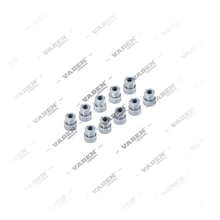
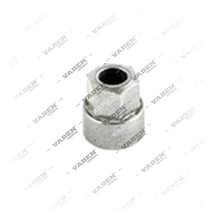
What is the Brake Caliper Mechanism Adapter?
This part is a connecting element that allows the caliper mechanism to mount to the housing or carrier bracket at the correct position and angle, while also enabling compatibility across different model variants. Without the adapter, the mechanism either does not seat on the housing at all or operates at the wrong angle, disrupting the pad-pressing pattern. In the Vaden catalog, this category offers adapter variants for different caliper model codes, matched to OEM references.
What are the functions of the Brake Caliper Mechanism Adapter?
- Correct alignment: ensures the mechanism is fixed at the correct angle and position on the housing or carrier.
- Model compatibility: compensates for differences in mechanism-to-housing connection across different caliper variants.
- Force transfer: ensures the pressing force from the mechanism is reliably transmitted to the housing.
- Vibration and loosening prevention: prevents cavity/play formation at the connection point, keeping the mechanism fixed.
- Ease of assembly: reduces the risk of installation error by allowing the mechanism to be fitted in the correct sequence from a single reference point.
What are the symptoms of Brake Caliper Mechanism Adapter failure?
When the adapter wears or deforms, the mechanism can move slightly on the housing, which is noticed as rattling or metallic noise during braking. When alignment is off, pad pressing force is distributed unevenly, causing one side of the pad to wear faster than the other and producing a slight vibration in the vehicle during braking. If a crack forms in the adapter, the mechanism cannot be fully secured, which can lead to delayed brake response or noticeable brake noise at a later stage. In a severely damaged adapter, the mechanism can shift completely out of position, critically reducing braking performance from a safety standpoint. In an advanced case, the mechanism separating entirely from the carrier is the most dangerous scenario, potentially causing sudden loss of braking when the pedal is pressed.
How is the Brake Caliper Mechanism Adapter inspected?
When the caliper is disassembled, the adapter is visually inspected for cracks, deformation, or excessively worn contact surfaces. The surfaces where the adapter contacts the mechanism and housing should be checked for scoring or irregularity, which indicates alignment problems. With the mechanism installed, it is tested by hand with slight force to check for play in the adapter connection. Bolt/pin holes should also be assessed for thread damage and ovalization. During inspection, the model code marking on the adapter should also be read; a faded or illegible marking increases the risk of installing the wrong part, so the OE reference list should be consulted to confirm.
What should be considered during replacement?
The adapter must be a full match for the caliper model code (e.g., SB6/SB7); installing an adapter made for a different model causes the mechanism to seat at the wrong angle. During installation, the contact surfaces between the adapter and housing/mechanism must be clean and undamaged, as dirt or rust prevents proper seating. Connection bolts must be tightened to the manufacturer-specified torque; under-torque risks loosening, over-torque risks cracking the adapter. After installation, the mechanism should be tested to confirm it moves freely and in the correct direction.
How to choose the right Brake Caliper Mechanism Adapter?
Selection should be based on the exact caliper model code, with the adapter's connection geometry and dimensions matching the original part exactly.
Brake Caliper Mechanism Adapter selection criteria| Criterion | Description |
|---|
| Caliper model code | Must match model codes such as SB6, SB7 exactly |
| Connection geometry | Must exactly match the mechanism and housing contact surfaces |
| OEM reference | The number specified in the vehicle's current OE service manual is authoritative |
| Material strength | Must be steel capable of withstanding high brake force and repeated loading |
| Bolt/pin hole dimensions | Must exactly match the original fasteners |
Maintenance and service life
The adapter has a long service life with correct installation and torque values; a visual check during periodic brake maintenance is sufficient. When the caliper mechanism is removed and reinstalled, the adapter's condition should also be assessed and renewed if wear or deformation is found. On vehicles operating in salted, humid environments, corrosion risk increases, so regular cleaning of the connection surfaces is important. During a full caliper overhaul, removing and cleaning the adapter as well allows hidden corrosion or cracks to be caught at an early stage.
VADEN Brake Caliper Mechanism Adapter
Vaden offers mechanism adapter variants for different caliper model codes at OE tolerances. For correct alignment and braking performance, the part should be selected according to the caliper model code.
Frequently Asked Questions (FAQ)
Can the mechanism be installed without the adapter?
Generally no; the adapter ensures the mechanism seats on the housing at the correct angle and position, so installation without it can result in misalignment or the mechanism not seating at all.
Can adapters for different caliper models be used interchangeably?
No, adapters are manufactured with different geometry depending on the caliper model code (e.g., SB6/SB7); using the wrong model's adapter causes the mechanism to operate at the wrong angle.
How can adapter wear be noticed?
Light rattling noise during braking, uneven pad wear, or scoring visible on the adapter contact surfaces when the caliper is disassembled are typical symptoms.
How tight should adapter bolts be?
They must be tightened exactly to the manufacturer-specified torque; under-torque can loosen the connection, while over-torque can crack the adapter.
If the adapter is damaged, is only that part replaced?
Generally yes, since the adapter is a part independent of the mechanism and housing and can be replaced on its own; however, if the mechanism or housing is also damaged, they should be assessed together.