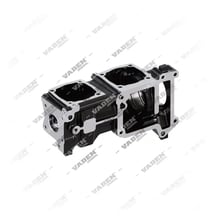
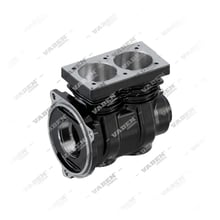
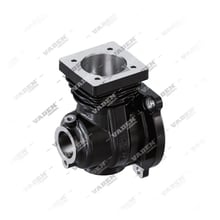
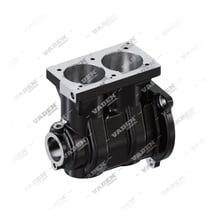
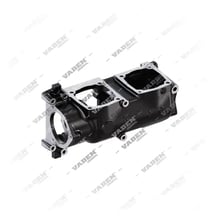
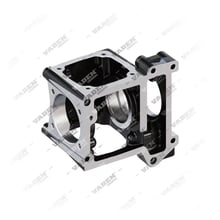
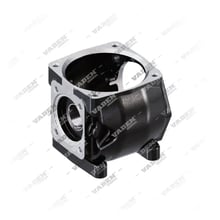
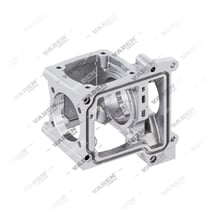
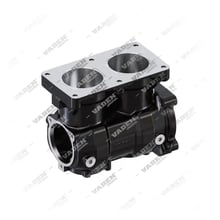
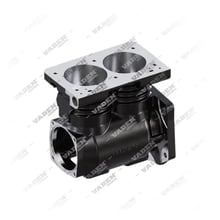
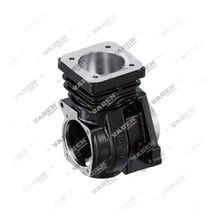
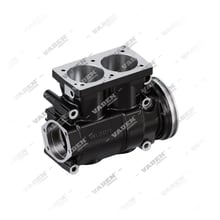
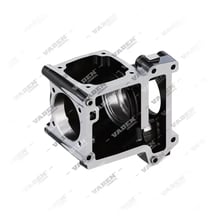
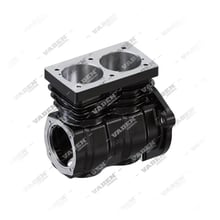
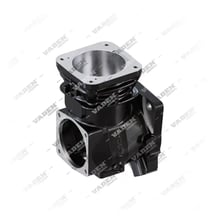
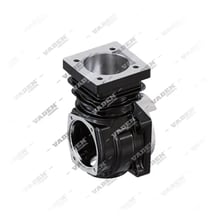
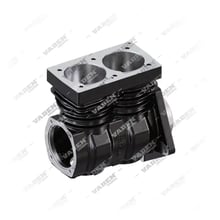
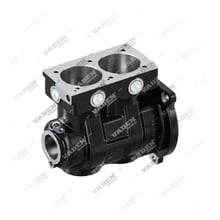
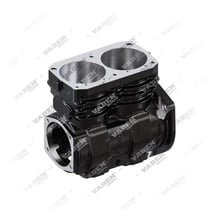
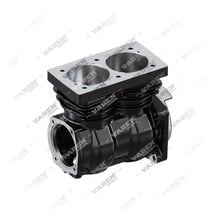
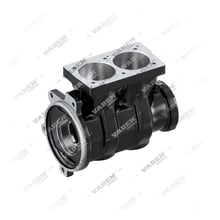
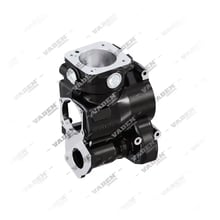
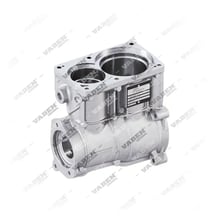
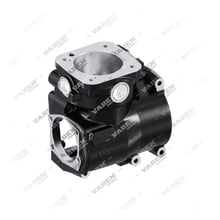
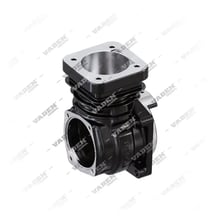
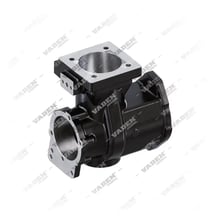
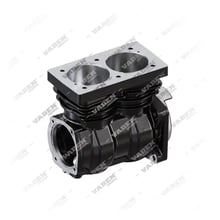
What is an air brake compressor housing?
Crankshaft bearing seats, cylinder bore, oil galleries, cooling channels, cylinder head seating surface, and the engine mounting flange are all machined on the same casting. Therefore even a small dimensional deviation in the housing directly affects piston-cylinder contact, bearing clearance, and sealing performance. Gray cast iron or aluminum alloy is used in production; aluminum offers a weight advantage, while cast iron provides durability under high duty cycle.
There are two main structures according to cooling type. Water-cooled housings have a water jacket and fitting seats connected to the engine cooling circuit; air-cooled housings have cooling fins on the outer surface. These two types cannot be used interchangeably, because both heat management and connection geometry are different.
What are the functions of the air brake compressor housing?
The compressor housing does not do a single job; it undertakes several interconnected tasks simultaneously. The failure of one usually causes the others to fail as well.
- Load bearing: Positions the crankshaft, connecting rod, piston, and cylinder head; withstands the axial and radial forces generated during compression.
- Axis alignment: Maintains the common axis of the bearing seats and the perpendicularity of the cylinder bore. If alignment is disrupted, the piston is loaded laterally and the ring and cylinder surface wear rapidly.
- Oil distribution: Directs pressurized oil coming from the engine to the bearings and, when needed, to the cylinder wall via internal galleries.
- Heat transfer: Dissipates the heat released during compression via the water jacket or cooling fins, keeping discharge temperature in a safe band.
- Sealing: Prevents air, oil, and water from mixing at the cylinder head, rear cover, and engine mounting surfaces together with the gasket.
- Vibration damping: Reduces cycling vibration with the mass of the casting, limiting resonance at the drive gear or pulley connection.
What are the symptoms of a compressor housing failure?
Housing-related problems progress slowly and initially appear as if another part is failing. If several of the following are seen together, the housing should also be added to the check list.
- Lengthened air fill time: If the cylinder bore has become oval or worn, flow drops and tank fill time noticeably lengthens.
- Excessive oil consumption: Cylinder wall scratches or a leaking oil gallery lead to oil being carried to the dryer and valves.
- Recurring leakage: Loss of flatness at the head and engine mounting surfaces continues to produce oil or water seepage even though the gasket has been renewed.
- Decreasing coolant: If there is a crack or corrosion perforation in the water jacket, water passes to the crankcase side, and emulsion is seen in the oil.
- Metallic knocking: An enlarged bearing seat increases crankshaft play; a knocking sound is heard at idle and under load.
- Overheating and crack marks: Blocked cooling channels raise temperature; fine cracks radiating from flange bolt holes are typical after over-tightening or impact.
How is the compressor housing checked?
The check is done after the compressor is removed, the housing is washed, and it has cooled to ambient temperature; measurements are not taken from a hot part.
- Visual inspection: Outer surfaces, flange hole surroundings, and head surfaces are examined for cracks, broken lugs, and porosity; a crack test with penetrant liquid is applied to suspicious areas.
- Cylinder bore measurement: Measurement is taken at the top, middle, and bottom levels with a bore dial gauge in two perpendicular axes; ovality and taper are evaluated.
- Bearing seat check: Seat diameter and axis misalignment are measured. If there is discoloration, crushing, or a rotated bushing mark, the housing must not be used.
- Flatness: Head and engine mounting surfaces are checked with a straightedge and feeler gauge, and light-leaking areas are marked.
- Channel cleanliness: Oil galleries are blown out with compressed air, the water jacket is cleared of sediment; passage is confirmed from both ends.
- Thread and sealing test: Bolt and fitting threads are checked with a thread gauge; on a water-jacketed housing, channels can be plugged and a low-pressure air leak test performed.
What should be watched for during replacement?
Housing replacement is not a simple installation but a rebuild of the compressor. If the steps below are skipped, the new housing will also be damaged quickly.
- Root cause first: Do not install without resolving excessive oil passage, blocked air filter, insufficient cooling, or dryer failure.
- Sealing elements renewed: Head gasket, seals, and O-rings must not be reused.
- Surface cleanliness: A hard scraper and grinding disrupt flatness; gasket residue is removed with a suitable remover.
- Staged torque: Head bolts are tightened from the center outward, in cross order, in stages, with a torque wrench. The value is per the vehicle's current OE service manual.
- Pre-installation lubrication: Bearing surfaces and the cylinder wall are lubricated with clean engine oil to form a film; a dry first cycle is not performed.
- Line check and first start: Carbon buildup in the discharge line is cleaned; after installation, oil pressure, sealing, and tank fill time are measured, and connections are rechecked after warming up.
How is the compressor housing selected?
Within compressor parts, the housing is one of the groups with the most variants. Because different compressor types may be used even within the same vehicle family, selection should be based on the OE number and type label on the compressor, not the brand name. Original equipment manufacturer numbers such as Bendix, Wabco, and Knorr-Bremse, as well as Mercedes-Benz, MAN, Volvo, DAF, Scania, and Iveco vehicle numbers, are used for cross reference.
The decisive headings in selection are: cylinder count and diameter, cooling type, drive form, hole pattern of the engine mounting flange, oil inlet location, and head connection geometry. If any of these headings does not match, the part will not work correctly even if it can be installed.
Compressor housing selection and inspection points| Inspection point | What is checked | Acceptance criterion |
|---|
| OE number | Compressor label and housing casting number | Must exactly match the cross-reference list |
| Cylinder bore | Ovality and taper | Must be below the manufacturer's limit |
| Bearing seat | Diameter and axis misalignment | No heat marks, crushing, or rotation marks |
| Head surface | Flatness | No light leak with feeler gauge |
| Cooling type | Water jacket or fins | Must be the same type as the removed part |
| Flange pattern | Hole count, hole circle diameter, centering diameter | Must fully overlap with the engine connection |
| Oil inlet | Position and gallery diameter | Free passage, no blocked channel |
| Tightening torque | Head and flange bolts | The vehicle's current OE service manual is authoritative |
Maintenance and service life
The compressor housing is not a periodically replaced wear part; its life depends on operating conditions. In a properly functioning system, the housing can serve through several compressor overhaul periods. The main factors that shorten its life are insufficient lubrication, dirty intake air, a clogged cooling circuit, high duty cycle, and carbon blockage in the discharge line.
In maintenance, timely replacement of the air intake filter, monitoring coolant level, checking the discharge line and dryer, and regular tank drainage directly protect the housing. If dimensions are within limit values during overhaul, the housing can be reused; if there is ovality, cracking, or bearing seat damage, replacement is preferred over repair.
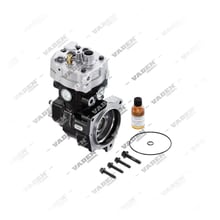
VADEN compressor housing
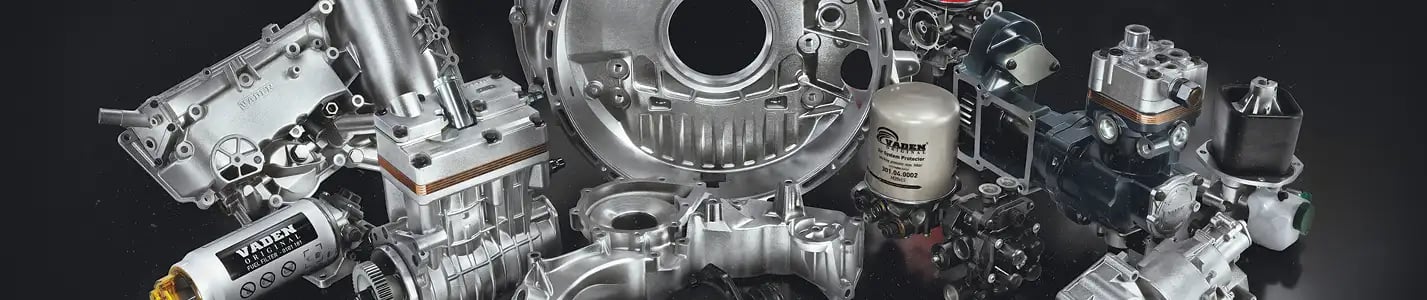
The VADEN product group offers housing options with different cylinder diameter, cooling type, and flange pattern for heavy commercial vehicle air brake compressors. Products are dimensioned to be used together with other compressor parts such as the cylinder head, valve plate, piston-ring set, and repair kits. To reach the correct part, it is recommended to search by the OE number on the compressor, and to confirm cooling type and flange pattern when more than one variant appears.
Frequently Asked Questions (FAQ)
Are the air brake compressor housing and the engine block the same thing?
No. The compressor housing is an independent casting block carrying the crankshaft, bearings, and cylinder volume of the air brake compressor. It is bolted to the engine via a flange and receives drive from the engine, but it is a separate part. Its dimensioning, material, and machining criteria differ from the engine block.
Can a cracked compressor housing be repaired by welding?
Weld repair is not recommended in areas carrying pressure and heat load. A housing with cracks in the bearing seat, around the cylinder bore, water jacket, or flange area should be replaced. After welding, internal casting stress and thermal deformation disrupt bearing axis alignment and surface flatness.
Can an air-cooled housing be installed instead of a water-cooled housing?
It cannot be installed. The two types have different cooling architecture, channel geometry, and often different connection surfaces. If an air-cooled housing is installed on a water-cooled application, discharge temperature rises, and carbon buildup and oil carryover increase. The same cooling type as the removed part must be selected.
How do I find the correct compressor housing?
Search by the OE number and type label on the compressor instead of the brand name. Bendix, Wabco, Knorr-Bremse OE numbers or Mercedes-Benz, MAN, Volvo, DAF, Scania, Iveco vehicle numbers can be used as cross reference. If more than one variant appears, confirm cylinder diameter, cooling type, and flange hole pattern.
What torques should be applied when replacing the compressor housing?
Torque values vary by compressor type, bolt diameter, and housing material; cast iron and aluminum housings do not use the same value. The general rule is to tighten head bolts from the center outward in cross order and in stages. The vehicle's current OE service manual is authoritative for exact values.