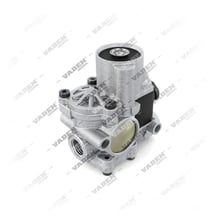
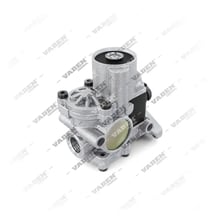
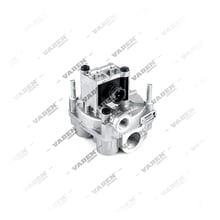
What Is an ABS Relay Valve?
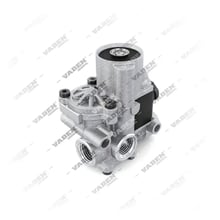
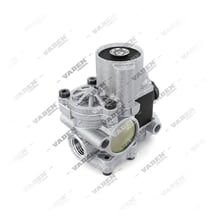
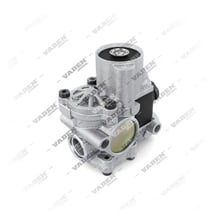
An ABS relay valve is the pneumatic actuation component of the ABS circuit in heavy commercial vehicle air brake systems, stopping the wheels from locking up under braking. This group covers the valve as a complete unit: body, solenoid assembly, diaphragm and cover set supplied together, ready to install. In the field it is also called an ABS solenoid valve or ABS modulator, sitting at the final control point on truck, tractor unit, bus and trailer axle brake circuits, governing pressure to the brake chambers.
How Does an ABS Relay Valve Work?
This valve combines a classic relay valve's rapid pressure-delivery function with electro-pneumatic control in one housing. When the brake pedal is pressed, the pilot-line control signal opens the valve and reservoir pressure feeds straight through to the brake chambers. When a wheel speed sensor reports an incipient lock-up, the control unit energizes the solenoids and modulates pressure several times per second, keeping braking force applied while the wheel keeps turning.
- Pressure build-up: Opens the supply port to the brake-chamber line on driver demand, raising braking force.
- Pressure hold: Closes the supply and exhaust paths as the lock-up threshold nears, holding pressure steady.
- Pressure release: Opens the exhaust port once the deceleration limit is exceeded, letting the wheel spin up.
- Relay function: A large-bore supply port gives fast response and dump times on long lines.
- Fail-safe operation: If power is lost, the valve keeps working like a mechanical relay valve, so braking stays available.
ABS Relay Valve Types and Subgroups
- Single-channel ABS relay valve: Controls a single wheel or one axle side independently; common on front axles.
- Dual-channel ABS relay valve: Modulates both sides of an axle separately via two solenoid assemblies in one housing; typical on rear axles.
- Trailer ABS relay valve: Designed for the trailer circuit, working with the parking and emergency brake functions.
- Integrated load-sensing type: Also regulates pressure distribution by load, working with a load sensor or EBS module.
- Connector and fitting variants: Bayonet, rectangular or DIN sockets; threaded, quick-connect and flange-mounted bodies.
Technical Specifications and How to Choose the Right ABS Relay Valve
The starting point for choosing a complete unit is the OE number stamped on the valve body, the most reliable route to an exact OEM match. If it cannot be read, weigh make, model, year, axle position and socket type together. The criteria below are general ranges; for exact figures, the manufacturer's current service manual is the authority.
Selection and compatibility criteria for a complete ABS relay valve unit| Criterion | General range / description | Why it matters |
|---|
| OE / OEM number | Original reference stamped on the body | The most precise match; prevents variant errors |
| Channel count | Single-channel or dual-channel | Determines control logic and socket pin layout |
| Operating pressure | Roughly 8-12 bar, pneumatic circuit | A mismatched unit causes response delay |
| Coil voltage | Usually 24V on heavy vehicles | Wrong voltage prevents modulation |
| Ports and mounting | Threaded, quick-connect or flange; hole spacing | Mismatch causes leaks and fitment problems |
| Application | Mercedes-Benz, MAN, Scania, Volvo, DAF, Iveco, Renault Trucks | Variants differ by equipment level in the same series |
Complete Unit Replacement or Repair Kit?
This category covers ready-to-fit complete units, not individual sealing parts, so knowing where to draw the line matters for cost. General rule: if the fault is purely a sealing issue and the body and solenoid assembly are otherwise sound, a repair kit is the economical choice. An electrical fault, body corrosion, damaged port threads or piston-bore wear call for a complete unit.
- Choose a complete unit when: The solenoid coil is open-circuit, the control unit throws a persistent valve fault, or the body is cracked or threads are stripped.
- A repair kit may be enough when: The only issue is an external leak, an aged O-ring or diaphragm hardening, with normal electrical readings.
- Assess by axle: The two valves on an axle tend to age at a similar rate, so check the other when replacing one.
- Factor in fleet economics: On high-mileage vehicles, a complete unit cuts repeat workshop visits and downtime.
ABS Relay Valve Maintenance and What to Watch For
The single biggest factor in this valve's service life is how clean and dry the incoming air is. If the dryer cartridge is not changed on schedule, moisture and oil vapor reach the valve, causing sticking, freezing and internal corrosion. Installation mistakes are the most common cause of repeat failures.
- Manage air quality: Change the dryer cartridge on schedule and drain reservoirs regularly; moisture in the valve is a direct cause of failure.
- Connect clean lines: Before fitting a new unit, clear hoses of dirt, swarf and oil residue.
- Follow the correct torque: Tighten fittings and bolts to the manufacturer's value; over-tightening damages the threads.
- Route the exhaust correctly: The silencer and exhaust port should face downward, shielded from water and snow.
- Test after replacement: Run a valve trigger test with a diagnostic tool, clear fault codes, and confirm with a brake test.
Common Faults and Solutions
- ABS warning light stays on: Usually an open solenoid coil or a poor connector contact; check resistance and replace the unit if the coil has failed.
- Braking delay or weak hold: The supply port is blocked or the internal bore has narrowed; check the line and replace the unit if the restriction is inside the body.
- Constant air leak from the valve: An aged diaphragm or degraded O-ring; if the sealing surface is damaged, a complete unit is needed.
- Slow brake release: The exhaust port is blocked or the silencer has frozen; clean the exhaust outlet and check the dryer and drain.
- Premature lock-up on one wheel: The channel is not modulating; run a channel test and re-verify the OE number.
Why VADEN ORIGINAL?
VADEN ORIGINAL ABS relay valves are manufactured to the original unit's connection dimensions, port layout and connector type, so they install without adapters or line modifications. The range covers numbers cross-referenced to OE numbers for Mercedes-Benz, MAN, Scania, Volvo, DAF, Iveco and Renault Trucks applications. Every unit is pressure- and leak-tested before shipping. VADEN manufactures air brake components and exports to more than 100 countries.
Conclusion
The ABS relay valve is the final point managing brake pressure per wheel, and its condition directly affects stopping distance and vehicle stability. Because the complete units here renew the body, solenoid and sealing group together, they cut the risk of repeat leaks and electrical faults. When choosing one, verify the OE number, channel count, connector type and port dimensions together; for exact torque and pressure values, the manufacturer's current service manual takes precedence.
Frequently Asked Questions (FAQ)
What does an ABS relay valve do?
An ABS relay valve raises, holds or releases the air pressure going to the brake chambers based on signals from the ABS control unit. This stops the wheel from locking up under hard braking, so the driver keeps steering control. Through its relay function it also feeds pressure to the chamber by the shortest route, shortening brake response time.
Should I replace the ABS relay valve as a complete unit, or is a repair kit enough?
If the fault is limited to an external leak, an aged O-ring or diaphragm hardening, and electrical readings test normal, a repair kit is the economical fix. Replace the complete unit if the solenoid coil has failed, the control unit keeps throwing a persistent valve fault, or the body shows corrosion, cracking or thread damage. On high-mileage vehicles, a complete unit usually works out cheaper overall.
How do I choose the right ABS relay valve?
The most reliable method is matching the OE number stamped on the current valve's body. If the number is unreadable, check make, model, production year, axle position, channel count, connector type and port dimensions together. Do not skip this step, since the same model series can use different variants depending on axle and equipment level.
What are the symptoms of an ABS relay valve fault?
The most common symptoms are a constant ABS warning light on the dash, delayed brake response, a steady air leak from the valve, slow brake release, and premature lock-up on one wheel. Faults that appear in cold weather and disappear once things warm up are usually caused by moisture freezing inside the valve. In these cases, also check the air dryer and reservoir drain.
Which vehicles use an ABS relay valve?
It is used on the front and rear axle brake circuits of trucks, tractor units, buses, trailers and semi-trailers fitted with air brakes. Options are cross-referenced by OE number for Mercedes-Benz, MAN, Scania, Volvo, DAF, Iveco and Renault Trucks applications. The correct variant is determined together with axle position and channel count.