ECAS Solenoid Valves: The Precision Control Point for Heavy-Duty Air Suspension
What is ECAS on trucks and trailers and how does it work? Components, the solenoid valve role, the difference from a mechanical leveling valve, fault diagnosis.
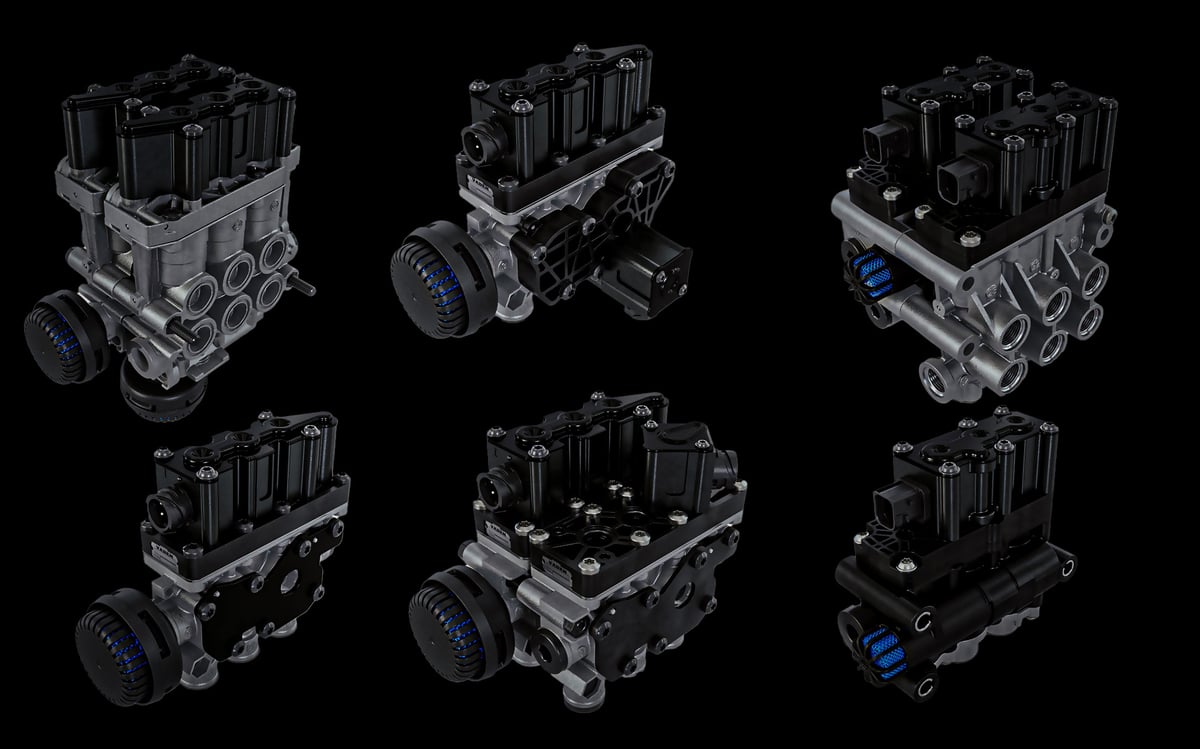
A tractor backing up to a loading dock drops its rear axle a few centimetres to bring the trailer floor level with the dock edge, then returns to ride height with a single command once loading is done. A city bus kneels on one side at a stop to close the gap between the step and the kerb. A loaded truck spinning its wheels on a wet ramp gets a burst of traction assist as part of the load shifts briefly onto the drive axle. All three scenes share the same hidden actor: an electronic chain that decides how much air enters which bellow, and from which side, at any given moment. At the far end of that chain sits the part that turns an electrical command into airflow — the solenoid valve. This guide treats that valve as the point where the electronic control of heavy-duty air suspension actually meets the road.
Why does air suspension need level control at all?
In a leaf-spring suspension, ride height changes with load: the more weight the spring carries, the more it sags. In an air suspension, the load-bearing element is not a spring but an air bellow whose stiffness and length change with the pressure inside it. Feed the bellow air and the vehicle rises; bleed it and the vehicle drops. That single fact gives air suspension its main advantage: ride height can be held constant regardless of load.
A constant ride height is not a styling preference — it is a safety and durability requirement. The bellow has to keep working inside its designed stroke: compress it too far and its inner walls chafe and tear; stretch it too far and the cord fabric and end fittings fatigue. When height drifts, the shock absorber's travel window shifts, anti-roll bar arms change angle, kingpin-to-fifth-wheel height on a trailer falls out of range, and on a bus the step-to-kerb height becomes a direct passenger-safety issue. That is why every air-sprung vehicle needs some device that continuously corrects the amount of air in the bellow to match the current load.
For many years that job belonged entirely to a mechanical part, the leveling valve. A lever tracks the mechanical distance between axle and chassis; when the gap shortens the valve feeds the bellow, when it lengthens the valve vents it. It is simple and durable, and its limitation comes from that same simplicity: the valve only ever knows the current distance. It cannot know the vehicle's speed, its load, what the driver wants, or what another axle is doing. Electronically controlled suspension exists precisely to close that information gap.
What is ECAS? What the name actually describes
ECAS stands for Electronically Controlled Air Suspension. The name describes a control approach, not a single part: the leveling decision is made not by a mechanical lever but by an electronic control unit that reads sensor data and issues commands to valves. The abbreviation is used so widely on the shop floor that many technicians say "ECAS valve" when they actually mean the solenoid valve block of an electronic level-control system.
The term traces back to the naming used by the air-brake equipment maker that first popularized the system. Systems performing the same job carry different names at other suppliers, and vehicle manufacturers often use their own abbreviations too. Cut through the naming and the field picture simplifies: whatever it is called, any system that takes a reading from a height sensor, produces a decision in a control unit, and delivers air to a bellow through a solenoid valve works on the same logic — and the diagnostic method is largely the same across brands.
What ECAS is not matters as much as what it is. ECAS is not a spring; it does not carry the load — the bellow does. It is not a shock absorber; it does not damp oscillation. It is not part of the brake system either, though it shares the same air source, the same dryer, and the same supply discipline. All ECAS does is decide which bellow gets air, when, and how much — or when that air should be released — and then carry that decision out.
How does ECAS work? The measure-compare-correct loop
ECAS is a closed-loop control system that repeats three steps continuously. The first step is measurement: a height sensor linked between axle and chassis converts the angle of its arm into an electrical signal and sends it to the control unit. The second step is comparison: the unit checks the measured value against the target level it holds in memory for that operating condition. The third step is correction: if the difference falls outside the tolerance window, the unit energizes the relevant solenoid valve, which either fills the bellow with air or exhausts it. Once the level returns to target, current is cut, the valve closes, and the system goes back to waiting.
The most critical detail in this loop is not the third step but the tolerance window built into the second. If the unit tried to correct every millimetre of deviation, the vehicle would be constantly filling and exhausting — running the compressor needlessly and creating a continuous bounce on the road. To avoid that, a dead band is defined around the target level, and no correction happens while the deviation stays inside it. The unit also does not act on an instantaneous sensor reading; it averages the signal over a short time window, so a momentary bump does not trigger a correction, while a sustained shift from taking on load does.
The control unit's real advantage over a mechanical valve is that it is not limited to the height sensor alone when deciding. Vehicle speed, door status, handbrake position, axle load and a command entered by the driver from a remote all feed into the decision. Typical behaviour: with the vehicle stationary, the driver can freely change the level; above a set speed the system automatically returns to ride height and ignores manual commands. A mechanical valve cannot make that distinction because it has no access to speed data at all. Nor does the system fully sleep at rest — on some setups the unit wakes at intervals with the ignition off and checks the level.
What's the difference between a mechanical leveling valve and ECAS?
Comparing the two systems explains most clearly why ECAS exists. A mechanical valve is a self-contained device that works correctly on its own; ECAS is a distributed system that only works if every one of its parts is correct at the same time. That makes ECAS more capable and, at the same time, more fragile. The mechanical valve's own failure behaviour, arm free play and replacement procedure are a separate subject, covered in detail in the levelling valve guide.
| Criterion | Mechanical leveling valve | ECAS (electronically controlled) |
|---|---|---|
| How it senses level | Direct mechanical linkage through arm and rod | Height sensor converts the angle into an electrical signal |
| Response speed | Slow; delay is fixed by the valve's design | Fast; delay can be tuned in software |
| Sensitivity and dead band | Set by mechanical free play, cannot be changed | Defined in software, tuned per application |
| Uses speed and load data | No, it only knows the current distance | Yes; speed, axle load, door and brake status all feed the decision |
| Extra functions | None; it only holds level | Raise, lower, memory, traction assist, lift axle control |
| Fault detection | Visual and manual only; no code, no log | Fault codes, live data and event history can be read |
| Post-installation adjustment | Arm length and position set mechanically | Sensor calibration done with a diagnostic tool, and mandatory |
| Cost and repair | Low; limited parts and labour | Higher; requires a diagnostic tool and calibration |
The practical conclusion from the table is this: when a mechanical valve fails, the symptom is almost always mechanical and can be found by hand; when ECAS fails, the symptom looks mechanical but the cause is very often electrical. On a vehicle sitting low on one side, the first place to check on a mechanical system is that side's valve arm; on ECAS, the first place to check is that side's height sensor signal and the solenoid's supply circuit. Starting diagnosis without making that distinction usually ends with a perfectly good valve being pulled for nothing.
What components make up an ECAS system?
ECAS is not one part but the sum of five interdependent groups: the electronic unit that decides, the sensors that measure, the solenoid valve block that executes, the remote interface that carries the command, and the air supply that feeds the whole system. A fault in any one of them shows up in the most visible place of all — the way the vehicle sits.
| Component | Function | Typical symptom when faulty |
|---|---|---|
| Electronic control unit | Compares sensor data with the target and generates commands | System gives no response at all, warning lamp lit |
| Height sensor | Converts the axle-to-chassis distance into an electrical signal | Vehicle sits at the wrong level, level drifts |
| Sensor arm and rod | Carries axle movement mechanically to the sensor shaft | Free play or a break causes unstable, incorrect readings |
| Solenoid valve block | Turns the electrical command into airflow | One side stays down, continuous air leak |
| Remote control or cab panel | Passes the driver's commands to the unit | Commands don't register, buttons work only partly |
| Air bellow | Carries the load, changes length with pressure | Leak, cracking, chafing marks, that side sagging |
| Air dryer | Removes moisture and oil from the compressed air | Valve sticking once moisture gets through, freezing in winter |
| Wiring harness and connectors | Carries signal and supply current | Intermittent fault, erratic operation, a code that keeps returning |
| Lift axle valve | Raises the axle when empty, lowers it under load | Axle won't lift or won't lower, faster tyre wear |
How this table is read matters for diagnosis. If the symptom is confined to one side, the search narrows to that side's sensor, wiring and solenoid; if the symptom is common to the whole vehicle, the search shifts to the supply side, the control unit and the data bus. For a broader fault map covering the bellow, the leveling valve and ECAS together, the heavy-duty air suspension failures guide is a useful companion.
What does the solenoid valve actually do in the circuit?
A solenoid valve is a coil that turns electrical energy into mechanical motion, paired with an air passage that motion opens or closes. When the coil is energized, the resulting magnetic field moves an internal pin; the pin leaves its seat against spring force and the air passage opens. When current is cut, the spring reseats the pin and the passage closes. The construction is that simple, and ECAS's intelligence sits not in the valve but in the control unit commanding it. The valve only opens and closes; how long it stays open is entirely the unit's decision.
The valve's job in the system falls into three categories. In the fill path, pressurized air from the reservoir is opened to the bellow and the vehicle rises. In the exhaust path, air in the bellow is vented to atmosphere through a muffler and the vehicle drops. In the hold position both paths are closed, the air in the bellow is trapped, and the level is maintained. In a healthy system, the valve spends most of its time holding; a system that keeps filling or keeps exhausting points to something worth investigating on the sensor or leak side before the valve itself is blamed.
It is worth remembering that a valve has two sides that need checking independently. The electrical side covers coil resistance, whether supply voltage actually reaches the valve socket, and the integrity of the chassis ground return. The pneumatic side covers the seal at the seat, free movement of the pin, and cleanliness of the internal passages. A valve can be electrically sound and still not do its job, or it can be mechanically perfect while no current at all reaches its socket. Any approach that doesn't verify these two sides separately risks replacing the right part for the wrong reason. Pulling a single valve, checking its seal, replacing it and verifying the result after fitting is a step-by-step job, covered in detail in the ECAS solenoid valve fault, replacement and maintenance guide.
Why does a vehicle need more than one solenoid valve?
One of the most common questions in the field is why a single valve isn't enough. The answer lies in how many functions ECAS is expected to deliver: a single solenoid valve can only open and close one air path, and the system needs at least four paths managed independently. First, fill and exhaust are separate paths; the path from reservoir to bellow and the path from bellow to atmosphere cannot both be open at once. Second, left and right sides must be controlled independently; correcting a body that is sitting crooked because load isn't evenly spread is only possible by feeding air to one side alone. Third, each axle has to be managed separately — a drive axle and a carrying axle handle different loads, and functions like traction assist concern only one specific axle. Fourth, a lift axle and other extra functions each need their own path.
In practice these needs are met by a valve block that groups multiple solenoids in a single housing. Inside the block there is a common supply gallery, a common exhaust gallery, and a separate coil valve for each function — which cuts down on hose runs and puts all the connections in one place. Because the control unit can drive each coil independently, sequencing two valves in the right order also produces compound behaviours: filling one side while exhausting the other at the same time corrects a lateral tilt quickly.
The block architecture also has a diagnostic consequence. A single coil failure usually disables only one function; by contrast, a blockage in the common supply gallery or an internal leak inside the block can knock out several seemingly unrelated functions at once. A complaint of "the right rear won't come down" points to a single coil; a picture of "nothing works and there's no code" points to the supply side.
Further reading
For a plain-language technical overview of this subject, see the reference article on Wikipedia. Always confirm specific figures and procedures against the vehicle manufacturer service data.
What can ECAS do? Raise, lower, kneel, and dock-ramp levelling
Where ECAS really departs from a mechanical valve is in the functions that go beyond simply holding level — all of them delivered on the same hardware, added purely through software and a control interface, which is also the economic case for going electronic in the first place. Raise and lower move the chassis above or below ride height, used for ramps, working under a crane, or clearing low obstacles. Level memory stores a frequently used height and recalls it with a single command. Automatic return to ride height brings the vehicle back to its target once a set speed is exceeded. Traction assist shifts part of the load onto the drive axle briefly to improve grip on wet or sloped ground. Lift axle management raises the axle when empty and lowers it under load. Trailer dock-ramp levelling brings the deck edge to dock height, and a bus's kneel function brings the door side closer to the kerb.
Most of these functions are limited by safety interlocks, and those limits are the source of behaviour that can be mistaken for a fault. Raise and lower are usually only accepted while the vehicle is stationary or moving very slowly; traction assist cancels itself automatically after a set time or speed, and regulations constrain how the function may be used; a bus's kneel function is interlocked with the door circuit. A driver reporting "the remote doesn't work" is very often describing an active safety interlock rather than a fault; checking the vehicle's current speed, door and brake status before starting diagnosis avoids an unnecessary teardown.
Remote control, level memory, and the driver's authority
The face of ECAS the driver actually sees is a wired or wireless handset, or a keypad in the cab. The remote itself drives no valve at all — it only passes the driver's request to the control unit. That distinction is often skipped during diagnosis: if a command is given and nothing happens on the vehicle, the fault could sit in the remote, its cable, the control unit, the valve, or the air side. The correct sequence starts by confirming from live data whether the command even reached the unit.
Driver authority isn't absolute either. The control unit rejects commands under certain conditions, usually flagging the refusal with an audible or visual warning. Common reasons include insufficient system pressure, a speed threshold being exceeded, an open door, or a detected system fault. Rejecting a level-change request when pressure is low matters in particular: the circuit shares its source with the brake system, and the suspension is not allowed to drain the reservoir. This order of priority is a deliberate part of the design and should not be read as a fault.
ECAS fault symptoms and what they point to
ECAS faults tend to look mechanical while their root cause is very often electrical or pneumatic. The key to reading a symptom correctly is asking two questions in order: is it confined to one side, or does it affect the whole vehicle? And is it constant, or does it only appear under certain conditions? Those two answers narrow the search area considerably.
| Symptom | Likely cause | First check |
|---|---|---|
| Vehicle sits low on one side | Bellow leaking, valve stuck, or sensor reading incorrectly | Compare both sides' sensor values in live data |
| Vehicle constantly sits too high or too low | Sensor arm has free play or calibration has drifted | Compare measured height with the target value |
| Level keeps rising and falling | Sensor signal unstable, loose wiring or connector | Watch the sensor signal while moving it by hand |
| No function works, and there's no code | Supply or ground connection broken, blown fuse | Measure the unit's supply voltage and fuses |
| Compressor runs continuously | System has a leak, or a valve isn't fully closing | Measure pressure drop rate, soap-test the lines |
| Continuous air noise from the valve block | Internal leak, dirt or wear on a seat | Listen at the exhaust port and block joints separately |
| Raise works, lower doesn't | Solenoid or muffler in the exhaust path is blocked | Energize that coil and watch for output movement |
There is one overlap in the table worth flagging: the same symptom can come from the sensor, the valve, or the bellow. A vehicle sagging on one side may be caused by a leaking bellow, but it could just as easily be a sensor reading that side incorrectly. The fastest way to tell them apart is live data: if the sensor reads higher than the actual height, the unit is working correctly but on bad information; if the sensor reads correctly and the unit still isn't correcting, the search shifts to the valve and supply side.
Reading fault codes and the diagnostic sequence
ECAS's biggest service advantage over a mechanical system is its ability to report its own fault. The control unit logs a detected defect as a fault code, and in most implementations it also stores the speed, pressure and sensor values at the moment it occurred. But a code is a starting point, not a diagnosis: a record reading "left front height sensor signal invalid" does not say the sensor is broken — it says the signal reaching the unit fell outside the expected window. A break in the wiring, a corroded socket, or a snapped sensor arm can all produce exactly that signal.
- Get a clear description of the complaint from the driver: is the fault always present, at what speed, loaded or empty, and which function triggers it. On intermittent faults this information is worth more than the code itself.
- Park the vehicle on flat, solid ground, apply the handbrake, chock the wheels, and confirm system pressure is within the range the manufacturer specifies; no measurement taken at low pressure can be trusted.
- Carry out a visual scan: look for cracking and chafing on the bellows, crushed hoses, free play or breaks at the sensor arms, and corrosion or moisture at the connectors. Do this before reading codes, because any mechanical fault found changes how the codes should be interpreted.
- Read the fault records with a diagnostic tool and log them before clearing anything; if freeze-frame data is available, note the conditions under which the fault occurred.
- Read all height sensors side by side in live data. What matters is not the absolute figure but consistency between left and right, and between axles.
- Move the vehicle by hand or with the remote while watching the sensor values change smoothly and without jumps; a signal that jumps or freezes at one point points directly to a wiring or sensor fault.
- Energize each solenoid individually using the scan tool's actuator test and observe whether the expected air movement actually occurs at each one. If the coil is energized but no air moves, the search shifts to the pneumatic side.
- Verify the electrical side: measure supply voltage, coil resistance and chassis ground return at the valve socket. Take these readings as close to the valve as possible, not from a socket on the unit's side.
- Check for leaks: bring the system to target level, let it sit, and watch the rate of pressure drop. Test suspect areas with a soap solution; air coming continuously from a valve's exhaust port points to an internal leak.
- Once the fault is fixed, clear the codes, run the system through a full level cycle, and repeat calibration if required.
- Finish with a road test: confirm that automatic return to ride height works and that the warning lamp goes out.
The logic behind this sequence is that cheap, reversible steps come before expensive, irreversible ones. Cleaning a connector and checking a sensor arm takes minutes; replacing a valve block costs parts, labour, and usually a recalibration afterwards. Whatever the code says, the integrity of the supply and the mechanical connection should be proven first.
What is height sensor calibration, and when is it needed?
A height sensor converts the angle it measures into an electrical value, but it has no way of knowing on its own which physical height that value corresponds to. The control unit makes that match, and it has to be taught it once. Calibration is the process of teaching the control unit the correspondence between the vehicle's actual height and the signal the sensor produces. Without it, the system will run — but it will protect the wrong target while believing it's correct.
The need for calibration isn't limited to a single situation. It has to be repeated whenever the height sensor itself is replaced, when the sensor arm or rod is removed or its length changes, when the control unit is replaced, after any repair that affects suspension geometry, and in some setups after a valve block replacement. Body or superstructure work carried out on the chassis creates the same requirement. The rule is simple: any intervention that affects the measured distance calls for a fresh calibration.
The general procedure is similar across manufacturers. The vehicle is positioned on level ground, at the specified load condition and correct tyre pressure; the actual distance between chassis and axle is physically measured; a diagnostic tool matches that measurement to the sensor signal; and ride height, along with upper and lower limit points where applicable, is taught in sequence. Teaching the limit points isn't only about comfort — those limits are what stop the system forcing the bellow beyond its designed stroke or letting the tyre rub the fender. A skipped calibration is very often mistaken for a fault: the vehicle sits higher or lower than normal, and a visible difference between left and right persists.
Winter conditions, moisture, and the effect of air quality
The air ECAS uses is the same air the brake system uses, and its quality directly determines valve life. Hot air leaving the compressor carries moisture and a small amount of oil vapour; as it cools, that mixture condenses and collects at the system's tightest points. A solenoid valve's seat surfaces and pin bore are exactly such points. That is why the health of the air dryer is directly tied to ECAS reliability — the first casualties of a dryer cartridge past its service life are usually not the brake valves but the suspension valves.
Winter makes the picture worse for two reasons. First, trapped moisture freezes and holds the pin in place; the valve cannot move mechanically even when it is electrically energized. The symptom is typical: nothing works in the cold of the morning, and everything returns to normal once the vehicle warms up. That does not mean the fault has gone away — only that the ice has melted. Second, cold reduces the flexibility of seal and bellow material; a small leak that would otherwise go unnoticed grows noticeably worse in the cold, and the vehicle can sag overnight as a result.
The countermeasures aren't expensive. Reservoir drain valves should be purged regularly, with a note made of whether water comes out — water is the clearest sign the dryer isn't doing its job. The dryer cartridge should be renewed on the interval the manufacturer specifies, and sooner under harsh conditions. Muffler and exhaust ports should be checked for blockage; a blocked muffler slows exhaust flow and makes the system look unresponsive.
Technical values and general reference ranges
The table below gathers the figures most often needed in the field as order-of-magnitude reference. These values are not meant for making a decision; they are meant for judging whether a measured result is plausible. Exact figures are always vehicle-specific.
| Value | General reference or criterion | How to read it |
|---|---|---|
| System working pressure | Roughly in the 8-12.5 bar range on a heavy commercial vehicle | Exact engagement values are vehicle-specific |
| Electrical supply | Typically a 24 V circuit on heavy commercial vehicles | Take the measurement as close to the valve as possible |
| Height sensor signal | Not an absolute figure — consistency between left and right | The difference between the two sides is what's interpreted |
| Ride height | Defined per vehicle and body, taught with a diagnostic tool | Not considered valid without calibration |
| Tolerance window (dead band) | Defined in software, not user-adjustable | The acceptance range that prevents constant correction |
| Solenoid coil resistance | Should fall within the window given in the OE manual | An open or shorted reading points to a coil fault |
| Calibration requirement | After work on the sensor, the unit or the geometry | Skipping it lets the system protect the wrong target |
The table's real rule is this: no ECAS numeric value can be used independently of the chassis and body information. The same manufacturer's identical tractor unit may be programmed with completely different level definitions because of a different trailer type or axle layout; "normal" figures taken from another vehicle should never be treated as a reference.
Maintenance, service life, and a checklist for fleets
A solenoid valve has no fixed replacement interval; its life is determined by the cleanliness of the air passing through it and the electrical health of its circuit. A valve running on dry air with well-protected connectors will complete a high mileage without trouble; a valve running on humid air will show stickiness within a few winters. ECAS maintenance is therefore maintenance of the chain feeding the valve, not of the valve itself.
- Air quality discipline: Purge reservoir drains periodically, renew the dryer cartridge on the interval the manufacturer specifies, and log any water that comes out during draining.
- Sensor mechanics: Check height sensor arms, rods and joints for free play, bending and breakage at every scheduled service.
- Connector care: Check sockets for moisture, corrosion and looseness, and inspect the harness for chafing and pulling points.
- Bellow inspection: Scan for cracking, chafing marks, trapped debris and leaks at the fittings; a leaking bellow also puts extra strain on the valve.
- Leak scan: Bring the vehicle to target level and leave it standing; note any level lost overnight.
- Function testing: Actually exercise raise, lower, return-to-ride-height and, where fitted, lift axle functions periodically; a function that's never used won't reveal a fault when it breaks.
- Reading the fault log: Check fault records periodically even when the warning lamp is off; a buildup of intermittent records is an early warning of a fault to come.
- Calibration tracking: Record in the vehicle's file whether calibration was carried out after every repair that affects suspension geometry.
In the end, ECAS is the control layer that gives air suspension the ability to make a decision; the solenoid valve is the point where that decision meets the physical world. However correctly the control unit decides, the outcome only happens as far as the valve opens; however precise the sensor is, the measurement is only as accurate as the arm carrying it is sound. That is why an "ECAS fault" diagnosis is a starting point, not an endpoint. The correct order is clear: first prove the air is at pressure and dry, then confirm the electrical supply is sound, then confirm the sensor is reading correctly — the solenoid valve is questioned last. In every case, the current OE service documentation for the vehicle's chassis and body code is authoritative.
Shop this part: ECAS Solenoid Valve
In-depth technical guide: For fault diagnosis, step-by-step replacement and service intervals: ECAS Solenoid Valve: Faults, Replacement & Maintenance Guide
Main guide: Heavy-Duty Air Suspension Failures: Air Springs, Leveling Valves and ECAS
Tags
Frequently Asked Questions
- What is ECAS and what does it do?
- ECAS stands for Electronically Controlled Air Suspension. Instead of a mechanical lever, it lets an electronic control unit make the leveling decision using data from a height sensor. This keeps the vehicle at its target ride height regardless of load, and enables extra functions such as raise, lower and traction assist.
- What's the difference between ECAS and a mechanical leveling valve?
- A mechanical valve only knows the current distance between axle and chassis; it has no idea about the vehicle's speed, its load or what the driver wants. ECAS also factors in speed, door status, brake status and axle load, reports its own faults as a code, and offers functions like level memory. In exchange it is more complex: the sensor, wiring, connectors, unit and valve all have to be correct at once.
- What components make up an ECAS system?
- The system consists of five groups: the electronic control unit that decides, the height sensors and arms that measure distance, the solenoid valve block that carries out the decision, the remote control or cab panel the driver uses, and the air supply that feeds the whole system. Air bellows, the dryer, the wiring harness and, where fitted, a lift axle valve complete the picture.
- What does the ECAS solenoid valve do?
- The solenoid valve turns an electrical command from the control unit into airflow. When the coil is energized, an air path opens and the bellow is either filled or exhausted; when current is cut, a spring closes the valve and the level is held. The valve itself makes no decision — the control unit decides how long it stays open.
- Why does a vehicle have more than one ECAS solenoid valve?
- A single solenoid valve can only open and close one air path, but the system needs to manage fill and exhaust separately, control left and right sides independently, and handle each axle on its own. That's why several solenoids are grouped into one valve block, sharing a common supply and exhaust gallery with a separate coil valve for each function.
- What are the symptoms of an ECAS fault?
- The most common ones are the vehicle sitting low on one side, sitting constantly too high or too low, the level bouncing up and down, remote commands not registering, and continuous air noise from the valve block. A compressor that runs more than normal also points to a leak or a valve that isn't closing fully. The symptoms look mechanical, but the cause is often electrical or pneumatic.
- If a vehicle sags on one side, is the valve definitely at fault?
- No. The same symptom can be caused by a leaking bellow, a sticking solenoid, or a height sensor reading that side incorrectly. The fastest way to tell them apart is comparing the left and right sensor values in live data; if the sensor is reading wrong, the control unit is working correctly but on bad information.
- What is height sensor calibration and when is it needed?
- Calibration teaches the control unit the correspondence between the vehicle's actual height and the signal the sensor produces. It has to be repeated whenever the sensor, the sensor arm or the control unit is replaced, after a repair affecting suspension geometry, and after body or superstructure work. Skip it and the system protects the wrong target while believing it's correct — the vehicle sits too high or too low.
- Why doesn't ECAS respond on cold mornings?
- The most common cause is moisture in the system freezing and holding the valve's pin in place, so it can't move even when it's electrically energized. Once the vehicle warms up and the ice melts, everything returns to normal — but that doesn't mean the fault is gone. The lasting fix is regular reservoir draining and proper air dryer maintenance.
- Does ECAS need regular maintenance?
- The solenoid valve has no fixed replacement interval; its life depends on the cleanliness of the air passing through it. Maintenance therefore targets the chain that feeds the valve: reservoir drains are purged, the dryer cartridge is renewed on schedule, sensor arms and connectors are checked, and bellows are inspected for leaks. Exact intervals come from the vehicle's OE service manual.
Related Articles
Air Brake Compressor Duty Cycle & Efficiency Guide
Heavy-duty compressor efficiency and duty cycle: how much time it runs loaded, how to measure build-up time, what drives high duty cycle, and fleet logging.
Air Brake Caliper: Air Disc Brake Systems Explained
Fixed and floating air disc brake calipers on trucks and trailers: how each turns air pressure into clamping force, core parts and why fade resistance matters.
Air Dryer: Faults, Replacement & Maintenance Guide
How a truck air dryer's charge and purge cycle keeps moisture and oil out of the brake system, and what a hissing purge valve or water in the tanks means.