What Is a Flywheel? Function, Types and Flywheel Housing Difference
Learn what a truck flywheel does, how the ring gear works, single vs dual-mass flywheel differences, its link to the clutch and how it differs from the housing.
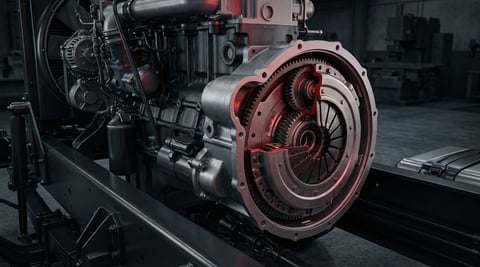
Pull the transmission for a clutch job and the first thing behind the engine is a heavy cast disc bolted to the crankshaft: the flywheel. Nobody schedules it until a complaint arrives: grinding on start-up, launch judder, or a new clutch that slips too soon. This article explains what a truck flywheel does, its types and how it differs from the flywheel housing.
What Is a Flywheel?
A flywheel is a heavy cast disc bolted to the rear end of the crankshaft that stores the engine's rotational energy through inertia. The flywheel smooths out speed fluctuations between combustion strokes, carries the ring gear driven by the starter motor and provides the friction face for the clutch disc, passing engine torque through the clutch to the transmission.
The flywheel sits at the back of the engine block inside the flywheel housing, which many technicians, especially in North America, call the bell housing. Its front face seats on the crankshaft flange, located by a dowel pin or the bolt pattern; its rear face is a machined friction surface for the clutch disc. The starter ring gear runs around the outer edge, and at the centre either the flywheel or the crankshaft tail carries the pilot bearing that supports the transmission input shaft.
Workshop names overlap. "Flywheel ring gear", "starter ring" and "flywheel teeth" mean the toothed ring on the outside, not the flywheel itself, while "bell housing" means the stationary casting around it. The flywheel's neighbour inside the engine is the crankshaft, covered in What Is a Crankshaft? Function, Failure Symptoms and Maintenance.
What does a flywheel do in a truck engine?
The flywheel does four separate jobs, each tying it to another part of the engine or driveline.
- Smoothing rotation: each diesel cylinder makes power only on its power stroke and absorbs energy on the others. The flywheel's inertia stores and returns this pulsing torque, keeping the idle steady and preventing stalls at low rpm.
- Giving the starter something to turn: the starter pinion meshes with the ring gear and cranks the engine until it fires.
- Acting as the clutch friction face: the pressure plate clamps the clutch disc against the flywheel, and torque passes to the transmission through that contact.
- Carrying and referencing other parts: the clutch cover bolts to the flywheel and the input shaft nose runs in the pilot bearing. On many current engines, holes or teeth on the flywheel are also the reference from which the engine control unit reads crankshaft speed and position.
Flywheel mass is a compromise: heavy smooths idle and launch but slows rev changes; light is more responsive but vibrates more at low speed. The engine maker selects the flywheel for a given engine family and duty cycle, so it should never be swapped on the idea that "lighter is better".
How does a flywheel work? How does inertia keep the engine turning smoothly?
A flywheel works on inertia: a rotating mass resists changes in its speed. The resistance depends on the mass and on how far from the centre it sits, so mass at the rim gives more inertia for the same weight. Hence the thick rim.
Within the engine cycle the flywheel spreads energy over time. On the power stroke, cylinder pressure drives the crankshaft forward and the flywheel stores part of that energy as a small rise in speed. On the compression stroke, when the crankshaft wants to slow, the flywheel gives the energy back. On an inline six the effect is felt most at idle and at low rpm under full load.
At launch, when a loaded truck's clutch engages and engine speed wants to drop, stored flywheel energy carries the first moment and prevents a stall. Because the flywheel is the first stop for torsional vibration entering the driveline, it is always considered together with the clutch disc damper springs or a dual-mass flywheel.
What is a flywheel ring gear and how does it relate to the flywheel?
The flywheel ring gear is the toothed ring around the outer edge of the flywheel that meshes with the starter motor pinion. The pinion moves in, cranks the engine to firing speed and retracts once it runs.
On many applications the flywheel ring gear is a separate part shrink-fitted onto the flywheel: the ring is heated, placed on the flywheel and held by an interference fit once it cools. A ring with worn teeth can then be replaced without replacing the flywheel. In other designs the ring is integral, and tooth damage affects the whole flywheel. The service manual and part number decide which applies.
Ring gear teeth usually wear in zones, because the crankshaft tends to stop at the same positions and the pinion strikes the same teeth on every start. Grinding during cranking, metallic scraping or a starter that spins without turning the engine are the typical signs. Starter motor faults themselves are covered in What Is a Starter Motor? Failure Symptoms and Brush Replacement. With repeated ring gear damage, also check the starter mounting bore in the housing.
What is the difference between a single-mass and a dual-mass flywheel?
A single-mass flywheel is a one-piece cast disc and the most common type on truck, tractor and bus engines. Damping engine torsional vibration is mostly left to the springs in the clutch disc hub. It is robust, easy to inspect, and its friction face can be resurfaced within the service manual limits.
A dual-mass flywheel (DMF) links a primary mass on the engine side and a secondary mass on the clutch side through springs and damping elements. It absorbs torsional vibration before the transmission, reducing gear rattle and cab boom. Dual-mass flywheels are common on cars and light commercial vehicles; on heavy-duty vehicles their use depends on the engine and transmission combination.
| Feature | Single-mass flywheel | Dual-mass flywheel |
|---|---|---|
| Construction | One-piece cast disc | Two masses linked by springs and dampers |
| Vibration damping | Mostly by the clutch disc hub springs | Inside the flywheel, before the transmission |
| Typical use | Most truck, tractor and bus engines | Cars, light commercial vehicles, some medium-duty applications |
| Resurfacing | Possible within the service manual limit | Not permitted by most manufacturers |
| Typical complaint | Surface cracks, hot spots, ring gear tooth damage | Rattle at idle, knock on launch, excessive free play |
| Inspection method | Visual check, flatness and runout measurement | Additionally, rotational and axial play between the masses |
Buses with torque converter automatic transmissions and some special applications have no clutch friction face; the converter connects to the crankshaft through a flexible drive plate (flexplate) or adapter, which on some applications bolts to a separate flywheel. Here "flywheel" may mean a different part, so always order by OE number, not part name.
How is the flywheel related to the clutch?
The flywheel is the engine-side half of the clutch. The clutch disc is clamped between the flywheel face and the pressure plate; with the pedal up, the pressure springs press the disc against the flywheel and engine and transmission turn together. Pressing the pedal makes the release bearing pull the clamping load back, freeing the disc and interrupting torque flow. The whole clutch is explained in What Is a Clutch? How It Works, Failure Symptoms and Disc Life.
The flywheel face directly determines clutch life. A clutch slipped for long periods leaves blue discoloration, hardened hot spots and fine heat checks on the flywheel. A new disc on that surface judders and slips early. A clutch replacement is therefore the right moment to inspect the flywheel; resurfacing or replacement is decided against the service manual limits.
The input shaft nose runs in the pilot bearing at the centre of the flywheel or crankshaft; if that bearing is worn or the axes are misaligned, the disc hub wears on one side and the release bearing is overloaded. Release bearing symptoms are covered in Clutch Release Bearing: Fault, Replacement and Care Guide, and the hydraulic release side in Clutch Central Unit (Lower/Upper Servo): Faults & Replacement.
What is the difference between a flywheel and a flywheel housing (bell housing)?
The flywheel and the flywheel housing are the two parts most often confused because their names are so close. The flywheel rotates with the crankshaft; the flywheel housing is a stationary casting bolted to the rear of the engine block. The housing encloses the flywheel and clutch, connects the transmission and keeps the two shaft axes aligned.
| Topic | Flywheel | Flywheel housing (bell housing) |
|---|---|---|
| Movement | Rotates with the crankshaft | Stationary, bolted to the engine block |
| Mounting point | Rear flange of the crankshaft | Between the block rear face and the transmission case |
| Main function | Inertia, carrying the starter ring, clutch friction face | Enclosing, supporting, aligning engine and transmission axes |
| Features on it | Starter ring gear, pilot bearing, pressure plate mounting | Starter mounting bore, sensor bore, inspection cover, drain hole |
| Typical problem | Surface damage, ring gear tooth wear, imbalance | Cracks, face separation, centring misalignment, oil build-up |
| Interface | Engine manufacturer's own design | On heavy-duty vehicles, mostly SAE J617 housing size classes |
Flywheel housing failure symptoms, dial indicator runout checks and replacement steps are covered in Flywheel Housing: Faults, Replacement & Maintenance Guide. The flywheel itself is not in the VADEN range; the housing side is found in the flywheel housings and flywheel housing categories, covers for the housing openings in flywheel housing cover, and housings with a fuel pump drive mounting in flywheel housing fuel pump drive. Confirm fitment with the OE number on the removed part and the vehicle's chassis code.
What are the symptoms of a bad flywheel?
Bad flywheel symptoms rarely arrive as "the flywheel has failed"; they show up as a clutch, starting or vibration complaint. Heat, incorrect installation and fatigue, rather than wear, are the usual causes. The table links symptoms to likely sources.
| Symptom | Possible cause | First check |
|---|---|---|
| Grinding or metallic scraping when cranking | Worn or broken ring gear teeth | Inspect the teeth through the inspection opening; check the starter pinion |
| Judder on launch, harsh engagement | Hot spots, warping or oil on the flywheel face | With the clutch off, check the face for discoloration, cracks and flatness |
| Early slipping despite a new clutch | Heat cracks, resurfacing limit exceeded, wrong face height | Compare the surface with the resurfacing limit in the service manual |
| Vibration that rises with rpm | Imbalance, loose flywheel bolts, damaged flywheel | Check bolt condition and measure flywheel runout |
| Rattle at idle, knock on launch | Worn internal springs and bearings in a dual-mass flywheel | Check rotational and axial play between the masses |
| Engine speed signal error, fault code | Damaged or dirty reference holes or teeth on the flywheel | Check the sensor signal and the reference surface |
When diagnosing bad flywheel symptoms, rule out neighbours: start-up grinding can come from the starter pinion, launch judder from engine mounts or the clutch disc, vibration from the driveshaft. Oil on the flywheel face points not to the flywheel but to the crankshaft rear main seal or the transmission input shaft seal; resurfacing or a new clutch without fixing the seal brings the complaint straight back.
How do you inspect the flywheel during a clutch replacement?
Flywheel inspection is a short but decisive step while the transmission is already out. The sequence below is general; engine-specific limits and bolt values come from the service manual.
- After removing the clutch, clean friction dust off the flywheel face with a suitable cleaner and a mask; do not blow it off with compressed air.
- Inspect the friction face for blue discoloration, hardened hot spots, heat checks and stepped wear.
- If there is oil on the face, find the source; tell the crankshaft rear seal and input shaft seal apart before going on.
- Check the ring gear teeth all the way round for zone wear, broken teeth and signs of the ring working loose.
- Check the pilot bearing or bushing for play, noise and rubbing; renew it if necessary.
- Measure face runout with a dial indicator and compare it with the service manual limit.
- If resurfacing, stay within the maximum removal allowed and keep the height relationship between the pressure plate mounting face and the friction face; never resurface a dual-mass flywheel.
- If the flywheel was removed, refit it with new bolts using the manual's sequence and method, and check housing centring and runout in the same job.
If the flywheel itself is replaced, compare the new part's OE number, bolt pattern, ring gear tooth count, sensor reference layout and clutch diameter with the old one. Flywheels differ with transmission and clutch options even within one engine family; confirm with the chassis and engine code.
Standards and further reading: which sources cover the flywheel?
The primary source is the manufacturer's service manual for the engine code, the only place engine-specific values are given. On the housing side, the interface size classes common on heavy-duty vehicles are defined by SAE J617. For the general concept and heavy vehicle inspection practice:
- Wikipedia: Flywheel - general reference for the physical principle of the flywheel and inertia.
- GOV.UK: HGV inspection manual - the UK annual test manual for heavy goods vehicles, with defect definitions and rejection criteria.
Main guide: What Is a Crankshaft? Function, Failure Symptoms and Maintenance
Tags
Frequently Asked Questions
- What is a flywheel and what does it do, in short?
- A flywheel is a heavy cast disc on the rear end of the crankshaft. Its inertia smooths speed fluctuation between combustion strokes and keeps the idle steady, it carries the ring gear the starter turns, and it provides the friction face for the clutch disc so engine torque reaches the transmission. On trucks and buses it is much heavier than on cars.
- Are the flywheel, flywheel ring gear and bell housing the same part?
- No. The flywheel is the rotating disc on the crankshaft. "Flywheel ring gear" or "starter ring" is the toothed ring on its edge that the starter pinion engages. "Bell housing" is the common North American name for the flywheel housing, the stationary casting around the flywheel. Ordering by OE number rather than by name avoids the confusion.
- What is the difference between a flywheel and a flywheel housing?
- The flywheel rotates with the crankshaft and provides inertia and the clutch friction face. The flywheel housing does not rotate; it is bolted to the engine block, encloses the flywheel and clutch, connects the transmission and keeps both axes aligned. The starter, speed sensor and inspection cover mount to the housing, whose faults are covered in a separate guide.
- What are the symptoms of a bad flywheel?
- Common bad flywheel symptoms are grinding when cranking, judder on launch, early slipping despite a new clutch, vibration that rises with rpm and, on dual-mass flywheels, rattle at idle. Some can also come from the starter, clutch disc, engine mounts or housing. A firm diagnosis needs face, ring gear and runout checks with the transmission removed.
- What is a dual-mass flywheel and do trucks use them?
- A dual-mass flywheel links an engine-side mass and a clutch-side mass through springs and dampers, absorbing torsional vibration before the transmission. It is common on cars and light commercial vehicles. Most trucks, tractors and buses use a single-mass flywheel with a sprung-hub clutch disc. The engine and transmission code determines which type a vehicle has.
- Can a truck flywheel be resurfaced or machined?
- A single-mass flywheel face can be ground or machined within the maximum removal given in the service manual, keeping the height relationship between the pressure plate mounting face and the friction face; otherwise clamping force changes and the clutch slips. Deep heat cracks or wear beyond the limit mean replacement. Most makers forbid machining a dual-mass flywheel.
- Can the flywheel ring gear be replaced on its own?
- On many applications the ring gear is shrink-fitted and can be renewed without replacing the flywheel: the old ring comes off and the new one is heated, expanded and seated. In other designs the ring is integral, so tooth damage means a new flywheel. Which construction applies depends on the engine family; the part number and service manual decide.
- Can flywheel bolts be reused?
- On many engine families flywheel bolts are single-use and tightened by torque-plus-angle; the bolt stretches in a controlled way and may not hold the same preload a second time. A loose flywheel bolt can cause vibration, crankshaft flange damage and serious engine failure. Fit new bolts and take the sequence and method from the service manual.
- What happens if oil gets on the flywheel face?
- Oil on the flywheel face makes the clutch disc slip, with judder on launch and a burnt friction smell. The oil usually comes from the crankshaft rear main seal or the input shaft seal; a blocked drain hole in the flywheel housing also lets it collect. Renewing only the disc or flywheel without the seal brings the complaint back quickly.
- Does VADEN sell flywheels?
- No, the flywheel itself is not in the VADEN range. The VADEN ORIGINAL catalogue covers the parts around it: flywheel housings, flywheel housing covers and housings with a fuel pump drive mounting. Confirm fit with the OE number on the removed part, the engine code and the chassis number before ordering.
Related Articles
Flywheel Housing: Faults, Replacement & Maintenance Guide
Flywheel housing (bell housing) on heavy trucks: failure symptoms, dial indicator runout checks, step-by-step replacement, torque values and maintenance.
Oil Filter Cap and Housing: Leaks, Cracks and Seal Replacement
Truck engine oil filter cap and housing: why plastic caps crack, O-ring leak causes, bypass valve faults, and correct torque and seal replacement steps.
Piston Rings: Oil Consumption, Compression Loss and Replacement
Ring-related oil consumption and compression loss in truck diesel engines: how rings seal, blow-by and leak-down tests, ring gap and replacement.