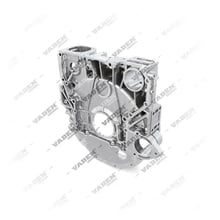
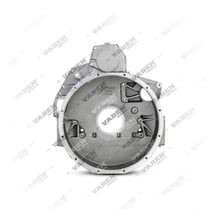
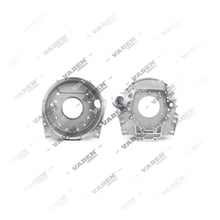
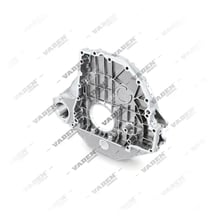
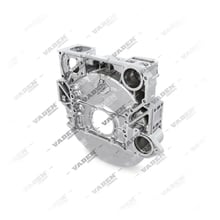
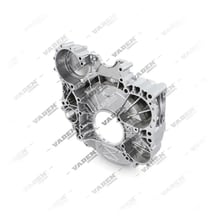
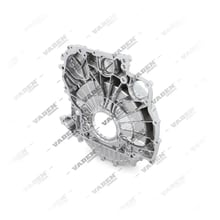
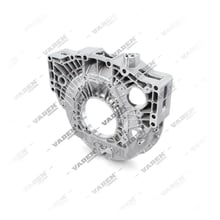
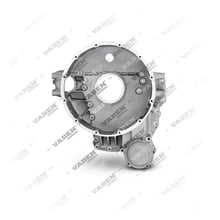
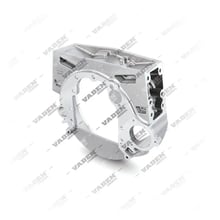
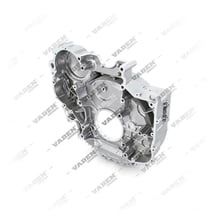
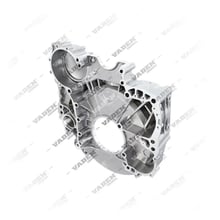
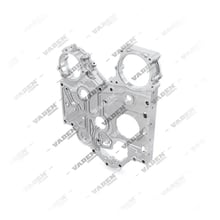
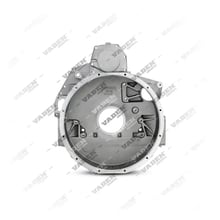
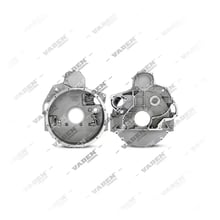
What are the functions of the Flywheel Housing?
The engine flywheel housing performs several functions on the vehicle, each of which directly affects the reliability of the engine-to-transmission driveline.
- Protection: Shields the rotating flywheel from external impact, splashed gravel, and moisture, and isolates service personnel from the rotating component.
- Alignment: Provides precise centering between the engine block and the transmission housing, minimizing radial run-out between the crankshaft and the transmission input shaft.
- Bearing support: On some designs, the transmission input shaft pilot bearing seats directly in this housing.
- Sealing support: Forms a boundary around the rear crankshaft seal and engine oil sealing points, containing leak paths.
- Sensor/accessory mounting: On several engine families, the speed sensor or flywheel ring gear sensor is mounted on this housing.
What are the symptoms of a faulty Flywheel Housing?
Because the engine flywheel housing is not a moving part itself, its failures usually show up as indirect symptoms; left unaddressed, they can damage the clutch system and engine-transmission alignment.
- Cracked or broken casting: Cracks caused by transport damage, impact, or excessive torque grow under vibration and compromise structural integrity.
- Abnormal vibration: When the housing's mounting face to the engine block is distorted, flywheel imbalance is felt as vibration inside the cab.
- Oil leak traces: Oil residue around the housing can indicate that rear-seal sealing is being affected by housing deformation.
- Irregular clutch engagement: Misalignment can cause a stiff clutch pedal, noise, or vibration during engagement.
- Loose or stripped bolts: Worn mounting holes allow the housing to shift, producing additional noise.
How is the Flywheel Housing inspected?
Inspection starts with a visual check without removing the housing, followed by detailed measurement once the transmission is separated if needed.
- Visual inspection: Check the casting surface for cracks, breaks, excessive corrosion, or weld repairs.
- Bolt torque: Verify all bolts securing the housing to the engine block and transmission against the manufacturer's specified torque; tighten any loose bolts immediately.
- Radial and axial run-out: Measure deviation at the centering face with a dial indicator; replace the part if the allowed tolerance is exceeded.
- Leak trace: Determine whether any oil buildup around the housing originates from the seal or the housing gasket.
- Sensor mounting face: If a speed sensor is mounted on the housing, also check the mounting hole and sensor air gap.
What should be considered during replacement?
Replacing the engine flywheel housing is a labor-intensive job that requires separating the transmission from the engine, so several critical points must be observed during the procedure.
- Alignment check: Clean the engine block and transmission mating surfaces before fitting the new housing, and check the centering dowels.
- Torque sequence: Tighten bolts in the sequence and to the value specified by the manufacturer, in stages; never apply full torque in a single pass.
- Seal and gasket condition: Inspect the rear crankshaft seal while the housing is off, and replace it in the same operation if needed.
- Pilot bearing: If the transmission input shaft bearing sits in this area, evaluate its condition separately.
- Lifting safety: Use proper support equipment when separating the transmission, and secure the flywheel and housing before they become free.
How to choose the right Flywheel Housing?
Correct part selection depends on the engine and transmission combination; choosing by OE part number rather than brand minimizes the margin of error.
Engine flywheel housing selection criteria| Criterion | Description |
|---|
| OE reference number | Use the number matching exactly the engine block and transmission code |
| Material | Cast iron or aluminum alloy, depending on engine weight class |
| Sensor bore | Whether a speed sensor or flywheel ring gear sensor mounting point is present |
| Centering bore | Inner diameter tolerance compatible with the transmission pilot bearing |
| Bolt pattern | Number and spacing of holes matching the engine block and transmission housing |
Maintenance and service life
Under normal conditions the engine flywheel housing is designed to last the life of the engine and does not require periodic replacement, but a visual inspection at every transmission removal or installation is recommended. Regularly checking bolt torque, especially on off-road and heavy-payload vehicles, helps prevent early crack formation. Always follow the torque values and inspection intervals in the vehicle's current OE service manual.
VADEN Flywheel Housing
VADEN offers OE-referenced engine flywheel housings for the heavy commercial vehicle engine group as stocked spare parts. Products are matched by OEM number to the specific engine block and transmission combination, allowing technical workshops to identify the correct part quickly.
Frequently Asked Questions (FAQ)
Can a vehicle keep running with a cracked engine flywheel housing?
Even a small surface crack can grow under vibration, so the vehicle should be brought to the workshop and the part replaced as soon as a crack is detected.
Does replacing the engine flywheel housing require removing the transmission?
On most heavy commercial vehicles the housing sits between the engine and transmission, so the transmission must be separated from the engine; this should be done at an authorized workshop.
Does an oil trace on the flywheel housing always mean a seal failure?
No; the leak can originate from the housing gasket, the seal, or adjacent mating surfaces, so a detailed check is needed to identify the source.
Is an alignment check needed after replacing the engine flywheel housing?
Yes, after fitting the new part, centering and bolt torque must be verified against the manufacturer's specified values.
Is the VADEN engine flywheel housing a direct fit for the original part?
VADEN products are matched by OE reference number; when the correct OEM number is selected, dimensions and mounting points match the original.
Related technical guide: Flywheel Housing: Faults, Replacement & Maintenance Guide