What Is a Truck Stabilizer Bar? Sway Bar Links, Bushings and Spring Plates
How a truck stabilizer bar limits body roll, where it sits on the front axle, rear axle and cab, and how its bushings, drop links and spring plates work.
A loaded truck takes the long curve of a motorway exit ramp, the cab leans toward the outside, the driver adds a little more steering and the truck settles back down. Part of that recovery comes from the springs and part from the shock absorbers; the part that shares the load piling onto one side of the truck with the other side is the stabilizer bar. When the stabilizer links wear out, nothing looks broken and no warning lamp comes on: the truck simply leans more in corners and a dull knock comes from the axle area on rough roads. This article explains what a truck stabilizer bar is, where heavy vehicles use one, and which parts make up its mounting and linkage.
What is a stabilizer bar on a truck?
A stabilizer bar is a spring-steel bar that ties the left and right wheel suspension together and twists to resist body lean when the truck rolls toward one side in a corner. It is also called an anti-roll bar, anti-sway bar or, in North American shop language, a sway bar. It carries none of the vehicle's weight and reacts only to the height difference between the two sides.
A stabilizer bar is shaped roughly like a U on most installations. The straight center section is clamped to the frame at two points inside rubber or polyurethane bushings, while the arms at each end drop down through drop links to the axle or a suspension arm. When both wheels rise and fall together, the bar simply rotates in its bushings and produces no force, which is why a stabilizer bar has little effect on ride comfort over a level bump that spans the full width of the road. When one wheel compresses further than the other, the center section twists, and its resistance to that twist returns to the suspension as a force that pulls the two sides back toward the same height.
A stabilizer bar is often confused with a shock absorber. A shock absorber reacts to the speed of suspension movement and damps out bouncing; a stabilizer bar ignores speed and looks only at how large the side-to-side difference is. How the two share the work is covered in detail in What Is a Shock Absorber? Bushing, Failure Symptoms, and Service Life. The search terms "sway bar", "anti-roll bar" and "stabilizer bar" all lead to the same answer: they are different names for the same part.
How does a stabilizer bar work? The logic of roll control
A stabilizer bar works by sharing the roll moment created during cornering between the springs on both sides. As the truck enters a curve, the lateral force acts on the vehicle's center of gravity, a point well above the roll axis. That force tries to tip the cab and body toward the outside: the outer spring compresses and the inner spring extends. The stabilizer bar twists in the process, pushing the outer side up, pulling the inner side down and reducing the roll angle.
On heavy vehicles this job matters far more than on passenger cars, because the center of gravity sits high. A high-cab tractor unit, a loaded tanker or a box trailer filled to the roof produces a much larger roll moment than a car at the same lateral acceleration. As the roll angle grows, the center of gravity shifts toward the outer wheels and the inner wheels press on the road with less force. By limiting roll, the stabilizer bar also limits that shift of the center of gravity. It does not protect the truck against rollover on its own, but it lengthens the path to the rollover threshold.
Why does the front-to-rear stabilizer balance matter?
The split of stabilizer stiffness between the front and rear axles decides which axle takes more of the load transfer in a corner. A truck set up stiffer at the front tends to slide wide at the front end, while one set up stiffer at the rear is more prone to stepping out at the rear. The vehicle manufacturer tunes this balance together with axle loads, tire size and cab type. Fitting a bar with a different diameter or arm length changes that tuning, so the bar and its linkage are always selected by the vehicle's OE number and chassis code.
What determines how stiff a stabilizer bar is?
Stabilizer bar stiffness depends on the bar diameter, the length of the section that twists and the length of the arms. On a solid bar, torsional stiffness rises with the fourth power of the diameter: a bar 10 percent larger in diameter is roughly 46 percent stiffer at the same length. A shorter arm also raises the stiffness felt at the wheel. That ratio explains why two bars that look almost identical can behave very differently on the vehicle.
Where are stabilizer bars used on heavy vehicles? Front axle, rear axle, cab and trailer
Stabilizer bars on heavy vehicles work at several locations rather than just one, depending on how the vehicle is built. On a truck the best-known position is the front axle, but the same principle appears in different forms on air-suspended rear axles, in cab suspension, on buses and on trailers.
Front axle stabilizer bar
The front axle stabilizer bar on many trucks and tractor units runs crosswise under or ahead of the frame. The center section is bushed into frame brackets, and the drop links at the ends of the arms run down to points on the axle close to the spring seats. Because the front axle is the steer axle, play in the front stabilizer linkage is often felt by the driver as vague or imprecise steering.
Rear axle stabilizer bar
The rear axle stabilizer bar is especially decisive on air-suspended rear axles. Air springs carry vertical load very well, but on their own they offer little resistance to roll, so air-suspended axles use a separate stabilizer bar or an arm layout that generates roll stiffness. In some designs, trailing arms clamped rigidly to the axle work together with the axle housing as a torsion bar. Faults on the air spring, leveling valve and ECAS side are covered in Heavy-Duty Air Suspension Failures: Air Springs, Leveling Valves and ECAS.
Cab stabilizer bar
A cab stabilizer bar is the torsion bar in a spring or air cab suspension that limits how far the cab leans in corners and over one-sided potholes. It usually runs crosswise between the front cab mounting points and works together with the cab tilt pivot. Faults and replacement of cab shock absorbers and mounts are covered in the Cab Suspension (Shock Absorber, Air Bellow, Leveling Valve): Faults & Repair guide.
Bus and trailer stabilization
Bus and trailer stabilization is mostly designed together with the air suspension. On low-floor city buses, the body height and the changing passenger load make a stabilizer bar per axle common. On air-suspended trailer axles, most of the roll stiffness comes from the trailing arms clamped tightly to the axle, so the condition of the arm pivot bushings has a direct effect on how the trailer behaves in a curve.
| Location | Function | Typical mounting components |
|---|---|---|
| Front axle | Limits cab and frame roll in corners, keeps steering precise | Frame bracket, stabilizer bushing, drop link with ball joint |
| Rear axle (air suspension) | Makes up for the low roll stiffness of air springs | Stabilizer bar or roll arm, bushings, axle mounting bracket |
| Rear axle (leaf springs) | Supports the roll stiffness of the leaf spring, reduces lean under load | Drop link, bushings, connections around the spring pack and spring plate |
| Cab | Limits cab lean in corners and over one-sided potholes | Cab stabilizer bar, front cab pivot bushings |
| Trailer and bus | Reduces roll angle with high center-of-gravity loads | Trailing arm bushings, axle connections, separate stabilizer bar where fitted |
What parts make up the stabilizer bar linkage?
The stabilizer bar linkage is made up of the bushings, drop links, ball joints, brackets and bolts that hold the bar to the frame and the axle. Because the bar itself is spring steel, it runs trouble-free for a long time; in the field, most complaints about play, noise and body lean come not from the bar but from these mounting points.
Stabilizer bushing and mount
A stabilizer bushing, often searched as a sway bar bushing, is the rubber or polyurethane mount that holds the center section of the bar in the frame bracket. The bushing lets the bar rotate and isolates vibration and noise from the frame. A bushing that hardens, cracks, swells from oil or fuel contamination, or starts turning inside its housing lets the bar develop play and causes a dull knock on rough roads. Bushing hardness also affects roll behavior, which is why a bushing matching the OE hardness is chosen.
Stabilizer drop link and ball joint
A stabilizer drop link, also called a sway bar end link, is the short member that connects the end of the bar arm to the axle or a suspension arm. Each end carries either a ball joint or a rubber eye bushing. The "stabilizer link ball joint" that comes up often in searches is the ball joint at the end of this drop link; it is not the same part as a steering tie rod end. Once the ball joint's dust boot tears, water and grit get in, the ball wears, and the play shows up first as noise and then as a noticeable shake.
Frame brackets, clamps and bolts
Stabilizer brackets and clamps are the metal parts that hold the bushings to the frame. A loose clamp lets the bushing slide out of position, and bolts that keep working loose ovalize their holes. Checking frame-side mounting brackets for cracks and loosening is covered in the Chassis Mounting Bracket: Failure, Replacement & Care Guide.
Axle-side connection and spring plate
The axle-side connection on leaf-sprung axles is closely tied to the area where the leaf spring pack is clamped to the axle. The spring pack is fastened to the axle with U-bolts and a clamp plate, and the forces generated by the stabilizer bar eventually pass through that joint into the axle and the wheel. In the VADEN catalog this family includes the stabilization spring plate, and every product in the family is listed in the stabilization category.
What is a stabilization spring plate and how does it relate to the stabilizer bar?
A stabilization spring plate is a steel plate that belongs to the stabilization group of the suspension and is used where the leaf spring pack is attached to the axle. Plates in this area usually clamp the spring pack onto the axle with the U-bolts and spread the clamping force across the face of the pack; the exact position and role of the plate on your vehicle are confirmed with the OE number and the service manual. Instead of concentrating U-bolt pressure at a single point, the plate spreads it over a wide area and limits sideways shifting of the spring leaves. The center bolt in the middle of the spring sets the position of the pack on the axle, while the plate and U-bolts hold that position under load.
A stabilization spring plate relates to the stabilizer bar through the load path. The lateral forces generated in a corner, and the load the stabilizer bar shares between the two sides, pass from the spring pack into the axle through this clamped joint. When clamping force drops, the pack can shift on the axle, the center bolt is overstressed, axle alignment is lost, and the truck leans more than expected in corners and becomes reluctant to change direction. However sound the stabilizer bar is, if the joint between axle and spring is loose, roll control cannot be fully delivered to the road.
When selecting a stabilization spring plate, spring pack width, U-bolt hole pattern, center bolt position and axle type are assessed together. The correct part is confirmed by the vehicle's OE number and chassis code; suitable products can be reviewed in the stabilization spring plate category.
How do you tell if a stabilizer bar has failed?
A stabilizer bar fault usually reveals itself not through a single symptom but through noise and body lean increasing together. The stabilizer bar itself rarely breaks; most complaints come from a worn bushing, a drop link ball joint with play, or a loose clamp. The table below is for an initial assessment; replacement steps for a failed part are found in the relevant part guides and in the vehicle's service manual.
| Symptom | Possible cause | Check / confirmation |
|---|---|---|
| Cab and body lean more than usual in corners | Worn bushing, broken or loose drop link, broken bar | Visual and pry-bar check of the linkage on both sides |
| Dull knock from the axle area on rough roads | Hardened bushing or bushing turning in its mount, loose clamp | Polished surface or cracks on the bushing, slip marks on clamp bolts |
| Metallic clunk when one wheel drops into a pothole | Play in the drop link ball joint, torn dust boot | Moving the ball joint by hand and with a pry bar, boot inspection |
| Vague steering, wandering within the lane | Play in the front stabilizer linkage, weak shock absorbers | Assess front axle linkage and shock absorbers together |
| Truck sits lower on one side on level ground | Usually not the stabilizer; a sagging leaf spring, leaking air spring or misadjusted leveling valve | Check the load-carrying components and the leveling valve |
| Uneven tire wear, truck pulling to one side | Loose spring clamp, shifted axle alignment | U-bolt, spring plate and center bolt check, axle alignment measurement |
A stabilizer bar does not set the ride height on level ground, so on a truck parked lower on one side the first place to look is the load-carrying components. On air-suspended trucks one of the most common causes is the leveling valve, and its diagnosis is covered in the Levelling Valve: Faults, Replacement & Maintenance Guide.
What is the difference between a stabilizer bar, shock absorber, leaf spring and tie rod?
The stabilizer bar, shock absorber, leaf spring and tie rod work in the same area, so they get mixed up in the field, yet each one responds to a different movement. Correct diagnosis starts with separating which movement the symptom appears in.
| Part | What does it respond to? | Main function | First sign of failure |
|---|---|---|---|
| Stabilizer bar | Height difference between left and right sides | Limiting body roll in corners | More lean in corners, noise over one-sided potholes |
| Leaf spring / air spring | The load itself | Carrying the vehicle, setting ride height | Truck sits low or leans to one side |
| Shock absorber | The speed of movement | Damping bounce | Oscillation continuing after a bump, cupped tire wear |
| Tie rod and drag link | Steering input | Steering the wheels | Play in the steering, inner or outer edge wear on front tires |
A stabilizer link ball joint and a steering tie rod end look like similar ball joints, but they carry different forces and are not interchangeable. Checking the tie rod, tie rod ends and drag link on the steering side is covered separately in Steering Drag Link & Tie Rod: Faults, Replacement, Care.
How do you inspect stabilizer bar links and bushings?
Stabilizer bar links and bushings can be checked in a few minutes as part of the running gear inspection during periodic maintenance. The goal is not to replace parts but to find where the play and wear actually are.
- Park the truck on level ground, apply the parking brake and chock the wheels; if possible, carry out the inspection both laden and unladen, because some play only becomes obvious under load.
- Inspect the stabilizer bushings on the frame brackets for cracks, swelling, oil contamination, rubber squeezing out of the bushing edge, and the shiny rotation mark the bar leaves inside the bushing.
- Check the clamp and bracket bolts for slip marks, missing bolts and ovalized holes.
- Move the ball joints or bushings at both ends of the drop links by hand and with a suitable pry bar; note axial and radial play and the condition of the dust boots.
- Look over the stabilizer bar near its mounting points for cracks, dents and corrosion.
- On leaf-sprung axles, check the U-bolts, spring plate and center bolt area for slip marks, rust streaks and cracks.
- Take a short road test at low speed in a safe area, with left and right turns and with one side dropping into a pothole; match the noise and lean you notice to the earlier findings.
Any play and wear found is assessed against the limits in the vehicle's service manual. When parts are replaced, final tightening is often required with the truck standing on its wheels at normal ride height; otherwise the bushings stay preloaded and their service life shortens. The exact tightening condition is given in the service manual.
Standards and further reading: how are stabilizer bars treated in inspections and regulations?
Stabilizer bars are assessed in periodic and roadside inspections as part of the suspension and running gear, and the defect criteria depend on the market. In Great Britain, suspension defects and rejection criteria for goods vehicles are described in the DVSA HGV inspection manual. In North America (US, Canada and Mexico), the suspension defects that put a vehicle out of service at a roadside inspection are set out in the CVSA North American Standard Out-of-Service Criteria. Canadian vehicle construction requirements are published in the Motor Vehicle Safety Regulations (C.R.C., c. 1038).
Replacing the stabilizer bar or the suspension layout with an arrangement that differs from the original design may count as a vehicle modification, which in many markets has its own approval process under local type-approval or vehicle construction rules. In Europe, the rollover stability of tank vehicles is additionally governed by UN ECE Regulation No. 111. For part replacement, the governing document is always the vehicle's own service manual.
Main guide: Heavy-Duty Air Suspension Failures: Air Springs, Leveling Valves and ECAS
Tags
Frequently Asked Questions
- What does a stabilizer bar do on a truck?
- A stabilizer bar limits how far the truck leans to one side in a corner or over a one-sided pothole. The bar connecting the left and right suspension twists when a height difference appears between the two sides and produces a force that reduces that difference. As a result, the cab and body lean less, the inner wheels keep their grip on the road, and the truck behaves more predictably when changing direction.
- Are a stabilizer bar, sway bar and anti-roll bar the same part?
- Yes. Stabilizer bar, sway bar, anti-roll bar and anti-sway bar all describe the same part; "sway bar" is the usual term in North American shops. Catalogs and service manuals may use different names, so the right part is found by the vehicle's OE number and chassis code rather than by name. Keep in mind that two trucks carrying the same model name can use different stabilizer bars.
- Can you drive a truck with a failed stabilizer bar?
- A truck with a broken or badly worn stabilizer link may look normal on a straight road, but it leans more in corners, during sudden lane changes and when running loaded. On tankers, box bodies and buses with a high center of gravity, that is a safety risk. Once the fault is noticed, have the truck inspected as soon as possible and keep speed and cornering limited in the meantime.
- Why does a sway bar bushing make noise?
- A sway bar bushing develops play and produces a dull knocking sound on rough roads once it hardens, cracks, or wears from the bar rotating inside it. Oil and fuel contamination swell the rubber and speed up the process. A loose clamp can make the same sound, so the clamp and bracket mounting are also checked before the bushing is replaced.
- What is the difference between a stabilizer link ball joint and a tie rod end?
- A stabilizer link ball joint is the ball joint at the end of the stabilizer drop link, and it carries the vertical forces generated during body roll. A tie rod end is part of the steering system and transmits the force that steers the wheels. Although they look alike, their dimensions, loads and mounting points differ; they are not interchangeable, and each one is selected by its own OE number.
- Can a stabilizer bar break?
- A stabilizer bar is made of spring steel and rarely breaks; when it does, the cause is usually deep corrosion, impact damage, or fatigue from a linkage that ran with play for a long time. Cracks usually start at the bends and around the mounting holes. A broken or bent bar is not straightened or welded; it is replaced.
- Do air-suspended trucks have a stabilizer bar?
- Yes, most air-suspended trucks and tractor units have a stabilizer bar. Air springs carry the load well but offer little roll resistance on their own, so a separate stabilizer bar or an arm layout that generates roll stiffness is used. The type of layout varies by vehicle manufacturer and axle design, and the details are given in the vehicle's service manual.
- What is a cab stabilizer bar?
- A cab stabilizer bar is the torsion bar on trucks with cab suspension that limits how far the cab leans in corners and over one-sided potholes. It usually runs crosswise between the front cab mounting points and works together with the cab tilt pivot and the cab shock absorbers. When its bushings wear, the cab leans too much in corners and a rattle comes from the cab area.
- Should stabilizer bushings be lubricated?
- Rubber stabilizer bushings are generally not lubricated, because petroleum-based oil and grease swell the rubber and shorten its life. Some polyurethane bushings are installed with a specific grease named by their manufacturer. How each bushing is fitted is set by the vehicle and bushing manufacturer's instructions, and solvents that attack rubber are not used during cleaning.
- When should a stabilization spring plate be replaced?
- A stabilization spring plate is replaced when it shows cracks, bending, deep corrosion, or a deformation that keeps letting the U-bolts work loose. Whenever the spring pack is removed, the condition of the plate and the U-bolts is assessed as well. The correct plate is selected by the vehicle's OE number and chassis code, and the service manual governs the torque value and tightening sequence during installation.
Related Articles
Levelling Valve: Faults, Replacement & Maintenance Guide
An air-suspended truck or trailer sitting low on one side or not holding ride height points to the levelling valve lever setting: diagnosis and replacement.
ECAS Solenoid Valve: Faults, Replacement & Maintenance Guide
A truck sitting low on one side or a trailer that will not settle to ride height points to the ECAS solenoid valve block: diagnosis, replacement and calibration.
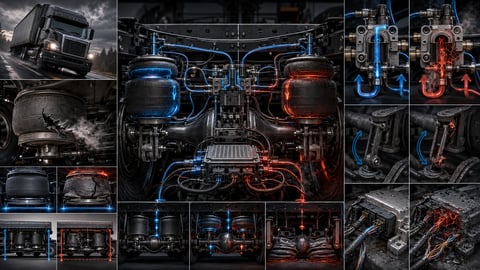
Heavy-Duty Air Suspension Failures: Air Springs, Leveling Valves and ECAS
Heavy-duty air suspension explained: air springs, leveling valve vs ECAS faults, leak diagnosis, and maintenance for trucks, trailers and buses.