Truck Steering Gear Box: Faults, Replacement & Maintenance
Heavy truck steering gear box guide: fault symptoms, pressure testing, replacement steps, torque values and maintenance tips from the VADEN technical team.
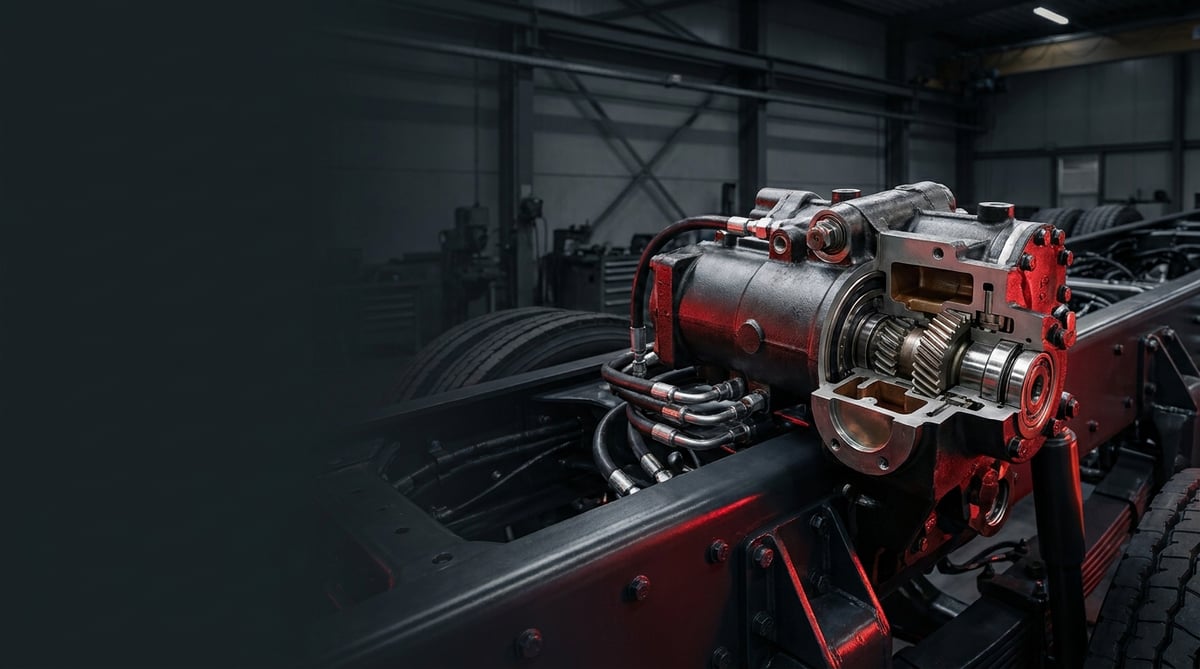
The driver's first complaint is almost always the same: "The steering has gone heavy." Sometimes it is "there's play in it", sometimes "it groans when manoeuvring", and sometimes "oil is dripping from somewhere." On a heavy commercial vehicle nearly all of these point to the same group — the steering gear box and the hydraulic pipe/hose circuit attached to it. Unlike the brakes, this group does not fail instantly; it degrades quietly: first a little play, then hard work when manoeuvring, then a leak, and finally a breakdown on the road. This guide covers the steering gear box and the supply/return lines in workshop language: what it does, how it fails, how it is diagnosed, how it is replaced and how its service life is extended.
E-E-A-T note: This document was prepared by the VADEN technical team on the basis of field and product experience with heavy commercial vehicle hydraulic steering systems. The values given here are typical reference ranges; they vary with the vehicle family, gear box type, axle load and year of manufacture. For exact torque, pressure, free play and oil type values, always refer to the vehicle manufacturer's current service manual. Last updated: September 2026.
Heavy commercial vehicle steering systems fall under ECE R79 regulation.What Is a Steering Gear Box? Function and Operating Principle
The steering gear box is the unit that converts the rotary motion coming from the steering column through a gear mechanism and transfers it to the front axle track rod linkage via the pitman arm, assisting that motion with hydraulic power; the connected pipes form the circuit that carries pressurised oil from the hydraulic pump to the gear box and returns the spent oil to the reservoir.
On a loaded tractor unit the mass carried by the front axle is measured in tonnes; it is simply not possible for the driver to turn that load by arm strength alone. That is why the system uses an "integral hydraulic assisted" architecture: the gear mechanism and the hydraulic assistance sit inside the same housing. When the driver turns the steering wheel, the torsion bar and rotary valve inside the gear box twist slightly; the valve opens and pressurised oil from the pump is directed to the appropriate side of the power piston. The piston pushes the sector gear and helps turn the steering. When the wheel is released, the valve re-centres, pressure equalises and the assistance stops.
The second half of the system is the pipework, which is often overlooked. The high pressure pipe running from the pump to the gear box, the low pressure line returning from the gear box to the reservoir, and the suction line between the reservoir and the pump form the vascular structure of the system. A restriction, crack or loose union anywhere in it can lead you to replace an innocent gear box. These pipes are dimensioned for vibration, heat and cab movement; a similar-looking hose is not an acceptable "make do" substitute.
- Gear box housing: Cast housing; it accommodates the power piston cylinder, the sector gear and the valve seat.
- Worm and recirculating ball nut: The common mechanism on heavy commercial vehicles; the balls reduce friction and carry high loads.
- Power piston: Piston integrated with the ball nut; converts hydraulic pressure into linear force.
- Sector shaft (pitman shaft): The output shaft of the gear box; the pitman (drop) arm is splined onto it.
- Torsion bar and rotary valve: The heart of the unit, determining steering feel and the amount of assistance.
- Pressure relief valve: Protects the system from excess pressure at full lock.
- Seal, O-ring and dust seal kit: The sector shaft and input shaft seals are the most frequent leak points.
- Pressure pipe: From the pump outlet to the gear box; usually a combination of steel pipe and flexible high pressure hose.
- Return pipe/hose: From the gear box to the oil cooler and reservoir; low pressure, high flow.
- Unions, banjos and sealing washers: Small but decisive parts that must be renewed at every removal and refit.
Integral hydraulic steering gear box (the most common heavy commercial architecture)
Used on the vast majority of trucks, tractor units and buses. ZF type and equivalent integral gear boxes fall into this class. The advantage is that the assisting force is generated directly on the gear mechanism, with no need for an additional cylinder in the track rod linkage. The disadvantage is that, if maintenance is neglected, a single unit wears out mechanically and hydraulically at the same time.
Applications with an auxiliary (assist) cylinder
On tractor units with heavy axle loads, on three-axle vehicles and in some bus and construction machinery applications, an auxiliary hydraulic cylinder mounted on the axle is fitted in addition to the gear box. On such vehicles the source of the "heavy steering" complaint is often not the gear box but the auxiliary cylinder or the line feeding it. During diagnosis, no decision should be made without isolating this second circuit.
Pipework: steel pipe or flexible hose?
Flexible high pressure hose is used where there is relative movement between the engine and the chassis, and steel pipe on fixed routes. The union area where the two meet is the most heavily stressed point in the system; both vibration and pressure pulsation accumulate there. When hunting a leak, these transition unions are the first place to look.
| Vehicle / application type | Typical gear box architecture | Hydraulic assistance layout | Prominent failure tendency |
|---|---|---|---|
| 2-axle distribution truck | Recirculating ball, integral hydraulic (ZF type equivalent) | Single circuit, power piston inside the gear box | Sector shaft seal leak, increasing free play |
| Long-haul tractor unit (4x2 / 6x2) | Integral hydraulic gear box, high capacity | Single circuit + back-up pump in some applications | Return hose fatigue, oil overheating |
| Construction / off-road type (6x4, 8x4) | Heavy duty integral gear box | Gear box + auxiliary cylinder | Impact damage, crushed pipes, contamination |
| City bus | Integral gear box, low-noise focused | Single or dual circuit (for safety reasons) | Heat and seal fatigue from constant manoeuvring |
| Trailer / semi-trailer steering arrangement | Separate steering mechanism | Hydraulic or mechanical follow-up system | Line leakage, loss of adjustment |
Part number verification is essential. With steering gear boxes, external appearance is misleading. The input shaft spline profile, the sector shaft tooth count and taper, the number of turns (lock to lock), the mounting hole spacing, the port orientation and the pressure setting all vary between variants even within the same vehicle family. On the pipe side, length, bend angle and union type are equally critical. Before ordering, verify the OE number on the removed part together with the vehicle chassis number and the axle configuration. A "it looked the same, so we fitted it" approach is not merely a comfort issue on steering — it is a safety issue.
Failure Symptoms and Diagnosis
The most common mistake with steering complaints is to blame the gear box straight away. Yet the same symptom can be produced by track rod end play, a tired pump, a restricted line, a low oil level or even tyre pressure. The correct sequence is this: first oil level and quality, then the lines and the pump, and the gear box last. The table below lists the symptoms most frequently encountered in the field and the checks that distinguish them.
| Symptom | Possible Cause | Check / Verification |
|---|---|---|
| Steering generally heavy, particularly hard work during parking manoeuvres | Low hydraulic pressure: tired pump, loose belt, restricted line or internal leakage in the gear box | Fit a pressure gauge and flow meter to the pump outlet and read the full lock pressure at idle; first verify belt tension and oil level |
| Free play (dead band) at the steering wheel has increased, the vehicle wanders on the road | Backlash inside the gear box has opened up, the sector shaft bearing is worn, or the track rod ends have developed play | With the front wheels on the ground, have an assistant rock the steering left and right and watch the lag between the input shaft and the pitman arm; determine whether the play is in the gear box or in the linkage |
| Groaning / whining noise when turning the steering | Low oil level, air in the system, or air being drawn in through the suction line | Check the reservoir oil level and look for foaming; with the engine running, check the suction hose union and the reservoir cap, then carry out the bleeding procedure |
| Oil leak around the gear box housing or at the base of the pitman arm | Sector shaft seal, input shaft seal or cover gasket has failed | Clean the area, then with the engine running make a few full lock manoeuvres and identify the exact leak point with a lamp |
| Dampness around a union or hose, oil level continuously dropping | Cracked pressure pipe, fatigued banjo washer, worn hose outer cover | Run your hand along the line to find the damp area; flex the hose to check for cracks, renew the washers and monitor again |
| Steering turns easily one way and hard the other | Rotary valve imbalance or one-directional internal leakage in the gear box | On level ground, turn the vehicle to full lock in both directions and observe the difference in effort; take pressure readings separately at each lock |
| Steering momentarily locks up / binds during manoeuvres | Contamination and particles in the oil, valve sticking or mechanical damage | Examine the colour, smell and sediment of the oil in the reservoir; if a filter is fitted, remove it and assess its contents |
| Oil overheats on long runs, with a burnt smell | Restricted return line, blocked cooler or continuous bypass (relief) operation | Check whether the return hose is crushed or kinked; ask whether the driver holds the steering at full lock for long periods |
| Steering becomes extremely heavy when the engine stalls (emergency situation) | Normal behaviour, but excessive stiffness in the mechanical part indicates an internal gear box problem | With the engine off, check whether the steering can be turned with acceptable effort; if it binds, look for mechanical damage |
Pressure and flow measurement: the test that ends the argument
A test set with a shut-off valve is connected between the pump outlet and the gear box inlet. System pressure is read at idle; the steering is then briefly taken to full lock to see the maximum (relief) pressure. Closing the valve briefly shows the peak pressure the pump can generate. If the pump peak pressure is adequate but pressure at the gear box is low, the leak is inside the gear box. If both values are low, the pump or the line is suspect. Do not keep the valve closed for more than a few seconds; the oil heats rapidly and damages the pump.
Is the play in the gear box or in the linkage?
This distinction saves money. While one person rocks the steering through a small amplitude, a second person watches the input shaft, the pitman arm and the track rod ends in turn. If the input shaft moves but the pitman arm lags, the source is inside the gear box; if the pitman arm moves but the wheel lags, there is play in a track rod end, kingpin or linkage joint. The number of sound gear boxes replaced because of a worn track rod linkage is far from negligible in the field.
The oil itself is a diagnostic tool
Darkened oil with a burnt smell points to overheating; milky, foamy oil to air being drawn in; oil with a metallic sheen to wear in the pump or inside the gear box. When metal particles are found, replacing the part alone is not enough; the system must be flushed and the lines cleaned, otherwise the new part will go the same way.
Further reading
For a plain-language technical overview of this subject, see the reference article on Wikipedia. Always confirm specific figures and procedures against the vehicle manufacturer service data.
Replacement / Installation Steps
Personal protective equipment and safety: The steering system is a safety system; work must be carried out by competent personnel. Park the vehicle on level ground, apply the parking brake, chock the wheels and switch off the ignition. Make sure system pressure has dropped — the high pressure line must never be disconnected with the engine running. Hot hydraulic oil causes serious burns; do not start before the engine and oil have cooled. Nitrile gloves and safety goggles are mandatory. If the cab is to be tilted, check the tilt lock and the safety support. If the front axle is to be raised, always use axle stands and never rely on the jack. Collect the drained oil according to the waste disposal procedure.
- Record the diagnosis: Before deciding on replacement, record the pressure/flow measurement, the free play check and the leak point in writing. This data is needed for comparison after installation.
- Verify the reference: Compare the OE number of the removed gear box, the input shaft spline profile, the sector shaft taper and the number of turns lock to lock with the new part. If the pipes are also being replaced, match length, bend and union type as well.
- Mark the straight-ahead position: With the wheels straight ahead, paint-mark the steering wheel, the input shaft, and the pitman arm and sector shaft spline. The centre position of the gear box will be the reference during installation.
- Drain the oil and disconnect the lines: Empty the reservoir and place a collecting tray underneath. Label and disconnect the pressure and return lines. Slacken the unions while holding the body with a counter-spanner; immediately plug all opened ports and line ends.
- Remove the pitman arm: Undo the nut and use a suitable arm puller. Never try to knock the arm off with a hammer; this damages the sector shaft and the internal bearings.
- Separate the steering column connection: Slacken the universal joint bolt and separate the shaft from the input shaft. Do not turn the steering wheel freely at this stage; the clock spring and mechanism position may be disturbed.
- Remove the gear box from the chassis: Slacken the mounting bolts progressively. The gear box is heavy — lower it with support. Inspect the seating face on the chassis for cracks and deformation.
- Clean the lines and assess the pipes: If a new gear box is to be fitted, flush the pressure and return lines with clean pressurised oil. If metal particles were found, the lines and any cooler must be flushed or renewed. Never reuse a hose that is fatigued, swollen or cracked.
- Fit the new gear box: Seat the gear box on the chassis and start the bolts by hand, then tighten in a crosswise sequence to the torque given in the manual. Find the centre position of the new gear box (by counting from lock to lock and going to the mid-point) and align it with the marked straight-ahead position.
- Connect the pitman arm and the column: Seat the spline according to the marks, tighten the nut to the manual torque and renew the locking element if fitted. Connect the steering column joint cleanly; check that the bolt seats correctly in the spline groove.
- Connect the lines and fill: Connect the unions with new sealing washers. Fill the reservoir with clean oil of the type specified by the manufacturer; do not mix different oil types.
- Bleeding and final check: Before starting the engine, with the wheels off the ground, turn the steering slowly from lock to lock several times and top up the level. Then run the engine at idle and repeat the same procedure; continue until the foam disappears. Do not hold at full lock for long. Carry out a leak check, have the front-end geometry (tracking) checked, and after a short road test re-inspect all connections and the oil level.
Points to Watch (Common Mistakes)
Do not hold at full lock. Turning the steering all the way and holding it there runs the system continuously over the pressure relief valve. The oil heats up seriously within a few seconds; seals, hoses and the pump all suffer directly from that heat. Getting into the habit of backing off slightly when you reach the lock during a manoeuvre noticeably extends the life of both the gear box and the pump.
A dirty installation = a second failure. In a hydraulic steering system even the smallest particle can make the rotary valve stick. Plug every port as soon as it is opened, do not leave line ends exposed, use lint-free cloth and fill the reservoir with clean oil. Fitting a new gear box to a system where metal particles were found, without flushing the lines, puts the new part directly at risk.
- Knocking the pitman arm off: The sector shaft and internal bearings are damaged; always use a puller.
- Skipping the gear box centre position: On a gear box fitted off-centre the steering wheel will not sit straight and assistance will be insufficient in one direction.
- Using the wrong hydraulic oil: Oil other than the type specified by the manufacturer (or a mixture of different types) causes seal swelling and loss of viscosity.
- Reusing copper/aluminium washers: A crushed washer leaks on the first heat cycle; renew them at every removal.
- Fitting a hose kinked or under tension: A hose whose bend radius is violated narrows internally and cracks within a short time. Fit all routing clips without exception.
- Managing a leak by "topping up the oil": A pump running with a falling level draws air, and the pump is soon added to the bill as well.
- Skipping the tracking adjustment: If the front-end geometry is not checked after a gear box replacement, tyre wear and an off-centre steering wheel will follow.
- Trying to "take up" play with the adjuster screw: Forcing the centre adjustment on a worn gear box creates binding and heat build-up in the centre range. Adjustment is not a cure for wear.
- Forgetting belt tension: A loose belt produces a pressure drop and groaning noise during full lock manoeuvres, and the gear box gets the blame.
- Ignoring the suction line: A loose clip between the reservoir and the pump lets air into the system without dripping a single drop of oil anywhere.
Technical Values and Check Points
The values below are typical / general reference ranges for hydraulic steering systems on heavy commercial vehicles. They vary with vehicle class, axle load, gear box type and manufacturer; for exact values the service manual is authoritative.
| Parameter | Typical reference range | Note |
|---|---|---|
| System operating pressure (straight driving, idle) | approx. 5 – 25 bar (≈ 70 – 360 psi) | When no assistance is demanded the valve centres and pressure is low |
| Maximum (relief) pressure, full lock | approx. 130 – 180 bar (≈ 1,900 – 2,600 psi) | Heavy duty applications sit near the upper band; the setting is made by the manufacturer |
| Pump flow rate (around idle) | approx. 8 – 20 L/min | Varies with vehicle class and gear box capacity |
| Hydraulic oil operating temperature | approx. 60 – 90 °C | Continuous operation above 110 °C markedly shortens seal and hose life |
| Steering wheel free play (on the road, measured at the rim) | typically in the order of 15 – 30 mm | The manufacturer's limit is authoritative; increasing play calls for a gear box/track rod linkage check |
| Number of turns lock to lock | approx. 4 – 6 turns | Specific to the gear box variant; a critical data point in spare part matching |
| Reservoir oil level | between min and max, near the lower band when cold | A reading taken hot is misleading; follow the manufacturer's procedure |
| Oil change interval | general reference: 2 – 4 years or at periodic service | Shortened for heavy site work and city bus duty |
| Connection point | Typical torque range | Warning |
|---|---|---|
| Gear box chassis mounting bolts (M14–M16) | approx. 180 – 300 Nm | Tighten progressively in a crosswise sequence; the manufacturer's value is authoritative |
| Pitman arm nut (large diameter) | approx. 350 – 600 Nm | High torque; the locking element must be renewed |
| High pressure line union | approx. 35 – 60 Nm | Tighten while holding the body with a counter-spanner; excessive torque deforms the union |
| Return line union / banjo | approx. 25 – 45 Nm | A new washer is mandatory |
| Steering column joint bolt | approx. 30 – 50 Nm | Verify that it seats fully in the spline groove |
Field tip: Do not carry out the pressure test at idle only. A system that looks normal at idle can behave differently as engine speed rises or as the oil warms up. Bring the vehicle to operating temperature, repeat the measurement both cold and hot, and compare the two values. A marked drop when hot is the clearest indication of internal leakage.
- Open the reservoir cap and check the colour of the oil and any foaming at every periodic service.
- Wipe the base of the pitman arm and the underside of the gear box with a dry cloth and check again a few days later; this is how a micro-leak is caught.
- If cracking, swelling or exposed braid appears on the outer cover of the high pressure hose, renew the hose without delay.
- Verify that all clips and clamps along the hose route are in place; chafing-induced perforation is a common cause of leaks.
- Check the pump belt tension and the pulley face together.
- Measure the steering free play and record it in the service log; the trend of increase is more informative than a single reading.
- Re-check the connection torques and the oil level within the first 500 – 1,000 km after a gear box replacement.
Maintenance and Service Life
With the right oil and a reasonable operating temperature, the steering gear box is a unit that can serve close to the life of the vehicle. Three things shorten that life, and they are almost always the same: aged or contaminated oil, overheating, and constant use at full lock. On the pipe side the decisive factors are hose ageing and chafing along the route. For that reason it gives better results to frame maintenance not as "protect the gear box" but as "protect the oil and the lines".
- Check the oil level periodically: A slow drop in level is the early warning of a leak that is not yet visible.
- Renew the oil and any filter on time: Aged oil loses both its lubricating and its sealing performance; shorten the interval in heavy duty use.
- Assess hoses by their age: Even if it looks sound, a hose that hardens over the years can shed particles from its inner surface. Assess the hose as well when the gear box is renewed.
- Do not neglect heat management: Keep the fins of the oil cooler clean if one is fitted; a blocked cooler stresses the whole system.
- Talk about driving habits: Forcing the steering while the vehicle is stationary ("dry manoeuvring") stresses both the gear box and the tyres. Manoeuvres should be made with the vehicle rolling slightly wherever possible.
- Check the track rod linkage at the same time: A track rod end with play imposes shock loads on the gear box and accelerates internal wear.
- Deal with leaks early: A small seal leak turns into pump damage once the level drops; solving it while it is small is always cheaper.
- Think in kits when replacing: When the gear box is renewed, the sealing washers and, where necessary, the hose and the oil should be renewed with it; replacing one part and leaving the rest brings the fault back.
In practice, on a vehicle whose oil is changed on time and which is not held at full lock, the steering gear box gives no trouble for many years. Conversely, on a vehicle whose leak has been managed for years by "topping up the oil", the gear box and the pump go together. The answer to "how many kilometres does a gear box last" lies far more in usage and maintenance discipline than in mileage.
The steering gear box is one of those rare parts that is noticed late in the field but must be dealt with early: a single day of delay usually adds the cost of the pump and the lines to the bill as well. In the VADEN ORIGINAL catalogue the steering group is held in stock as steering pumps, steering pipes and steering box references, matched to OE numbers for heavy commercial vehicle applications; identifying the correct reference using your vehicle's chassis and axle data, and planning your spare in good time, is the preparation that pays back most in the field.
Related categories: Steering · Pipe
Related technical guides: Exhaust Manifold: Cracks, Leaks, Replacement & Torque Guide · Engine Cylinder Head Group: Faults, Replacement & Maintenance · Exhaust / Engine Brake: Faults, Replacement & Maintenance Guide · Oil Cooler: Failure Symptoms, Replacement & Maintenance Guide · Truck Oil Pan Group: Faults, Replacement & Maintenance Guide
Application and compatibility: Vehicle compatibility catalogue · Engine compatibility catalogue
Main guide: Power Steering Pump Failure Symptoms: What to Watch for in Heavy-Duty Commercial Vehicles
Tags
Frequently Asked Questions
- The steering has gone heavy — is the gear box finished?
- Not necessarily. Check, in order, the hydraulic oil level, the pump belt tension, line restriction, tyre pressure and the front-end geometry. If these are clear, take pressure readings at the pump outlet and at the gear box inlet; if the pump generates adequate pressure but a low value is read at the gear box, internal leakage in the gear box becomes the prime suspect.
- Is the play in the steering coming from the gear box or from a track rod end?
- To tell them apart, carry out a two-person check: one person rocks the steering through a small amplitude while the other watches the input shaft, the pitman arm and the track rod ends in turn. If the input shaft turns but the pitman arm lags, the source is inside the gear box; if the pitman arm moves but the wheel lags, there is play in the linkage components.
- There is a groaning noise when turning the steering — what does it mean?
- The most common cause is a low oil level or air that has entered the system. If there is foaming in the reservoir, the suction line, reservoir cap and clips should be checked. If the noise persists after the level and the air have been corrected, pump wear should be assessed.
- Should a steering gear box be repaired or replaced complete?
- If there is only a seal leak and the mechanical play is within limits, repair with a seal/gasket kit is possible. However, if the backlash has opened up, the sector shaft bearing is worn or metal particles have been found in the system, replacing the complete unit is the safer choice.
- Which hydraulic oil should be used?
- The type specified by the vehicle manufacturer is authoritative; some applications require ATF type oil, others a dedicated power steering fluid. Mixing different types causes seal swelling and loss of performance. Verify the specification in the manual before filling.
- What should be watched when replacing a steering pipe?
- Length, bend angle and union type must match the original exactly; the hose must be fitted without violating its bend radius, without tension, and with all clips in place. Sealing washers must be renewed, and bleeding and a leak check must be carried out after installation.
- Does the steering lock up completely if the engine stalls?
- No — the mechanical connection remains, so the steering can still be turned; but because the hydraulic assistance is lost it becomes noticeably heavy. In that situation the vehicle should be brought to a safe place and stopped in a controlled manner. If binding or stiffness is felt in the steering with the engine off, mechanical damage should be investigated.
- Is a tracking adjustment needed after a gear box replacement?
- Yes, it needs to be checked. When the centre position of the gear box and the pitman arm mounting angle change, the steering centre can shift; if the front-end geometry is not checked, the wheel will not sit straight and tyre wear will accelerate.
- Why is holding the steering at full lock during a manoeuvre harmful?
- Holding at full lock runs the system continuously over the pressure relief valve. The oil heats up seriously within a few seconds, and the seals, hoses and pump all suffer directly from that heat. Backing the wheel off slightly once you reach the lock noticeably extends the life of both the gear box and the pump. The same applies while bleeding: do not dwell at full lock.
- We found metal particles in the oil — is fitting a new gear box enough?
- No. A metallic sheen indicates wear in the pump or inside the gear box, and the particles stay behind in the lines and in the oil cooler if one is fitted. Before the new unit goes on, flush the pressure and return lines with clean pressurised oil, and renew the lines and cooler where necessary. In an unflushed system even the smallest particle can make the rotary valve stick.
Related Articles
What Is a Flywheel? Function, Types and Flywheel Housing Difference
Learn what a truck flywheel does, how the ring gear works, single vs dual-mass flywheel differences, its link to the clutch and how it differs from the housing.
Oil Filter Cap and Housing: Leaks, Cracks and Seal Replacement
Truck engine oil filter cap and housing: why plastic caps crack, O-ring leak causes, bypass valve faults, and correct torque and seal replacement steps.
Piston Rings: Oil Consumption, Compression Loss and Replacement
Ring-related oil consumption and compression loss in truck diesel engines: how rings seal, blow-by and leak-down tests, ring gap and replacement.