EBS Modulator: Faults, Diagnosis, Replacement Guide
Technical guide to the EBS modulator on trucks and trailers: how it works, fault symptoms, diagnosis, replacement steps, torque values and maintenance tips.
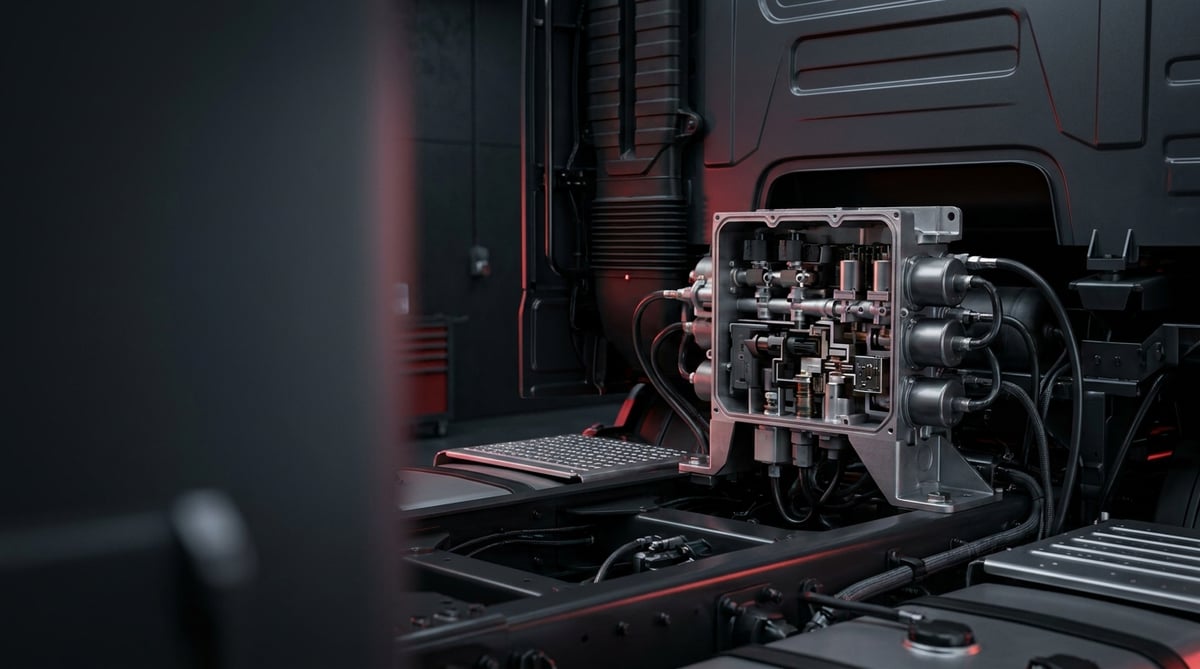
If you have pressed the brake pedal on a heavy commercial vehicle and felt a "late" response from the rear, or found the ABS/EBS lamp lit on the dashboard with the vehicle dropped into backup braking mode, there is a good chance an EBS modulator sits at the centre of the story. The sentence we hear most often in the field is this: "Air pressure is fine, chambers are fine, but the trailer brakes just won't hold." This guide explains exactly what to check at that point, how to tell a genuine modulator failure from a wiring, air or sensor issue, and how to carry out the replacement correctly. We work through real scenarios encountered in the field on tractor units, trucks, buses and semi-trailers.
What Is an EBS Modulator / Electronic Brake Unit? Function and Operating Principle
An EBS modulator is an electro-pneumatic valve unit in the electronic braking system (EBS) that receives the electrical signal from the central control unit and precisely regulates the air pressure delivered to the brake chambers on a per-wheel or per-axle basis; it contains solenoid valves, a pressure sensor and, in most types, its own electronic board.
In a conventional air brake system with ABS, the pedal opens the brake valve mechanically and pneumatically; air travels along the line, reaches the chamber and the brake applies. In this chain the air column takes time to move, and in a long tractor-trailer combination the rear axle joins the braking event noticeably later than the front axle. EBS shortens that delay electrically: the sensor at the pedal converts the driver's demand into an electrical signal, the central ECU evaluates that demand together with load condition, axle load, wheel speed and the requested deceleration, and then sends each modulator the command "deliver this many bar to that chamber". The pneumatic line remains only as a redundant circuit; if electrical power is lost the system falls back to conventional pneumatic mode and the vehicle still stops, only comfort and distribution accuracy are lost.
The modulator's real strength is its closed loop. The internal pressure sensor measures how much pressure actually reaches the chamber and reports it back to the ECU. The gap between demanded and measured pressure is closed within milliseconds. This is why brake lining wear progresses far more evenly between axles on an EBS-equipped vehicle, the difference in stopping distance between unladen and laden conditions is reduced, and ABS and ASR interventions are smoother.
- Solenoid valve group (inlet/outlet): Fast-switching valves that build and release pressure; during ABS regulation they operate dozens of times per second.
- Backup/redundancy valve: The valve that brings the pneumatic control line into play in the event of an electrical fault.
- Integrated pressure sensor: The element that measures outlet pressure and provides feedback.
- Electronic board and connector: The driver circuit connected to the vehicle harness via a bayonet or DIN-type socket (axle modulators are also available in versions with a separate ECU).
- Relay valve section: The body that manages a large air flow from a small control signal, filling and exhausting the chamber quickly.
- Silencer and exhaust port: Reduces exhaust noise and is the point most exposed to contamination and freezing.
- Housing, gaskets and O-rings: Cast aluminium housing and internal sealing elements.
The difference between single-channel, dual-channel and axle modulators
A single-channel modulator controls one wheel independently; it is generally used on front axles where fine ABS regulation is required. A dual-channel modulator (with two independent outlets) drives the two sides of an axle separately and is commonly seen on rear axles. The axle modulator combines two channels, the relay valve and the electronics in a single housing mounted close to the rear axle, and is the most widespread type. On the trailer side the task usually belongs to a more comprehensive unit known as the "trailer EBS module", which carries its own ECU, an axle load input and park/emergency brake functions.
Its neighbours in the system: what is it connected to?
The modulator does not work in isolation. At its inlet is the supply line coming from the air dryer and the air tank; on the control side the foot brake valve (pedal unit) and the central EBS ECU; at the outlet the brake chambers; and on the electrical side the wheel speed sensors, the axle load sensor / chamber pressure line and the CAN bus. This is why a significant proportion of cases reported as "modulator failure" actually turn out to be caused by supply voltage, earth quality, a CAN break or wheel speed sensor air gap. This is the first rule of diagnosis in heavy commercial vehicles: verify the signal and the air reaching the part before you blame the part itself.
OE context and the logic of equivalence
Heavy commercial EBS architecture has largely taken shape around the solutions of two or three system suppliers; Knorr-Bremse type and Wabco type systems are the ones most frequently encountered on European tractor units, trucks and trailers, while Bendix type architectures are seen in predominantly North American fleets. These names are used here only to describe the system context; VADEN products are positioned as equivalents/types of the relevant OE numbers. The critical point is this: in EBS, "it physically fits" is not enough. If the software version, channel configuration and CAN message set do not match, the unit will bolt on but the system will throw a fault.
| Application / vehicle type | Typical modulator layout | Key feature | Point to watch |
|---|---|---|---|
| Tractor unit (4x2 / 6x2), long haul | Rear axle modulator + front single-channel valves | Load-dependent brake distribution, trailer compatibility | Must be assessed together with the trailer control valve |
| Truck / chassis-mounted bodywork (6x2, 6x4) | Dual-channel axle modulator | Management of large laden-unladen differences | Axle load sensor calibration is essential |
| City bus / coach | Axle modulator + retarder integration | Frequent stop-start, lining life balance | Retarder-EBS transition setting must be checked |
| Semi-trailer | Trailer EBS module (single housing, integrated ECU) | RSS/roll stability, park function | Will not work without parameter upload |
| Construction / off-road heavy duty | Reinforced housing, protected connector | Resistance to vibration and mud | Silencer and exhaust port clog frequently |
| Refrigerated / dangerous goods transport | Trailer EBS + extended diagnostic module | Logging and warning functions | Software version must match the vehicle |
Fault Symptoms and Diagnosis
The most misleading aspect of EBS faults is that the same symptom can arise from very different sources. The table below summarises the situations most frequently encountered in the field and the order in which to verify them. Do not break the sequence: eliminate the simple and inexpensive causes first.
| Symptom | Possible Cause | Check / Verification |
|---|---|---|
| EBS/ABS warning lamp permanently lit, system drops into backup mode | Internal electronic failure of the modulator, loss of supply/earth, CAN break | Read the fault code with a diagnostic tool; measure supply voltage and earth resistance at the unit connector; take a resistance measurement on the CAN line |
| Late brake response, delayed application after the pedal is pressed | Valve sticking inside the modulator, restriction in the supply line, blocked silencer | Compare chamber inlet and outlet pressure with a gauge; remove the exhaust silencer and inspect the flow; look for crushed or kinked air line |
| One side grips harder, vehicle pulls to one side under braking | Channel-based pressure deviation, chamber/line leak on one side, wheel speed sensor signal difference | Measure left and right chamber pressure simultaneously; check wheel speed sensor air gap and signal amplitude; rule out lining and drum condition separately |
| Continuous air leak noise, compressor cutting in too frequently | Fatigued internal gasket/O-ring in the modulator, exhaust valve not closing fully | Test connections and the exhaust port with soapy water; with the engine off and the system fully charged, measure the rate of pressure drop |
| ABS activating unnecessarily at low speed, juddering sensation | Contaminated wheel speed sensor / damaged tone ring, drift in the modulator pressure sensor | Compare wheel speeds as live data on the diagnostic tool; clean and inspect the sensor tip and the tone ring teeth |
| Trailer brakes behaving independently of the tractor, applying late or harshly | Trailer EBS module parameter error, ISO 7638 supply problem, yellow/red line mix-up | Measure pin-by-pin voltage at the ISO 7638 socket; read the trailer module fault memory; verify the couplings by colour and position |
| Fault present on cold mornings, disappears once warm | Internal freezing caused by an inadequate air dryer and moisture, damp/oxidation in the connector | Drain water from the tanks; question the age of the dryer cartridge; look for green deposits/moisture on the connector pins |
| Intermittent "clicking" valve noise while braking, no fault code | Modulator solenoid operating at its limit, pressure fluctuation | Compare demanded and measured pressure in live data; check tank pressure and the governor cut-out value |
Do not start work without reading the fault code
EBS is a networked system; attempting a diagnosis by looking at a single part is a waste of time. Connect the vehicle to a diagnostic tool suited to the system, list active and passive faults separately, and check the fault counter. If a code shows as "once in the past" it is usually a poor contact; if it is "permanently active" it is a hardware failure. After clearing the faults, carry out a test drive and read again; the code that comes back is the real one.
Electrical or pneumatic? Make the distinction quickly
A simple approach: with the ignition on the system works in electrical mode, and when EBS is disabled (backup mode) it works pneumatically. If braking is normal in backup mode but faulty in electrical mode, the problem lies on the electronics or signal side. If the same weakness is present in both modes, look at the air side, the chambers, the lines and the mechanical brake hardware. This single distinction prevents the majority of unnecessary modulator replacements.
Live data: demanded pressure versus measured pressure
On the diagnostic tool, monitor "demanded pressure" and "actual pressure" side by side for each modulator. As you apply the pedal progressively, the two curves should follow each other closely. If the measured value reaches the demand late, overshoots and falls back, or sticks at a certain level, an internal valve/sensor problem in the modulator is highly likely. If the two values match but the vehicle still brakes weakly, the problem lies beyond the modulator, in the chamber-linkage-lining chain.
Standards and further reading
This subject is governed by the equipment rules for air-braked commercial vehicles. In the United States the federal air brake standard, FMVSS 121 (49 CFR 571.121) defines the reservoirs, protection and timing a compliant system must provide, and Europe applies the equivalent limits of UNECE Regulation No. 13. For further detail, see the on-road braking performance requirement in 49 CFR 393.52. Always confirm specific figures against the current regulation and the vehicle manufacturer service data.
Outside the United States the equivalent duties sit in national law. In the United Kingdom, regulation 18 of the Road Vehicles (Construction and Use) Regulations 1986 requires every part of the braking system to be maintained in good working order. In Canada, air brake systems fall under the Motor Vehicle Safety Regulations, which contain CMVSS 121.
Replacement / Installation Steps
- Preliminary diagnosis and recording: Before removal, read the fault memory, note the existing parameters and software version, and photograph the label on the unit. This record is required for the correct configuration of the new unit.
- Make the vehicle safe: Stop the engine, chock the wheels, switch off the ignition, reduce system pressure to zero and also drain the water from the tank drain cocks. Confirm that the pressure gauge has genuinely returned to zero.
- Disconnect the electrical supply: Switch off the battery isolator. Before removing the connector, photograph its lock and orientation; pull on the connector body, not the cable.
- Mark the lines: Label the inlet, outlet and control air lines. On an EBS modulator, swapping the lines causes the system to behave completely incorrectly; use colour or number tags.
- Remove the unit: Loosen the unions with a correctly sized spanner without straining the housing. Then remove the mounting bolts and take the modulator off its bracket. Immediately cap or plug all open ports with a clean plug.
- Clean and inspect the area: Clean the bracket, the sealing faces and the line ends. If there are cracks in hoses, crushed unions or oxidation on the connector, replace them during the same operation. Fitting a new modulator to a dirty line will bring the fault straight back.
- Compare the new unit: Place the new and old parts side by side and verify the number of channels, outlet positions, connector type, thread size and mounting hole spacing. If there is any difference, do not fit it; re-check the part number.
- Fitting and torque: Using new gaskets, seat the unit on its bracket and tighten the bolts progressively in the manufacturer's sequence with a torque wrench. Start the unions by hand to make sure the threads are not crossed, then tighten to the specified torque. Overtightening strips the thread in an aluminium housing.
- Electrical connection: Fit the connector dry and clean until you hear it click. Secure the harness away from vibration and hot surfaces with no tension; leave a drip loop in the lower section of the cable so that water cannot run into the connector.
- Charge the system and carry out a leak test: Switch the battery isolator on, start the engine and charge the system to working pressure. Check all connections with soapy water and measure the rate of pressure drop with the engine stopped.
- Parameter upload and calibration: Using a diagnostic tool, upload the vehicle-specific parameters to the new unit, carry out the axle load / pressure sensor learning procedure and clear the fault memory. If this step is skipped, the system will not achieve correct brake distribution even though the unit is physically installed.
Points to Watch (Common Mistakes)
- Blaming the modulator for a leak: The source of an air leak is most often a union, a hose or a chamber diaphragm. Do not replace the unit without carrying out a soapy water test.
- Fitting into a contaminated system: On a vehicle whose air dryer has reached the end of its life and whose tanks hold water, a new modulator will develop the same fault within a short time. Address the dryer cartridge and tank draining in the same service.
- Aiming compressed air or a pressure washer at the connector: Direct spraying during washing stresses the seal and leads to corrosion on the pins.
- Excessive torque: The "let me give it one more turn" reflex strips threads and cracks the housing on an aluminium body. Use a torque wrench.
- Skipping earth and supply quality: A poor earth point or a loose supply causes recurring faults that no part replacement will cure.
- Forgetting the silencer: A blocked or frozen exhaust silencer makes the brakes release late and causes overheating through drag; it is an inexpensive part, so renew it at the same time as the replacement.
- Leaving the unit connected while welding: If electrical welding is to be carried out on the vehicle, the connectors of the EBS units must be removed and the batteries disconnected.
- Fixating on a single symptom: On a "weak brakes" complaint, do not move on to the electronics before checking the linings, drums/discs, slack adjusters and chamber stroke.
Technical Values and Check Points
The values below are typical/general reference ranges for heavy commercial vehicle EBS systems. They vary according to vehicle make, axle configuration and system type; for exact values the vehicle manufacturer's service manual takes precedence.
| Parameter | Typical range (general reference) | Note |
|---|---|---|
| System working pressure (cut-out value) | approx. 8.0-12.5 bar (115-180 psi) | The difference between governor cut-out and cut-in must be checked |
| Minimum working pressure (warning threshold) | approx. 5.0-6.5 bar | Below this value a warning and restricted function are to be expected |
| Supply voltage | 24 V system, typically 22-28 V range | Generates a fault if it drops below 21 V under load |
| ISO 7638 trailer supply line | 24 V, pin-by-pin measurement; voltage drop must be minimal | Socket corrosion is the most commonly found cause |
| Chamber pressure difference unladen versus laden | a clear difference is expected depending on load | If no difference occurs, the axle load learning must be checked |
| Pressure drop (engine off, brake applied) | typically a limited drop over several minutes is acceptable | The acceptance limit is defined in the manufacturer's manual |
| Operating temperature range | approx. −40 °C to +80 °C | Insulation is required near the exhaust and turbocharger |
| Wheel speed sensor air gap | typically below 1 mm | If there is play in the sensor housing, the bearing/bush must be replaced |
| Chamber stroke (slack adjuster) | within the manufacturer's limit and equal across the axle | A difference between axles creates brake imbalance |
| Connection point | Typical torque range (general reference) | Warning |
|---|---|---|
| Modulator bracket bolts (M8) | approx. 20-30 Nm | Progressive and cross-pattern tightening |
| Modulator bracket bolts (M10) | approx. 40-55 Nm | Watch for bracket deformation |
| Air line unions (M16 / M22 class) | approx. 25-40 Nm | Overtightening strips the thread in an aluminium housing |
| Exhaust silencer | hand-tight plus roughly a quarter turn | Do not force it; the plastic body will crack |
| Chassis/earth connection | approx. 8-12 Nm | A clean metal surface and an oxide-free washer are essential |
- Confirm that the warning lamps go out with the ignition on and that the system self-test completes.
- Confirm on the diagnostic tool that there are no active faults and that cleared passive faults do not return.
- Compare left-right and front-rear chamber pressures under progressive pedal applications.
- With the engine off and the system fully charged, measure the rate of pressure drop and confirm there is no leak.
- Carry out a controlled brake test at low speed to check that the vehicle stops straight and does not pull to one side.
- On a tractor-trailer combination, carry out the trailer compatibility test with both units together; testing the tractor alone is not sufficient.
- Visually check the securing of the connector and harness and confirm there are no chafing points.
Maintenance and Service Life
An EBS modulator is not a part that is "replaced" at set intervals; under a correctly functioning air preparation system it serves for many years and high mileage. The main factor that shortens its life is not the part itself but the quality of the air reaching it and the health of its electrical connection. Moist air creates corrosion and freezing in the internal valves; oily air swells the seals; a poor earth and a vibrating connector wear out the electronics side. The cheapest way to reduce EBS fault frequency across a fleet is to establish discipline around the air dryer and tank draining.
- Air dryer cartridge: Replace at the interval specified by the manufacturer, and earlier in dusty and humid operating conditions.
- Tank water draining: Carry this out regularly, particularly in the winter months; if water comes out of the drain, the dryer should be questioned.
- Annual leak test: Catch hidden leaks early by measuring the pressure drop with the system fully charged.
- Connector maintenance: Inspect the pins visually at scheduled service, use a suitable contact protectant and renew the cable clips.
- Fault memory scan: Read passive faults as well at every major service; recurring passive codes are a warning sign of a developing failure.
- Silencer replacement: An inexpensive and effective precaution; renew it without delay at the first sign of blockage.
- Mechanical brake hardware: If linings, discs/drums, slack adjusters and chamber stroke are not checked regularly, EBS continually tries to compensate and generates fault codes.
- Software updates: Keep the system software up to date where a service campaign or bulletin exists.
The practical criterion for a replacement decision is this: if the electrical and air sides are clean, the wiring and earth are sound and there is no leak, yet the gap between demanded and measured pressure still does not close or the unit repeatedly reports internal faults, the modulator should be renewed. Beyond that point, repair attempts are both a waste of time and a safety risk; the brake system is the one system where "it will do for a while longer" is never acceptable.
The VADEN ORIGINAL EBS Modulator / Electronic Brake product family covers the repair kits for the EBS modulators used on heavy commercial vehicles (axle, trailer and bidirectional types), together with EBS relay valve, EBS trailer control valve and EBS brake module references offered both as complete units and as repair kits; the products are offered as equivalents/types of the relevant OE numbers and are matched on a vehicle-chassis basis through the stocked code list. To identify the correct reference for your vehicle, you can contact the VADEN technical team with the OE number on the label of the existing unit, the number of channels and the connector type.
Related categories: Ebs Modulator · Repair Kit · EBS Relay Valve · Repair Kit · Complete · EBS Axle Modulator
Related technical guides: ABS Wheel Speed Sensor & ECU: Faults, Replacement & Care · Brake Caliper Overhaul Kit: Guide Pins, Boots & Adjuster · Air Processing Unit (APU/EAC): Faults, Replacement & Care · Pressure Limiting Valve: Faults, Replacement & Maintenance · Four-Circuit Protection Valve: Faults, Diagnosis & Replacement
Application and compatibility: Vehicle compatibility catalogue · Engine compatibility catalogue
Main guide: ABS Brake System: How It Works, Warning Light and Faults
Tags
Frequently Asked Questions
- Can the vehicle still be driven when the EBS modulator fails?
- In most cases yes, but the system drops into backup (pneumatic) mode. The brakes work, but ABS/ASR and load-sensitive distribution may be disabled, stopping distance may increase and trailer compatibility may be impaired. Other than taking the vehicle to the nearest service centre at low speed and with a reduced load, the journey should not be continued.
- Is coding or parameter upload mandatory after replacing an EBS modulator?
- Yes. A new unit does not carry the vehicle's configuration; the parameters must be uploaded with a diagnostic tool, the axle load and pressure sensor learning must be carried out, and the fault memory must be cleared. If this step is skipped, the system will not deliver correct brake distribution even with the part installed.
- The ABS lamp is on — is the modulator definitely the problem?
- No. The most common causes are the wheel speed sensor, the sensor cable, tone ring damage, a supply/earth problem and corrosion of the trailer socket. Replacing the modulator without reading the fault code and comparing live data is usually an unnecessary expense.
- Are the trailer EBS module and the modulator on the tractor the same part?
- No. The unit on the trailer side is generally a more comprehensive module containing its own ECU, park/emergency brake function and roll stability capability. It is not interchangeable with the axle modulator on the tractor.
- Is an equivalent EBS modulator safe — does it do the same job as the OE part?
- With correct number matching, the appropriate channel configuration and correct parameter upload, an equivalent unit fulfils the OE function. What matters is not the fact that it is an equivalent, but the correct reference and correct installation. VADEN products are offered as equivalents/types of the relevant OE numbers, and number verification should be carried out before ordering.
- The brakes release late and the wheel heats up — could the modulator be the cause?
- It could. A blocked exhaust silencer, or a valve inside the modulator not opening fully, causes air to leave the chamber late and the brake to drag. However, first rule out the slack adjuster, the chamber return spring and the possibility of mechanical binding.
- What does an EBS fault that appears in cold weather and disappears once warm indicate?
- Almost always moisture in the system. It means the air dryer cartridge has reached the end of its life and water has collected in the tanks. Freezing moisture temporarily blocks the valves. Replacing parts without resolving the dryer and tank draining will not deliver a lasting result.
- How long does an EBS modulator last — is there a scheduled replacement interval?
- It is not a scheduled replacement part. On vehicles where air quality and electrical connections are kept in good condition it gives a very long service life. The main factors determining its life are moisture, oil carry-over, vibration and connector corrosion.
- How can I tell from the diagnostic tool that the fault is inside the modulator itself?
- Monitor demanded pressure and actual pressure side by side for each modulator. Under progressive pedal application the two curves should follow each other closely. If the measured value reaches the demand late, overshoots and falls back, or sticks at a certain level, an internal valve or sensor problem is highly likely. If both values match yet braking is still weak, look beyond the modulator at the chamber, linkage and lining.
- Why does labelling the air lines before removal matter so much?
- Connecting the air lines to the wrong port is the most dangerous fitting error. Routing the control line to the supply port, or swapping the left and right chamber lines, can make the system brake incorrectly without generating any fault code. Before removal, tag the inlet, outlet and control lines with colour or number labels; on an EBS modulator swapped lines make the whole system behave incorrectly.
Related Articles
Relay Valve & ABS Relay Valve: Faults, Replacement & Care
Heavy commercial vehicle relay valve and ABS relay valve guide: how it works, fault symptoms, diagnosis, replacement steps, torque values and maintenance tips.

ABS Brake System: How It Works, Warning Light and Faults
Learn how the ABS brake system works on heavy trucks, why the warning light comes on, how to diagnose sensor faults, and the correct replacement steps.
Brake Chamber, Diaphragm & Hose: Faults, Replacement, Care
Learn how to spot a leaking brake chamber, measure push rod stroke, cage the power spring safely and replace the unit and hose without risk on heavy trucks.