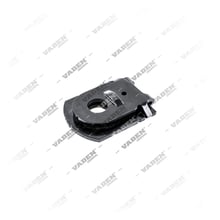
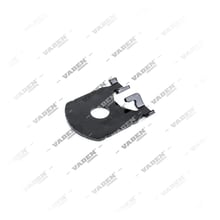
What is the Stabilization Spring Plate?
Since the suspension system on heavily loaded vehicles is constantly exposed to variable loads, this plate is designed to prevent the connection between the axle and spring pack from loosening over time; frequent loading and unloading cycles, particularly on trailers and tipper trucks, increase the mechanical stress on the plate.
What are the functions of the Stabilization Spring Plate?
The plate is a supporting element that preserves the mechanical integrity of the suspension system.
- Retention: Clamps the leaf spring pack firmly to the axle beam, distributing the clamping force of the U-bolts.
- Lateral stabilization: Limits lateral shifting of the spring leaves during cornering or under load.
- Load distribution: Distributes U-bolt clamping pressure evenly across the spring pack, preventing point loading.
- Vibration damping: Reduces looseness that can occur at the contact surfaces between the leaf springs.
What are the symptoms of a faulty Stabilization Spring Plate?
Deformation or breakage of the plate negatively affects vehicle stability and suspension life.
- Cornering instability: The vehicle swaying more than expected in corners indicates the plate or its connection has loosened.
- Metallic squeaking/rattling: Noises heard on rough roads or during braking can indicate a loss of clamping in the spring pack.
- Visible deformation: Bending, cracking or excessive corrosion can be observed on the plate.
- U-bolt loosening: Recurring loosening issues with the bolts around the plate.
- Uneven tire wear: A disturbed axle alignment can create an irregular tire wear pattern.
How is the Stabilization Spring Plate inspected?
Inspection should be carried out with the vehicle raised and unloaded.
- Visual inspection: Check the plate for cracks, bending or excessive corrosion.
- Bolt torque check: Measure U-bolt torque values to identify any loosening.
- Spring pack alignment: Check whether the leaf springs are properly aligned under the plate.
- Play test: Check for play between the spring pack and axle by hand or with a pry bar.
- Road test: Take the vehicle into a low-speed corner and observe for abnormal noise or sway.
What should be considered when replacing it?
Replacing the plate is an operation that affects the overall safety of the suspension system.
- Correct dimensions: The plate must be selected to match the spring pack width and axle beam dimensions.
- U-bolt renewal: Worn or deformed U-bolts should be replaced together with the plate.
- Correct torque sequence: Bolts must be tightened symmetrically and progressively to the value specified in the vehicle's current OE service manual.
- Spring pack alignment: Ensure the leaf springs are correctly aligned with the center pin during installation.
- Re-torque check: Bolt torque should be rechecked during the first period of use after installation.
- Axle position verification: After installation, also confirm the plate is correctly positioned around the center pin and axle alignment has not been disturbed.
How to choose the right Stabilization Spring Plate?
Selection requires correctly matching axle type, spring pack dimensions and vehicle load capacity. The table below summarizes the main criteria.
Stabilization leaf spring plate selection criteria| Criterion | Description |
|---|
| Axle type | Front or rear axle suspension application |
| Spring pack width | Plate width matching the leaf spring pack |
| Material | High-strength, corrosion-resistant steel |
| Bolt hole pattern | Match of U-bolt and center pin hole positions |
| Load capacity | Plate thickness matching the vehicle's load capacity |
Maintenance and service life
The service life of the stabilization leaf spring plate depends on periodic torque checks of the U-bolts and road conditions. For vehicles operating frequently on rough terrain, more frequent visual inspection of the plate and bolt area is recommended. Regular cleaning against corrosion and preventing moisture buildup extends the plate's structural life. Overloading increases stress on the plate and can lead to premature deformation. Periodically disassembling and cleaning the entire leaf spring pack helps remove rust and dirt that accumulate at the contact surfaces between the plate and the spring leaves. Operating the vehicle above its rated load capacity quickly fatigues not only the spring pack but also the plate, so staying within load limits is important for plate longevity.
VADEN Stabilization Spring Plate
VADEN manufactures stabilization leaf spring plates used in heavy commercial vehicle suspension systems to original dimensions and material quality, offering ready-to-fit solutions for securely clamping the leaf spring pack and maintaining vehicle stability. The high-strength steel used in production retains its dimensional stability under repeated road impacts and U-bolt clamping force, and the surface coating provides additional corrosion resistance in humid and salted road conditions. Since load conditions change frequently on trailer, tractor and truck fleets, keeping this plate in periodic maintenance stock reduces the risk of unexpected suspension-related failures. VADEN ensures quality through dimensional measurement and material testing on every production batch.
Frequently Asked Questions (FAQ)
Should the stabilization leaf spring plate be replaced alone or together with the U-bolts?
If the plate is deformed or heavily corroded, the U-bolts on it have usually undergone the same fatigue. For safety, replacing both together is recommended.
Is cornering instability always caused by this plate?
No, shock absorber, anti-roll bar or tire pressure issues can produce similar symptoms. However, if the plate and U-bolts show looseness, this is likely the primary cause.
Why is torque value so important when replacing the plate?
Insufficient torque can allow the spring pack to loosen and shift, while excessive torque can deform the plate or bolt. The exact value should follow the vehicle's current OE service manual.
Does light rust on the plate require immediate replacement?
Light surface rust can be cleaned and inspected; however, if there is structural thinning or pitting, the plate's strength has been reduced and replacement is recommended.
When should the torque check be repeated after installation?
During the first short period of use after a new installation (for example, within the first few hundred kilometers), bolt torque should be rechecked to compensate for settling.
Related technical guide: Heavy-Duty Air Suspension Failures: Air Springs, Leveling Valves and ECAS