What are the functions of the Wheel Hub Repair Kit?
- Re-establishing bearing preload: By supplying, in one set, the components that wear out or are single-use during removal, it allows the bearing clearance to be re-adjusted according to the manufacturer's procedure.
- Renewing the load-bearing bearings: Since the inner and outer bearings carry the same load, the kit makes it easier to replace them as a set rather than on just one side.
- Restoring the seal: The new seal and gasket prevent grease or oil from leaking out and dust or water from getting in, and stop leaking oil from reaching the brake linings.
- Renewing the locking chain: The axle nut, lock washer and safety element fix the adjustment clearance in place; a locking element that has already been deformed once is no longer reliable.
- Complete service in a single visit: Having matched parts arrive in one package avoids waiting for missing parts and refitting the old part.
What are the symptoms of a fault that requires a Wheel Hub Repair Kit?
- Speed-related humming noise: A humming noise that rises as the vehicle accelerates and fades as it slows down points to fatigue on the bearing surfaces or a loss of lubrication.
- Play and vibration in the wheel: Free play felt when the wheel is rocked, steering-wheel vibration, or noise that changes with the direction of a turn, indicate that the bearing adjustment has gone out of spec.
- Oil or grease traces on the inner rim surface: Lubricant escapes due to inner seal leakage, a scored seal wear ring, or a damaged hub cap gasket.
- Excessive heat at a single wheel: A hub that is noticeably hotter than the others on the same axle suggests excessive preload, a low lubricant level, or a damaged bearing.
- Contaminated linings and ABS warning: Leaking oil can soak the brake linings and cause the vehicle to pull under braking; if the play disturbs the sensor gap, the ABS warning light can come on.
How is the wheel hub inspected?
After the vehicle is raised and supported on stands, the wheel is turned by hand to listen for roughness or noise, then rocked while held at the 12 and 6 o'clock positions. Any play that is clearly felt by hand is always excessive; however, feeling nothing does not prove the adjustment is correct, because excessive preload also produces no felt play. For this reason, the decision is made by measuring axial play with a dial indicator. For the heat check, the difference matters more than the absolute value: hub temperatures on the same axle are compared with an infrared thermometer after a stretch of driving without braking. For a leak, the area is cleaned and, after a short drive, it is checked whether the wetness starts from the seal line or from the axle shaft flange. After disassembly, the bearing races are checked for pitting and bluing, and the seal wear ring is checked for scoring.
What should be considered during replacement?
Before opening the hub, the kit's contents should be verified against the list on the product page, and its fitment confirmed against the axle code. The spindle, the seal wear ring and the bearing races must be cleaned completely; any dirt left behind will wear the new bearing within the first few kilometres. Outer races must be pressed into place with a fitting tool, never driven in with hammer blows. The bearings must be packed with the specified lubricant so that the space between the rollers is filled, and grease types must not be mixed. The seal is fitted without tilting, with its lip facing the oil side. Bearing preload is set by procedure, not by feel: the nut is tightened while rotating the hub, brought to the final value specified by the manufacturer, and the play is confirmed with a dial indicator. The seal, lock washer and safety element are renewed at every removal. No general figure can be given for torque and play; for exact values, the vehicle manufacturer's current service manual is the authoritative source. Wheel nut torque should be re-checked after the first short period of use.
How to choose the right Wheel Hub Repair Kit?
Even within the same vehicle model, the wheel hub varies by axle manufacturer, axle capacity, brake type and bearing arrangement; the repair kit should therefore be selected by verifying the axle code together with the OE reference number.
Selection criteria for Wheel Hub Repair Kit| Criterion | Why it matters |
|---|
| Axle code and axle capacity | Bearing sizes and the type of locking element are specific to the axle; the vehicle model alone is not enough |
| Bearing arrangement (adjustable / unitized) | No field adjustment is made on a unitized cartridge; the kit's scope also changes according to the arrangement |
| Lubrication type (grease / oil bath) | The seal and hub cap gasket type is selected according to the lubrication method |
| OE reference number | Confirms that the kit's contents and dimensions match the removed part exactly |
Maintenance and service life
On a vehicle that receives regular maintenance, the wheel hub is one of the longest-lasting assemblies; its service life is determined by lubrication, sealing and correct adjustment. A significant share of field hub failures do not come from the bearing fatiguing on its own but from lubrication being slowly lost after a small seal leak. In an oil-bath arrangement, the level should be checked at every service against the sight line on the hub cap; in a grease-lubricated arrangement, the grease should be renewed at the manufacturer's specified interval. When servicing the brakes, also checking the bearing play and the seal, avoiding overloading, and keeping pressurized water away from the seal line all extend service life. Renewing the parts as a set in the same service visit is more economical than raising the vehicle again later.
VADEN Wheel Hub Repair Kit
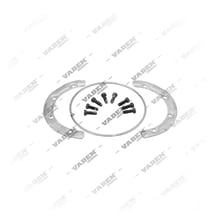
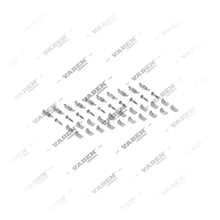
The VADEN ORIGINAL Wheel Hub Repair Kit offers, in a matched package based on OE dimensions and fitment data, the parts that need renewing when servicing the wheel hub. The kit's contents vary by product code; they can typically include the bearings, the seal or sealing element, the axle nut, the lock washer, a washer and a retaining ring. See the list on the product page for exact contents and OE references. The cap, lock washer and washer are also available as individual parts in separate categories.
Frequently Asked Questions (FAQ)
What parts are included in the Wheel Hub Repair Kit?
Contents vary by product code; they can typically include the bearings, the seal or sealing element, the axle nut, the lock washer, a washer and a retaining ring. See the contents information on the product page for the exact list.
Once the wheel hub is removed, can the seal and lock washer be reused?
No. During its first use, the seal lip takes the imprint of the wear ring and will not seat in the same spot on a second installation; the lock washer and safety element have already deformed once and can no longer provide reliable locking. These parts are renewed at every removal.
Is it enough to replace only the damaged bearing?
Generally not. The inner and outer bearings have carried the same load over the same mileage; renewing only one side can cause the new bearing to reach the condition of the old one within a short time. The bearings should be treated as a set together with their outer races.
What should the wheel hub bearing play and axle nut torque be?
The value depends on the axle manufacturer, the axle capacity and the bearing arrangement, so no exact figure is given here. Play is confirmed with a dial indicator, and the vehicle manufacturer's current service manual is the authoritative source. On a unitized cartridge arrangement, no adjustment is made; only the specified torque is applied.
How is the correct repair kit selected?
Not by vehicle model; it is selected by verifying together the axle code on the axle plate, the axle capacity, the bearing and lubrication arrangement, and the OE reference number on the old part.
Related technical guide: Truck Wheel Hub: Faults, Replacement and Maintenance Guide