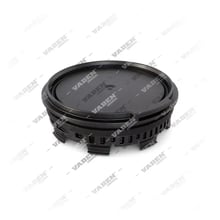
What is a Wheel Hub Cover?
- Location: At the outer end of the wheel hub body, at the point covering the axle shaft and hub nut assembly.
- Material: Stamped sheet steel or plastic/polycarbonate body, with a corrosion-resistant surface coating on some models.
- Parts used together with it: Gasket or O-ring, a grease nipple on some models, and a transparent inspection window on oil-level types.
- Application: Truck, tractor unit, bus, and trailer wheel hub assemblies.
What are the functions of the Wheel Hub Cover?
The cover's primary function is to prevent grease or oil inside the wheel hub from leaking out and to protect the hub nut assembly from external factors. It also prevents contaminants such as dust, water, and dirt from reaching the bearing and nut area, preventing premature wear and corrosion.
- Sealing: Prevents grease or oil from leaking out of the hub.
- Protection: Prevents dust, moisture, and dirt from reaching the bearing and nut assembly.
- Maintains grease/oil level: Ensures the amount of lubricant inside the hub remains at a sufficient level.
- Protects the nut assembly: Protects the hub nut and locking elements against impact, corrosion, and contamination.
What are the symptoms of Wheel Hub Cover failure?
Cover failure generally shows itself as grease or oil leakage caused by a crack or wear in the gasket or the cover itself. Contamination around the hub, a sudden drop in oil level, and the cover loosening or falling off are typical symptoms.
- Oil/grease leakage: Visible oil stains or dripping around the wheel hub cover.
- Cover looseness or falling off: The cover shifting out of position or falling off entirely, leaving the hub unprotected.
- Abnormal noise: A rattling sound caused by the cover vibrating as the wheel rotates.
- Drop in oil level: On covers with a transparent window, the oil level dropping faster than expected.
- Visible corrosion: Rust or cracking on the cover surface.
How is the Wheel Hub Cover inspected?
Inspection begins with a visual examination of the area around the cover and the gasket surface. Then it is observed whether the cover sits fully on the hub and whether there is any leakage; if necessary, the cover is removed and the gasket surface and hub nut area are checked.
- Visual inspection: Scanning for oil stains, cracks, and corrosion.
- Seating check: Verifying that the cover sits fully and firmly on the hub opening, with no looseness.
- Removal check: Checking the evenness of the gasket surface and the condition of the hub nut/locking elements.
- Oil level check: On covers with a transparent window, verifying that the oil level is within the OE range.
What should be considered when replacing it?
When replacing the cover, care should first be taken to remove the existing cover without damaging or deforming it, and the grease or oil level inside the hub should be checked. The gasket surface of the removed cover should be cleaned, installation should be carried out with a new gasket, and the cover should be seated on the hub with even pressure.
- Correct removal: The cover should be removed with a suitable removal tool without damaging the hub opening.
- Gasket renewal: The gasket/O-ring must always be replaced together with the cover.
- Surface cleanliness: No residue from the old gasket should be left on the body surface.
- Installation pressure/torque: Press-fit covers should be seated with even, non-deforming pressure, while bolted covers should follow the general torque range; the vehicle's current OE service manual should always be the reference.
- Oil/grease filling: After installation, the lubricant level inside the hub should be topped up to the OE value.
How to choose a Wheel Hub Cover?
The wheel hub model, hub opening diameter, and gasket compatibility are the determining criteria in choosing the correct cover. A cover of the wrong diameter or made from the wrong material can compromise sealing and lead to premature failure; therefore a product matching OEM dimensions should be preferred.
Wheel Hub Cover selection criteria| Parameter | Typical value / range |
|---|
| Hub opening diameter | Varies by wheel hub model; the exact dimension should be confirmed with the OEM number |
| Temperature resistance | -30°C to +120°C |
| Material | Stamped sheet steel or plastic/polycarbonate |
| Gasket type | NBR-based, oil- and grease-resistant |
| Compatibility | Exact match with the wheel hub model and OEM part number |
Maintenance and service life
The service life of the wheel hub cover is directly related to the cleanliness and regular inspection of the grease or oil inside the hub. Dirty or degraded lubricant causes premature wear on the gasket and cover surfaces. Periodic oil/grease level checks and visual leak inspections help detect a potential failure early. The operating environment of the vehicle also affects service life; on vehicles operating in salty, humid, or dusty regions, corrosion on the cover surface can begin earlier, so underbody washing and protective coating applications are complementary measures that extend cover life.
Having the wheel hub assembly regularly inspected at an authorized service center prevents premature wear not only of the cover but also of the bearing and nut assembly inside the hub. The recommended approach for fleet operators is to include a visual inspection of the wheel hub cover area in the periodic maintenance plan and to note the condition of the cover gasket during wheel servicing.
VADEN Wheel Hub Cover
For the wheel hub cover it produces for heavy commercial vehicle wheel hub systems, VADEN follows OEM dimensional and material standards. Products are manufactured to match the original hub tolerances, aiming to ensure sealing from the very first moment after installation. For correct application and compatibility information, the VADEN product catalog and technical support line can be consulted; service teams can quickly confirm the correct cover model using the vehicle's license plate or chassis number.
Frequently Asked Questions (FAQ)
What happens if a wheel hub cover leak goes unnoticed?
A small leak may not be noticed at first, but as the grease or oil level drops, the bearings receive insufficient lubrication and wear accelerates over time. Early intervention is recommended once a leak is detected.
Is it necessary to replace the gasket when replacing the cover?
Yes, a used gasket generally loses its flexibility, so reusing it increases the risk of leakage; installing a new gasket/O-ring together with the cover is recommended.
What problems can an incorrectly installed cover cause?
A cover seated crookedly or deformed can cause leakage, while a cover forced into place with excessive pressure can damage the body edges or crush the gasket; the vehicle's current OE service manual should be followed during installation.
How often should the wheel hub cover be inspected?
There is no fixed interval; a visual leak inspection is recommended during periodic maintenance and before long-haul trips.
If the cover shows corrosion, should it be replaced or cleaned?
Surface rust can be cleaned, but if there is deep corrosion or cracking, replacing the cover is recommended since sealing cannot be guaranteed.
Related technical guide: Truck Wheel Hub: Faults, Replacement and Maintenance Guide