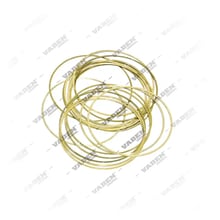
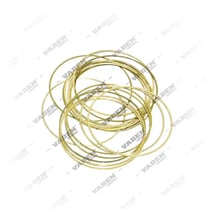
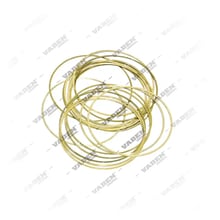
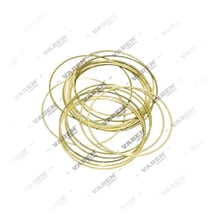
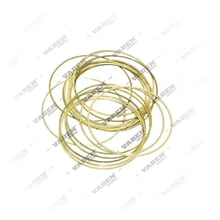
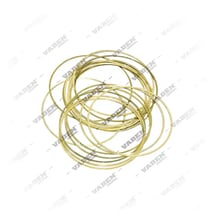
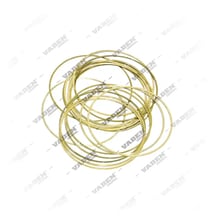
What Is a Piston & Liner Shim?
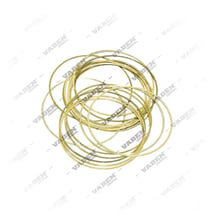
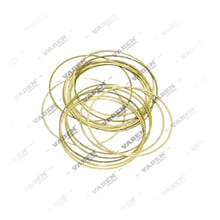
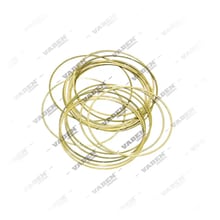
A Piston & Liner Shim is a thin metal ring fitted between the cylinder liner and its seating surface on the block in heavy-duty diesel engines, used to set liner protrusion. In the field it is simply called a liner shim. The height difference between block bore and liner flange never comes out the same on every engine, due to manufacturing tolerances and prior resurfacing, and the shim closes that gap so the liner seats correctly.
The category sits under the Piston & Liner subgroup within the Engine main group, alongside pistons, piston rings, liners, and liner seals. In truck, tractor, bus, and off-highway engines this protrusion must stay within a narrow tolerance, or the head gasket will not see the correct clamping load.
How Does a Piston & Liner Shim Work?
Wet-type cylinder liners seat on shoulders machined into the block, with their top surface sitting a set amount above the block deck. That difference is called liner protrusion, and it determines how much sealing pressure the gasket sees once the head is torqued down. The shim sits between the liner and its seating surface, moving protrusion into range.
- Height adjustment: If measured protrusion falls short of target, a shim of the right thickness brings it back into range.
- Balanced gasket load: Correct protrusion lets the gasket carry even pressure around the combustion chamber.
- Protected seating surface: Creates a clean, even contact area between liner flange and block shoulder.
- Reduced vibration: A firmly seated liner vibrates less, slowing cavitation-related wear on its outer wall.
- Cylinder-to-cylinder consistency: Each cylinder is measured individually and corrected with the appropriate shim.
Piston & Liner Shim Technical Specifications
Liner shims are manufactured from steel or copper-based material, formed into a thin, flat ring. The material is chosen to hold its dimensions under oil, coolant, and high temperature, and to resist crushing under varying head-bolt load. Surface flatness and thickness tolerance are the two most decisive properties; an out-of-spec shim becomes the error it was meant to correct.
Thicknesses are supplied in a graduated series, from a few hundredths of a millimeter up to a few tenths, with inner and outer diameter set by the liner flange size. Target protrusion varies by engine and is defined within a narrow range; for measurement and tolerance values, the vehicle manufacturer's current service manual is the authority.
Piston & Liner Shim Types and Subgroups
- Graduated thickness series: One diameter in multiple thicknesses, so the closest shim to the measured result can be selected.
- Steel liner shims: Resist crushing; common in heavy-duty engines running high cylinder pressures.
- Copper-based shims: A more conformable contact surface, tolerating minor surface imperfections.
- Engine-family-specific sets: Multi-thickness sets matched to a particular engine series.
- Kits with sealing components: Packages bundled with the liner seal and gasket.
- Groups by brand application: Dimension groups by liner-bore fit for Mercedes-Benz, MAN, Scania, Volvo, DAF, Iveco, and Renault Trucks.
How to Choose the Right Piston & Liner Shim
Shim selection is done by measurement, not guesswork. Once the block deck and liner bore are cleaned, the liner is set in place without a shim, and protrusion is read at several points with a dial gauge and bridge or a depth gauge. The difference between the reading and the target gives the required thickness. Repeat the measurement under the preload the manufacturer specifies.
Criteria to check when selecting a Piston & Liner Shim| Criterion | What to check | Why it matters |
|---|
| Engine type and OE number | Engine series and OE reference for the liner group | Bore size differs across engines from the same brand |
| Shim thickness | Difference between measured protrusion and target range | Wrong thickness upsets gasket clamping load |
| Inner and outer diameter | Fit against liner flange and block shoulder | An oversized shim will not form a clean contact area |
| Material | Steel or copper-based construction, surface flatness | Crush resistance determines how long the setting holds |
| Quantity logic | Using a single shim per cylinder | Stacking shims reduces stability of the setting |
| Cylinder-to-cylinder variation | Protrusion values across all cylinders | Head-bolt load needs even distribution |
Piston & Liner Shim Maintenance and Points to Watch
- Clean surfaces thoroughly: Gasket residue, scale, or corrosion on the block shoulder skews the reading and gives a false protrusion value.
- Use a single shim: Choose one shim at the right thickness grade rather than stacking two thin ones.
- Measure each cylinder separately: Block wear varies cylinder to cylinder, so do not generalize from one reading.
- Inspect the shim before fitting: A bent, burred, or deformed shim should not be used, and a removed shim should not be refitted.
- Follow the tightening procedure: Bolts must be torqued in the specified sequence, stages, and value.
- Renew liner seals: If the liner was removed, the lower sealing elements must be new, or coolant can leak into the crankcase.
Common Failures and Their Solutions
- Combustion gas leaking past the head gasket: Bubbling in the coolant tank and a loss of power. Usually protrusion is below target; remeasure and correct with the right shim.
- Cracking at the liner flange or seat collapse: Caused by excessive protrusion or the wrong shim. Renew liner and shim together, and check the shoulder surface.
- Coolant mixing into the oil: Linked to lower seals not seating properly or the liner sitting too low. Remove the liner and re-check shim and seals.
- Irregular knocking and vibration: Seen when the liner moves in its bore or the shim has crushed. Remeasure protrusion and replace a crushed shim.
- Torque loss at head bolts: Stacked or softened shims crush over time and throw off the setting. Switch to a single shim of correct material.
Why VADEN ORIGINAL?
- Manufactured to OE dimensions: Thickness, diameter, and surface flatness are machined to the same logic as the original part.
- Broad OEM coverage: Matches common liner groups found in Mercedes-Benz, MAN, Scania, Volvo, DAF, Iveco, and Renault Trucks engines.
- Graduated thickness options: Multiple grades let you pick the value closest to your measurement, no stacking needed.
- Stable material quality: Holds its thickness under high temperature and varying load.
- Exported to over 100 countries: A broad service and distributor network makes supply easy.
Conclusion
A Piston & Liner Shim is a small but decisive component that brings liner protrusion in heavy-duty diesel engines into the target range. A shim selected at the correct thickness and fitted as a single piece onto a clean surface lets the head gasket carry a balanced clamping load, preventing gas leaks and repeat gasket failures. Protrusion should be measured at every liner change, and a matching shim fitted. For dimension and torque values, the vehicle manufacturer's current service manual is the authority.
Frequently Asked Questions (FAQ)
What does a Piston & Liner Shim do?
It is fitted onto the cylinder liner's seating surface on the block to set liner protrusion, how much the liner stands proud of the block deck. This height determines how evenly the head gasket clamps down and keeps the combustion chamber sealed. A shim selected at the right dimension has a direct effect on the engine's reliability after an overhaul.
How is liner protrusion measured, and which shim thickness should be chosen?
After the block shoulder and liner flange are fully cleaned, the liner is set in place without a shim and protrusion is read at several points with a dial gauge and bridge. The difference between the reading and the target range gives the shim thickness needed. Since target protrusion varies by engine, the vehicle manufacturer's current service manual is the authority.
Can two shims be stacked on the same cylinder?
Standard practice is to use a single shim. Thin shims stacked together crush over time, throwing off the protrusion setting and potentially causing torque loss at the head bolts. Choose the single thickness grade closest to the target.
Should the liner shim be renewed at every liner change?
A removed shim may be crushed, bent, or scratched, so reusing it is not recommended. At every liner change, protrusion should be remeasured and a new shim fitted to match the result. The liner's lower sealing elements should be renewed at the same time.
Which engines are VADEN ORIGINAL liner shims compatible with?
The catalogued references correspond to the common liner groups used in Mercedes-Benz, MAN, Scania, Volvo, DAF, Iveco, and Renault Trucks heavy-duty engines. The most reliable way to find the right part is to match by OE reference number together with the engine type.
Related technical guide: Engine Piston & Liner: Faults, Replacement and Maintenance
Related technical guide: Engine Piston, Liner & Ring Set: Failure and Replacement