What Is EBS on a Truck? Electronic Braking System vs ABS and TEBS
How a truck electronic braking system works, how EBS differs from ABS, its main components, trailer EBS (TEBS), the ISO 7638 link and warning lamps.
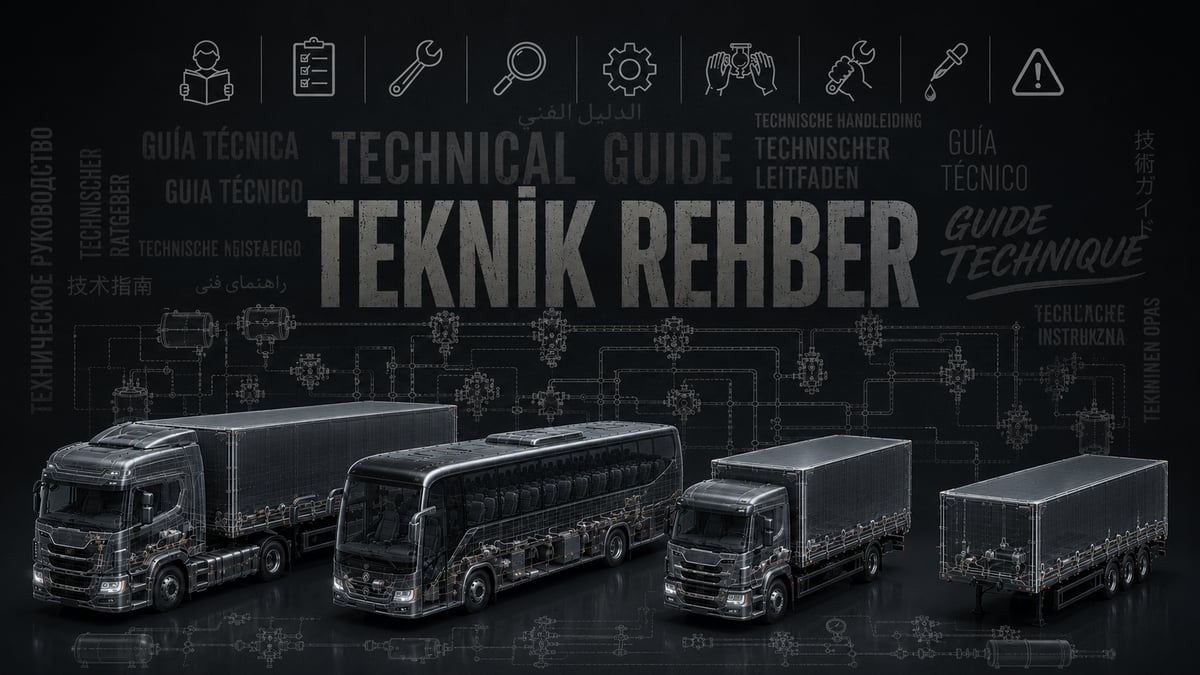
Drivers moving to a current tractor often say the brakes feel sharper from the first part of the pedal stroke, and the trailer no longer pushes the truck when slowing down. In the workshop the same change looks different: the brake system now has its own fault memory, a diagnostic connection and a dashboard lamp marked EBS. This guide explains what an electronic braking system is, how it differs from ABS, which components it uses, and how the trailer joins in through TEBS and the ISO 7638 connection.
What Is EBS on a Truck?
EBS (Electronic Braking System) on a truck is an air brake system in which the driver's brake demand travels to the axles as an electrical signal, while compressed air still does the work at the brake chambers. A central module calculates the required pressure for each axle, modulators set that pressure, and a pneumatic backup circuit keeps the truck braking if the electronics fail.
UN Regulation No. 13 describes the principle as a braking system with an electric control transmission. The compressor, air dryer, protection valve and air tanks supply air exactly as on a conventional truck; only the control side changes. Instead of air pressure travelling along control lines to every relay valve, the pedal movement is measured electronically and each axle receives its pressure command through a wire.
EBS was introduced on European heavy trucks in the mid-1990s and is found today on most current tractors, rigid trucks and buses from Mercedes-Benz, Volvo, DAF, MAN, Scania, Iveco and Renault Trucks. In North America, heavy trucks are still generally built with pneumatic control plus ABS. The main system suppliers are Knorr-Bremse and WABCO, whose architectures differ in detail but follow the same logic.
How Does a Truck EBS Work, Step by Step?
A truck EBS works as a closed control loop that starts at the pedal and ends at the brake chamber, with pressure feedback flowing back to the electronics. The sequence below describes a normal service brake application on a tractor unit coupled to a trailer.
- The driver presses the pedal. Inside the foot brake module (also called the brake signal transmitter), two independent travel sensors convert the pedal stroke into electrical signals, and at the same time two pneumatic circuits produce a backup control pressure.
- The central EBS module combines the driver's demand with axle load, wheel speed, lining wear data and requests from systems such as the retarder.
- The central module sends a target pressure for each axle and the trailer over the brake system's data bus.
- Each modulator fills or exhausts its brake chambers through fast-acting solenoid valves and a relay section, using supply air taken directly from the tanks.
- Pressure sensors inside the modulators measure the actual chamber pressure and report it back, so the difference between demanded and delivered pressure is corrected continuously.
- If a wheel starts to lock or spin, the same modulators reduce, hold or rebuild pressure on that wheel.
- The backup pressure waits at redundancy valves in the modulators and takes over only if electrical control of that circuit is lost.
Because the signal travels electrically, pressure builds at the rear axle and trailer with much less delay than in a purely pneumatic system.
What Is the Difference Between EBS and ABS?
The difference between EBS and ABS is one of scope. ABS (anti-lock braking system) is a safety function added on top of a pneumatically controlled brake system: it only steps in when a wheel is about to lock. EBS controls the whole brake application from the first moment of pedal travel, and ABS becomes one of the functions it performs. A truck with EBS therefore always has ABS, but a truck with ABS does not necessarily have EBS. The ABS brake system guide covers the anti-lock side.
| Feature | Pneumatic brake with ABS | EBS |
|---|---|---|
| Brake control signal | Air pressure from the foot brake valve to relay valves | Electrical signal from the foot brake module, with pneumatic backup |
| When the electronics act | Only when a wheel is about to lock (and wheel spin, if ASR is fitted) | During every brake application |
| Load-dependent braking | Mechanical or pneumatic load sensing valve on the axle | Calculated electronically from axle load data |
| Response at rear axle and trailer | Delayed by the length of the air control lines | Much shorter delay, as the command travels by wire |
| Brake lining wear between axles | Not actively balanced | Can be balanced within limits using wear sensor data |
| Trailer control | Pneumatic control line only | Electric and pneumatic control line, plus coupling force control |
| Typical control parts | ABS control unit, wheel speed sensors, ABS solenoid modulator valves, relay valves | Central module, foot brake module, axle modulators, proportional relay valve, trailer control module, sensors |
| Diagnostics | Fault codes for the anti-lock function | Fault codes, pressure values and status data for the whole brake system |
The load sensing point is worth noting. On many ABS trucks a mechanical valve on the axle adjusts brake pressure to the load, as explained in the ALB load sensing valve guide. On an EBS truck that job moves into software, and the axle load is estimated by the system, for example from air suspension pressure or from the difference in wheel slip between axles.
What Are the Main Components of a Truck EBS?
The main components of a truck EBS are a central module, a foot brake module, axle modulators, a trailer control module and a set of sensors. Names differ between suppliers and some parts share a housing, but the functions are the same.
Central module
The EBS central module is the computer of the brake system. It decides how much pressure each axle and the trailer receive and stores fault codes; on some layouts it is combined with front axle control. For the module units VADEN supplies, see the EBS brake modules category; each is selected by OE number.
Foot brake module or brake signal transmitter
The foot brake module, which WABCO-type systems call the brake signal transmitter, sits under the pedal. It contains redundant electrical travel sensors and pneumatic sections that deliver the backup control pressure. On an EBS truck it replaces the purely pneumatic foot brake valve, although it looks similar from the outside. See the EBS brake signal transmitter category for the unit family.
Axle modulators
The EBS axle modulator controls brake pressure on an axle, usually with two independent channels for the left and right sides. A typical rear axle modulator combines solenoid valves, a relay section, pressure sensors, a redundancy valve and electronics in one housing. VADEN supplies EBS axle modulators and matching repair kits.
Front axle control and proportional relay valve
Front axle control on a truck EBS is handled either by single-channel modulators or by a proportional relay valve that converts the electrical command into pressure, often working together with ABS solenoid valves for each front wheel. The EBS relay valve family belongs to this part of the system.
Trailer control module
The EBS trailer control module on the towing vehicle supplies the trailer and sets the pressure in the trailer's pneumatic control line according to the central module's command. The EBS trailer control valves category covers this unit.
Wheel speed, wear and pressure sensors
EBS sensors provide the data the central module works with. Wheel speed sensors read a toothed ring at each wheel, exactly as on an ABS truck; the ABS wheel speed sensor guide explains how they generate their signal. Brake lining wear sensors on air disc brakes report how much friction material is left, and pressure sensors inside the modulators close the control loop.
What Does an EBS Do Beyond Anti-Lock Braking?
An EBS does much more than prevent wheel lock, because the central module takes part in every brake application. Which of the functions below a truck has depends on its specification.
- Brake force distribution: pressure is shared between axles according to the actual load, so an empty truck does not over-brake its rear axle and a loaded one receives full pressure.
- Wear harmonisation: using lining wear data, the system can shift a small share of braking between axles so pads on all axles reach the end of their life closer together.
- Coupling force control: the trailer control pressure is adjusted so that the trailer carries its own share of braking, reducing push and pull forces in the coupling.
- Traction control (ASR): a spinning drive wheel is braked and engine torque is reduced.
- Retarder and engine brake blending: the central module can use wear-free brakes first and add service brake pressure only when more deceleration is requested.
- Base for stability and emergency braking: stability control and advanced emergency braking use the EBS modulators to brake without the driver touching the pedal.
What Is Trailer EBS (TEBS) and How Does It Connect to the Truck?
Trailer EBS, usually shortened to TEBS, is the trailer's own electronic braking system: a modulator with an integrated control unit that sets brake pressure on the trailer axles. TEBS gives the trailer anti-lock braking, load-dependent pressure and, on most current units, roll stability support. VADEN's EBS trailer modulator category covers this unit family.
TEBS receives commands from the towing vehicle in two ways at the same time. The pneumatic control line (the yellow coupling head in Europe; in North America the service line is usually blue) carries a control pressure, and the electrical ISO 7638 connection carries power and data. ISO 7638 is the international standard for the electrical connector that supplies trailer ABS and EBS; the seven-pin version includes two data lines over which the truck and the trailer exchange brake commands and status messages according to ISO 11992. Earlier five-pin versions only powered trailer ABS. The red supply line keeps feeding air to the trailer tanks in both cases.
If the ISO 7638 cable is missing or damaged, the trailer still brakes from the pneumatic control line, but its anti-lock and stability functions are lost or limited. The pneumatic side of the trailer interface is covered in the trailer control valve guide.
EBS or TEBS: What Is the Difference and Do You Need Both?
EBS and TEBS are not competing options: EBS is the braking system of the towing vehicle and TEBS is the braking system of the trailer. The two are designed to work as a pair. An EBS tractor can pull a trailer with conventional ABS or with TEBS, and a TEBS trailer can be pulled by a tractor without EBS, as long as the ISO 7638 power supply is connected.
| Point | EBS (towing vehicle) | TEBS (trailer) |
|---|---|---|
| Installed on | Tractor unit, rigid truck, bus or coach | Semi-trailer, drawbar trailer, centre-axle trailer |
| Main control unit | Central module plus axle modulators | Trailer modulator with integrated control unit |
| Brake demand comes from | Driver's foot brake module and vehicle systems | Towing vehicle via ISO 7638 data and pneumatic control line |
| Load information | Axle load estimated from suspension pressure or wheel slip | Air suspension pressure on the trailer axles |
| Stability function | Electronic stability control on many trucks | Roll stability support on most current units |
| Without electrics | Pneumatic backup circuit from the foot brake module | Pneumatic braking from the control line, anti-lock lost or limited |
What Do the EBS Warning Lamps Mean?
EBS warning lamps tell the driver how much of the electronic braking system is still available. Symbols and colours vary by manufacturer, so the operator manual is the reference, but a red brake warning usually means a serious fault that requires stopping safely, while an amber EBS or ABS lamp means some electronic functions are reduced. A separate lamp covers trailer ABS or TEBS.
A lamp that stays on after the start-up self-check, comes on while driving or flashes means a fault code has been stored. Reading that code with a diagnostic tool is the first step, because the cause may lie in a sensor, a cable, a connector, the power supply or a modulator. Fault symptoms, diagnosis order and modulator replacement are explained step by step in the EBS modulator guide.
Standards and Further Reading
The legal and technical framework for truck electronic braking systems is set by type approval rules and connector standards. In Europe and in other countries applying the UNECE vehicle regulations, braking systems including electric control transmission are approved under UN Regulation No. 13, and the truck-to-trailer electrical connection follows ISO 7638 together with the data protocol in ISO 11992. In the United Kingdom, regulation 18 of the Road Vehicles (Construction and Use) Regulations 1986 requires the braking system to be maintained in good and efficient working order, and the DVSA HGV inspection manual describes how brake warning devices and anti-lock systems are checked at inspection.
United States: air brake design and performance requirements, including the anti-lock requirement, are set out in 49 CFR 571.121 (FMVSS 121). In Canada, air brake systems fall under the Motor Vehicle Safety Regulations, which contain CMVSS 121.
Main guide: ABS Brake System: How It Works, Warning Light and Faults
Tags
Frequently Asked Questions
- What does EBS stand for on a truck?
- On a truck, EBS stands for Electronic Braking System, sometimes written as electronically controlled braking system. The driver's brake demand is measured electronically at the pedal and sent to the axle modulators as an electrical command, while compressed air still applies the brakes. A pneumatic backup circuit remains in place, so the truck can still brake if the electronic control fails.
- Is EBS the same as ABS?
- No. ABS is an anti-lock function that only intervenes when a wheel is about to lock, on a brake system that is otherwise controlled pneumatically. EBS controls the entire brake application electronically and includes ABS as one of its functions, together with load-dependent brake distribution, traction control and trailer coupling force control. Every EBS truck has ABS, but not every ABS truck has EBS.
- Can a truck still brake if the EBS fails?
- Yes. EBS is designed with a pneumatic backup circuit: the foot brake module produces a backup control pressure that is held at redundancy valves in the modulators and takes over if the electrical control of a circuit is lost. The truck still stops, but load-dependent functions may be lost and the warning lamp indicates this mode.
- What is the difference between EBS and TEBS?
- EBS is the electronic braking system of the towing vehicle, while TEBS (trailer EBS) is the electronic braking system fitted to the trailer. TEBS has its own modulator and control unit, reads its own wheel speed sensors and suspension pressure, and receives commands from the truck through the ISO 7638 connection and the pneumatic control line. The two systems are designed to work together rather than replace each other.
- What is the ISO 7638 connector used for?
- The ISO 7638 connector supplies power to the trailer's ABS or EBS and, in its seven-pin version, carries the data lines over which the truck and trailer exchange brake commands and status messages according to ISO 11992. Without it, a TEBS trailer brakes only pneumatically and its electronic functions are lost.
- Can a TEBS trailer be towed by a truck without EBS?
- Yes, as long as the truck provides an ISO 7638 power supply for the trailer brake electronics. The trailer then takes its brake demand from the pneumatic control line, while TEBS still provides anti-lock braking, load-dependent pressure and roll stability support. What is lost is the electrical brake command from the truck, so the trailer response is slightly slower and coupling force control is not available.
- Does EBS replace the foot brake valve?
- On an EBS truck the conventional foot brake valve is replaced by a foot brake module, also called a brake signal transmitter. It looks similar and sits in the same place under the pedal, but it contains electronic travel sensors in addition to the pneumatic sections that provide the backup pressure. The two are not interchangeable, so the replacement unit must be selected by its OE number.
- Why does the EBS lamp come on at start-up and then go out?
- The EBS lamp lights at ignition as a self-test, showing that the lamp works and that the system is checking itself. It should go out after a few seconds or, on some trucks and trailers, once the vehicle has moved off and the wheel speed sensors have been confirmed. A lamp that stays on or comes on during driving indicates a stored fault code that should be read with a diagnostic tool.
- Do American trucks use EBS?
- Most North American heavy trucks and tractors use pneumatic brake control with ABS, which federal rule FMVSS 121 requires, rather than full EBS. Electronic stability control on these trucks is usually built on the ABS platform. Full EBS is found mainly on vehicles built to European specifications.
- Does EBS reduce brake lining wear?
- EBS can help brake linings wear more evenly. With lining wear sensors on air disc brakes, the central module can shift a small share of braking effort between axles so that pads reach the end of their life closer together. Actual lining life still depends on load, route and driving style.
Related Articles
Tractor Protection Valve: How It Works, How to Test It, Failure Signs
What a truck's tractor protection valve does in a breakaway or low air, how it works with the red trailer supply knob, how to test it and spot failure signs.
ABS Brake System: How It Works, Warning Light and Faults
Learn how the ABS brake system works on heavy trucks, why the warning light comes on, how to diagnose sensor faults, and the correct replacement steps.
Brake Chamber, Diaphragm & Hose: Faults, Replacement, Care
Learn how to spot a leaking brake chamber, measure push rod stroke, cage the power spring safely and replace the unit and hose without risk on heavy trucks.