What Is a Truck Chassis? Frame Structure, Types and Mounting Parts
How a truck, tractor and trailer chassis is built: ladder frame rails, crossmembers, steel grades, chassis types, the parts bolted to it and what the VIN means.
Put a truck over a pit and look up, and the first thing you see is two heavy steel rails running from front to rear, tied together by shorter beams. The engine, transmission, axles, suspension, cab, fuel tank, air tanks and body all hang from that skeleton. Yet the chassis rarely gets attention until a conversion, a crack or an inspection finding puts it on the job card. This guide explains what a truck chassis is, how it is built, which types exist and how the parts bolted to it work.
This document was prepared by the VADEN technical team to explain the structure of truck, tractor, bus and trailer chassis independently of any vehicle brand. Dimensions, sections and material grades in the text are general reference values and vary by model, version and production year. For exact data, the current OE service manual matching the vehicle's engine/chassis code and the manufacturer's body builder guidelines take precedence. Last updated: October 2026.
What is a truck chassis?
A truck chassis is the load-bearing skeleton that carries a vehicle's engine, driveline, axles, suspension, cab and body, and passes payload and road shocks down to the axles. On trucks, tractors, buses and trailers it is usually a ladder-type steel frame of two long side rails joined by crossmembers, built separately from the body.
The word comes from the French "châssis", meaning a frame. In North America the structural part is usually called the "frame" and its long members "frame rails", while "chassis" often means the frame together with axles, suspension and driveline, as in "cab-and-chassis". In Europe, India and many other markets "chassis" means the frame itself. Either way, the chassis does three jobs: it carries the weight of the vehicle and its load, transfers drive, braking and road forces from one end to the other, and gives every component a fixed mounting base.
Most passenger cars have no separate chassis: body and structure are one welded shell, a monocoque or unibody. On heavy-duty vehicles the range of loads and bodies is so wide that the frame is kept separate from the cab and the body. That is why the same chassis can carry a tipper, a tanker, a refrigerated box, a mixer, a crane or a concrete pump.
How is a ladder frame chassis built on a heavy-duty truck?
A ladder frame chassis consists of two side rails running the length of the vehicle and crossmembers that connect them at set intervals. From above it looks like a ladder: the rails are the uprights, the crossmembers the rungs.
The side rails do most of the load carrying. On a loaded truck the middle of each rail tries to bend downwards, and the upper and lower flanges resist that bending. Crossmembers keep the rails square, limit twist and give extra mounting points for heavy equipment such as the engine, transmission, fuel tank or fifth wheel.
A heavy-duty ladder frame is designed to flex. When one wheel drops into a hole, the frame twists in a controlled way and limits the stress on the suspension, the load and the fasteners. Rigid connections that stiffen the frame at one point, random reinforcement plates and unapproved welds change how the structure works. How cracks start where that flexibility is lost is covered in Truck Chassis Crack: Causes, Risk Assessment and Weld Repair Limits.
Which axle configurations is a truck chassis built in?
Very different chassis can sit under one model name. Truck and tractor chassis are described by codes such as 4x2, 6x2, 6x4, 8x2 or 8x4: the first number counts wheel positions, the second driven wheel positions. Wheelbase, rear overhang, frame height and suspension type are also part of the chassis identity, so the model name alone is not enough when ordering a chassis part; check the chassis code and the part's OE number together.
What material and cross-section are truck frame rails made from?
Heavy-duty frame rails are mostly formed from high-yield-strength steel sheet suitable for cold forming. In Europe these grades fall under the EN 10149 family, and frame rails commonly use yield strengths roughly between 400 and 700 MPa. North American builders often quote rail strength as a resisting bending moment (RBM). High-strength steel gives the same capacity with a thinner section, lowering tare weight and raising payload.
The most common side rail section is the C-channel: a horizontal flange at top and bottom joined by a vertical web. On typical trucks the rail is roughly 250 to 330 mm high with a wall of about 6 to 10 mm. Heavy-haul and construction versions add a second channel inside the main rail, called an inner liner or insert. Trailers more often use welded I-beam main rails.
| Section type | Where it is used | Key property | What to watch |
|---|---|---|---|
| C-channel side rail | Truck and tractor chassis | Formed by bending, flat web for mounting holes | Flange holes and edge notches speed up fatigue |
| Double C-channel (inner liner) | Tipper, mixer and heavy-haul chassis | Higher bending strength at the same height | Fastening and corrosion between the channels |
| Welded I-beam | Trailer and semi-trailer main beams | Tall web, high strength over long spans | Weld seam ends concentrate stress |
| Box (closed) section | Bus space frames, some crossmembers | High torsional stiffness | Internal corrosion is hard to see |
| Pressed crossmember | Cross beams joining the rails | Light, keeps rails aligned, gives mounting points | Loose bolts or rivets cause noise and fretting |
Rails and crossmembers are joined with rivets, lockbolts or high-strength flange bolts. Welding is not used on the frame outside the limited areas the manufacturer allows, because it changes high-strength steel in the heat-affected zone. Many manufacturers protect the frame with e-coat (KTL) dip coating and paint, the first defence against corrosion on rail and bracket contact faces.
Which parts are mounted to a truck chassis?
Almost every part on a truck chassis is attached through a bracket, plate or carrier rather than directly to the rail. These parts spread the load over the rail web, damp vibration through rubber mounts and bushings, and hold each component in position.
- Suspension brackets: spring hangers, shackle brackets, air spring carriers and equaliser mounts transfer axle loads into the frame. VADEN suspension brackets and bracket bushings belong here.
- Spring plates and U-bolts: they clamp the leaf spring to the axle and help fix the axle's position relative to the frame.
- Equipment mounting brackets: air tanks, the air dryer, valve groups, fuel and AdBlue (DEF) tanks, battery boxes and mudguards attach to the rail with these. See support brackets and support bracket wedges.
- Engine and transmission mounts: they carry the powertrain on rubber and limit vibration reaching the frame and cab.
- Cab mounting points: the cab sits on front and rear brackets and the cab suspension, explained in Cab Suspension (Shock Absorber, Air Bellow, Leveling Valve): Faults & Repair.
- Fifth wheel mounting plate: on tractors, it passes the trailer's front load into the frame.
- Subframe and body mounts: the profiles and brackets that connect a body, tank or tipper to the chassis.
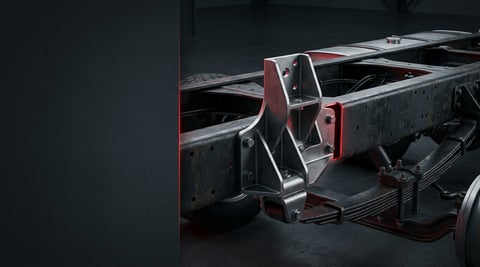
How equipment brackets fatigue and how they are replaced is covered step by step in Chassis Mounting Bracket: Failure, Replacement & Care Guide. This article covers the bracket's place in the chassis, not its failures.
How is a fifth wheel mounted to the chassis?
The fifth wheel is the tractor coupling that locks the trailer's king pin and carries a large share of the trailer's weight. A fifth wheel is bolted to a mounting plate or rail-mounted profile system on top of the frame, not straight to the rails. Its height and position affect axle loads and turning clearance. Makers such as JOST offer several mounting plate options; the choice follows the tractor's chassis code and the body builder guidelines. Maintenance is covered in Fifth Wheel & King Pin: Faults, Replacement & Maintenance Guide.
What types of chassis are there?
Chassis types differ by whether the load-bearing structure is separate from the body and by how the beams are arranged. The ladder frame dominates heavy-duty vehicles; the others appear in specific classes.
| Chassis type | Structure | Typical use | Advantage | Limitation |
|---|---|---|---|---|
| Ladder frame | Two side rails and crossmembers | Trucks, tractors, pickups, off-road vehicles | High capacity, many body types, repairable | Heavy, raises body height |
| Welded beam | I-beam rails with welded joints | Trailers and semi-trailers | Strong over long spans | Welds need regular inspection |
| Backbone (tube) | One central tube, axles attached | Some off-road and special trucks | Torsional stiffness, independent axle travel | Complex to build and repair |
| Integral space frame | Welded box sections, one with the body | Buses, especially coaches | Light, low floor, large luggage space | Body damage hits the structure |
| Monocoque (unibody) | Sheet steel body is the structure | Cars, many light commercials | Light, low centre of gravity | Unsuited to heavy loads or body changes |
How do truck, tractor and trailer chassis differ?
A rigid truck chassis carries the cargo body or equipment directly, so it usually has a long wheelbase and rear overhang. A tractor chassis takes the load from the semi-trailer through the fifth wheel; it has a shorter wheelbase, a fifth wheel mounting area and carriers for the air and electrical lines to the trailer.
A semi-trailer chassis has no drive unit and carries the king pin plate at the front. On many semi-trailers the main beams end at the front in a gooseneck that drops over the tractor's fifth wheel, and at the rear in axle and suspension mounts. A drawbar trailer carries most of its load on its own axles thanks to a steerable front axle and passes mainly pulling force to the towing vehicle. Because the load path differs, a bracket or reinforcement solution cannot be carried over from one chassis to another.
Axles and wheel hubs are explained in What Is a Truck Axle? Axle Types and Wheel Hub Bearing Failure, and the air spring and leveling valve layout in Heavy-Duty Air Suspension Failures: Air Springs, Leveling Valves and ECAS.
What is a truck subframe and how is a body mounted to the chassis?
A truck subframe, also called an auxiliary frame, is a second profile system laid on the chassis that spreads the body's load evenly along the frame rails. Tippers, tankers, mixers, cranes and refrigerated boxes are usually mounted through one. It spreads concentrated loads along a long line while preserving the chassis' natural flex.
Two kinds of connection work together. Flexible ones, such as spring-loaded brackets or slotted holes, let the frame twist; rigid ones stop the body sliding under braking and acceleration. Where each goes, the subframe profile size and the frame zones where drilling is allowed are set in each manufacturer's body builder guidelines. Mercedes-Benz, Volvo, MAN, Scania, DAF, Iveco and Ford Trucks publish these guidelines, and they are the basis of any installation.
Do not drill, weld or cut the flanges of a truck frame without approval. Holes in the upper and lower flanges of a side rail, welds near a flange edge and arc strikes on the surface are the most common starting points of fatigue cracks. Choose hole positions only within the zones allowed by the body builder guidelines, with the stated diameter and edge distance. Without the guidelines, do not proceed; use the existing hole pattern.
What is a chassis number, and does it describe the chassis itself?
A chassis number is the 17-character vehicle identification number (VIN) that identifies a vehicle uniquely worldwide. Its structure follows ISO 3779: the first three characters are the world manufacturer identifier (WMI), the next six describe vehicle attributes, and the last eight (the VIS) hold the serial number and often the model year and plant code. It is printed in the registration documents and stamped into the frame or body and on the type plate; on trucks usually on a front section of a side rail.
The chassis number describes the vehicle's identity, not the frame, so "what is a chassis" and "what is a chassis number" are different questions. For spare parts it is valuable: it is the most reliable way to tell generations and specifications apart. Use it with the chassis code and the OE number of the removed part. At inspections it is checked against the registration, and tampering with it is an offence.
Which chassis work counts as a modification?
Chassis work such as lengthening or shortening the frame, changing the wheelbase, adding or removing an axle and conversions that change the vehicle class alter type approval data and count as modifications. In the EU the type approval framework is Regulation (EU) 2018/858, and national rules set how a modified vehicle is re-approved and re-registered; other markets have equivalent procedures. The technical execution still rests on the manufacturer's guidelines.
Replacing a bracket with a part of the same OE number, renewing suspension mounts or changing rubber mounts is repair, not modification. The rule is simple: use the existing hole pattern, never downgrade the bolt grade, do not reuse self-locking nuts and fit a part only after checking its OE number and chassis code. Parts from the VADEN chassis group should be selected the same way.
The chassis is also examined at inspection. Cracks, breaks, advanced corrosion and signs of unapproved work can be recorded as defects, and the chassis number is checked against the registration. In the United States, 49 CFR 393.201 sets frame requirements for commercial vehicles in service, and frame defects appear in the CVSA out-of-service criteria.
Standards and further reading
- HGV inspection manual (DVSA, GOV.UK): UK annual test procedures and defect criteria for heavy vehicles, including chassis condition.
- North American Standard Out-of-Service Criteria (CVSA): roadside inspection criteria for the US, Canada and Mexico, including frame defects.
- Truck frame, Wikipedia: general definition and history of frame types.
For materials the reference standard is EN 10149 (high-yield-strength steels for cold forming); for vehicle identification, ISO 3779. For dimensions, drilling zones and connection details, follow the manufacturer's body builder guidelines and service manual.
Main guide: What Is a Truck Axle? Axle Types and Wheel Hub Bearing Failure
Tags
Frequently Asked Questions
- Is a chassis the same as a frame?
- On a truck, the frame is the structural core of the chassis: the side rails and crossmembers. In North America "frame" usually means only that structure, while "chassis" often includes the axles, suspension and driveline, as in a cab-and-chassis sold to a body builder. In Europe and many other markets "chassis" means the frame itself. Both describe the load-bearing skeleton.
- What does a truck chassis do?
- A truck chassis carries the weight of the vehicle and its load, transfers drive, braking and road forces along the vehicle, and gives the engine, transmission, cab, tanks and body a fixed mounting base. It also flexes in a controlled way, limiting stress on the suspension and fasteners on rough ground.
- Do cars have a chassis, and how is it different from a truck chassis?
- Most passenger cars have no separate chassis; the body and the load-bearing structure are one piece, called a monocoque or unibody. A truck uses a ladder frame chassis separate from the cab and the body. Thanks to that separation, the same truck chassis can carry a tipper, a tanker or a box body.
- What is a chassis number and where is it found?
- The chassis number is the 17-character vehicle identification number (VIN) that identifies a vehicle uniquely. It is printed in the registration documents and stamped into the frame or body and on the type plate, at a location set by the manufacturer; on trucks usually on a front section of a side rail. For spare parts it is the most reliable way to identify the right generation.
- Why do trucks use a ladder frame chassis?
- A ladder frame chassis offers high load capacity, accepts many different bodies and allows damaged parts to be repaired one by one. It twists in a controlled way, protecting the load and suspension on rough ground. Its weight and height are drawbacks, but on heavy trucks and tractors that cost is accepted for payload capacity.
- What are frame rails and crossmembers?
- Frame rails, also called side rails or longerons, are the main beams of a ladder frame running the length of the vehicle, usually C-channel sections. Crossmembers are the cross beams that connect the two rails at set intervals. The rails carry bending loads; the crossmembers keep them aligned, limit twist and provide mounting points for heavy equipment.
- Does every truck need a subframe?
- Not every truck needs a subframe; it depends on body type, load distribution and use. Bodies that create concentrated or dynamic loads, such as tippers, tankers, mixers and cranes, usually require one. Whether it is needed, its profile size and the connection type come from the vehicle manufacturer's body builder guidelines.
- Can you drill holes in a truck frame?
- Holes may be drilled in a truck frame only in zones allowed by the body builder guidelines, with the stated diameter and edge distance. Rail flanges, bend areas and the space near existing holes are generally prohibited. A hole in the wrong place concentrates stress and can start a fatigue crack. Without the guidelines, use the existing hole pattern.
- What is a truck chassis made of?
- Heavy-duty truck chassis are mostly formed from high-yield-strength steel sheet suitable for cold forming; in Europe these steels are defined in the EN 10149 family. High strength gives the same capacity with a thinner section, reducing tare weight. The surface is usually protected by e-coat dip coating and paint.
- What should you check when buying a chassis part?
- Before buying a chassis part, verify the OE number of the removed part, the vehicle's chassis number and the chassis code together. One model name can cover different wheelbases, suspensions and cabs, so do not choose by appearance alone. Compare hole spacing, plate thickness and bend angle with the old part, and renew bolts, nuts and rubber mounts as a set.
Related Articles
What Is a Bracket on a Truck? Engine, Chassis and Suspension Brackets
What a bracket does on a truck, the main types from engine brackets and spring hangers to fan and cab brackets, how bushings fit in, and OE-based selection.
Truck Chassis Crack: Causes, Risk Assessment and Weld Repair Limits
What causes a truck chassis crack, how it's inspected and classified, and where stop-drill holes and weld repair reach their limit.
Chassis Mounting Bracket: Failure, Replacement & Care Guide
Chassis mounting bracket guide for trucks and trailers: fatigue cracks, diagnosis, step-by-step replacement, bolt torque values and maintenance tips.