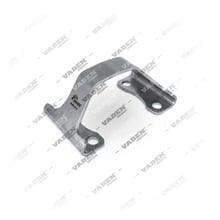
What are the functions of a suspension bracket?
- Load transfer: Carries all static and dynamic load resting on the suspension element through to the chassis.
- Positioning: Keeps the spring, bellow, or shock absorber at the correct angle and position, preserving the system's geometric accuracy.
- Impact distribution: Prevents sudden loads from road irregularities from concentrating at a single point, spreading them over a wider chassis area.
- Vibration resistance: Continues to function under repeated loading-unloading cycles without developing fatigue cracks.
What are the symptoms of a failed suspension bracket?
- Visible crack or fracture: A crack trace on the bracket body, especially around the weld seam.
- Abnormal noise: A metallic knocking or creaking sound from the chassis area over road irregularities.
- Suspension geometry disturbance: The vehicle pulling to one side, or uneven tyre wear.
- Loose connection: Loosening at bracket bolts, or the bracket shifting on the chassis.
- Rust and corrosion: Advanced corrosion, especially at weld areas, is a sign of structural weakening.
How is a suspension bracket checked?
Inspection should be done with the vehicle raised. The bracket body and weld seams are visually examined for cracks, deformation, or excessive corrosion. Bolted connections are checked against torque value, since a loose bolt allows the bracket to develop micro-movement and, over time, a fatigue crack. Suspension movement is observed while the vehicle is loaded during a test, noting any abnormal sound or movement from the bracket area. If a defect is suspected, weld seams can be examined in more detail using methods such as dye penetrant testing, which can reveal invisible micro-cracks.
What should be considered during replacement?
- Correct bracket model: The bracket model must match exactly according to axle type, chassis width, and the suspension element it connects to.
- Weld quality: On brackets requiring welded installation, the work must be carried out by a certified welder following the manufacturer's procedure.
- Bolt torque: Bolted connections should follow the manufacturer's specified torque value and tightening sequence.
- Corrosion protection: Bare metal surfaces exposed after welding must be protected against corrosion with the appropriate primer and paint.
- Load test: After replacement, the vehicle should be loaded and a short test drive performed to check for abnormal noise from the bracket area.
How should a suspension bracket be selected?
Selection should be based on the vehicle's axle capacity, chassis type, and suspension configuration (leaf spring or air bellow). Confirming against the OEM part number guarantees geometric fit and material strength.
Suspension bracket selection criteria| Criterion | Description |
|---|
| Material strength | High-strength steel suited to the axle's load capacity |
| Geometry | Matches chassis and suspension element connection points exactly |
| Connection type | Welded or bolted installation matching the original |
| Surface protection | Corrosion-resistant coating or primer treatment |
| Load capacity | Suitable for the axle load value specified in the vehicle's current OE service manual |
Maintenance and service life
A suspension bracket lasts a long time on vehicles with regular load checks that are not routinely overloaded. Continuous overloading, frequent use on poor roads, or delayed maintenance leads to early fatigue cracking. During routine underbody inspections, a visual check of the bracket area along with checking weld seams and bolt torque is the most effective way to prevent a serious structural failure.
VADEN suspension bracket
VADEN manufactures OEM-matching brackets for heavy-duty commercial vehicle suspension systems, built to the correct material strength and geometric tolerance, with the goal of preserving the vehicle's original load-carrying and driving safety performance.
Frequently Asked Questions (FAQ)
Why does a suspension bracket crack
Repeated loading-unloading cycles, overloading, poor road conditions, and micro-defects in the weld seam lead to fatigue cracking over time.
Can a vehicle keep driving with a cracked bracket
No, a cracked bracket can disturb suspension geometry and lead to a sudden structural failure; it should be replaced before the vehicle is driven again once found.
Can I weld a suspension bracket myself
It is not recommended; since it is a load-bearing structural part, welding must be carried out by a certified welder following the manufacturer's procedure.
How often should bracket bolts be checked
Torque checking is recommended during routine underbody maintenance; a loose bolt can allow the bracket to develop micro-movement and eventually crack.
Does a suspension bracket failure affect tyre wear
Yes, deformation or looseness in the bracket disturbs suspension geometry, leading to uneven tyre wear and the vehicle pulling to one side.
Related technical guide: Heavy-Duty Air Suspension Failures: Air Springs, Leveling Valves and ECAS