Truck Air Filter and Intake Air: Maintenance Guide
How intake air reaches a truck engine, what the air filter does, clogging symptoms, the restriction indicator, filter life and correct replacement steps.
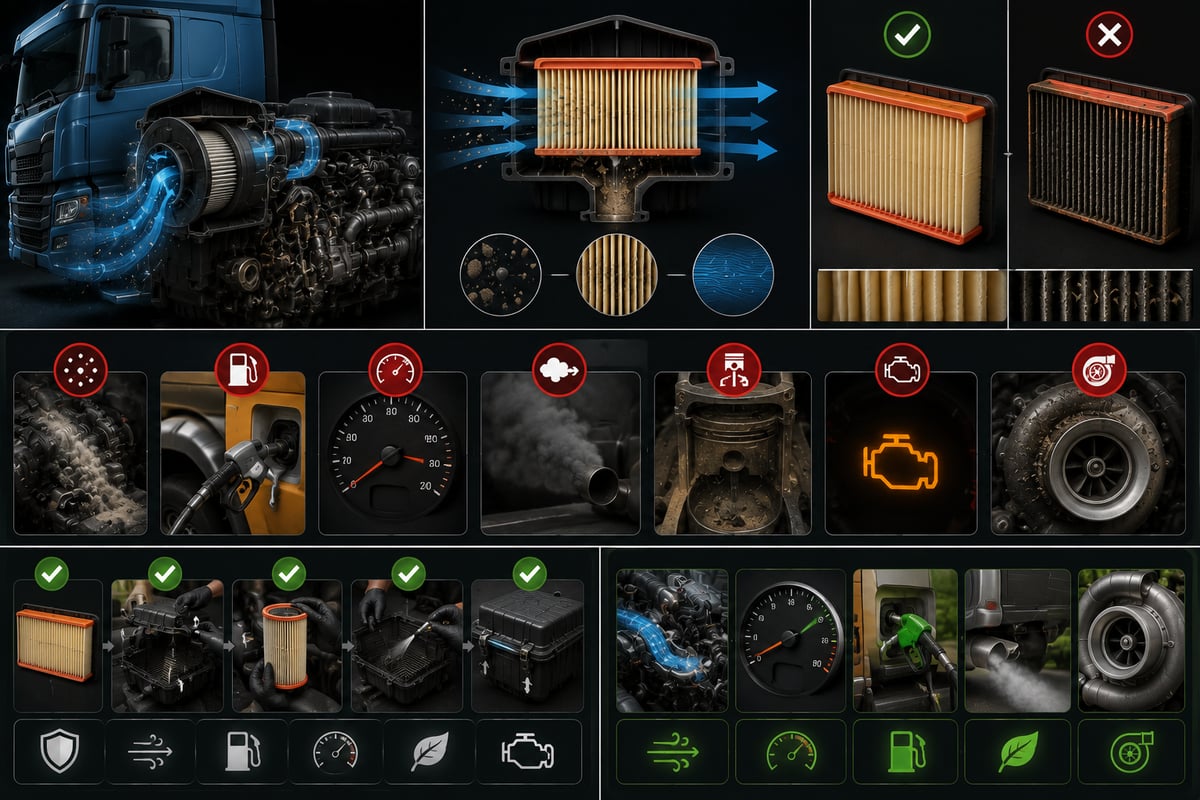
Picture two tractor units pulled from the same fleet: identical engine, identical service interval, almost identical mileage. One spends its life on the highway; the other drives in and out of a quarry haul road every day. At service time, the first truck's filter element still has work left in it. The second one has a layer of dust thick enough to feel with a fingertip, and its driver has been saying for weeks that "the truck doesn't pull like it used to, it falls back on hills." The difference between the two trucks isn't the service interval — it's the air they breathe. This guide doesn't look inside the engine; it follows the path the air takes to get there: where intake air comes from, which stages it passes through, what job the filter actually does in that chain, and how the engine reacts when that job goes wrong.
Where Does Intake Air Come From? The Path From Intake to Cylinder
A diesel engine's fuel is easy to see; the air it swallows is not. Yet the ratio is telling: for every unit of fuel it burns, the engine needs on the order of tens of units of clean air by mass. Over a single shift, a heavy-duty engine draws in thousands of cubic meters of air, and whatever is in that air travels with it all the way to the cylinder. That's why the intake path is never a single part — it's a chain of stages, each depending on the one before it.
The chain starts at the point where the truck can reach the cleanest air available to it. On trucks and tractor units, the air intake is usually mounted behind the cab, high off the ground — the dust cloud thrown up by the wheels is far denser close to the road surface. Air entering the intake passes in turn through a pre-separation stage, the main filter element, a safety element where fitted, the clean-side hose, and the turbocharger compressor wheel; it condenses in the charge air cooler, is distributed through the intake manifold, and, where fitted, mixes with recirculated exhaust gas before entering the cylinder.
The defining feature of the chain is this: once any single link lets air through unfiltered, every link after it has to carry that dirty air. One leak point downstream of the filter is enough to make even the best filter element pointless, which is why diagnosing the intake side means looking at the housing, gaskets, hoses, and clamps just as closely as the element itself.
| Component | Job | Effect of a fault on the engine |
|---|---|---|
| Air intake / snorkel | Draws in outside air from the cleanest, coolest point available | A low or blocked intake clogs early and lets in water and snow |
| Pre-separator / cyclone stage | Spins out coarse dust and water droplets | When it fails, the main element fills up several times faster |
| Dust ejector (evacuator) valve | Discharges separated dust from the housing | If it sticks shut, dust builds up in the housing and chokes the element from inside |
| Main filter element | Traps fine dust, cleans the air heading to the cylinder | Clogged, it starves the engine of air; torn, wear begins |
| Safety (secondary) element | Final barrier if the main element is removed or torn | Without it, dirt dropped during service goes straight to the turbo |
| Restriction indicator or sensor | Measures the intake vacuum downstream of the element | A stuck or faulty indicator lets clogging go unnoticed |
| Clean-side hose and clamps | Carries filtered air to the turbo without loss | A cracked or loose joint draws in unfiltered air |
| Turbocharger compressor stage | Compresses the air and raises mass flow | Excess intake vacuum risks oil seepage and blade wear |
| Charge air cooler and intake manifold | Cools and densifies the air, distributes it to the cylinders | Fouling and soot buildup upset boost pressure and distribution |
| Cylinder, liner and ring set | Burns the air with fuel, maintains the seal | Unfiltered dust sands down the liner and rings like grit paper |
The housing itself isn't a passive box either: tangential vanes at the inlet spin the air into a cyclone effect, and the coarse dust and water thrown outward drain out through the rubber-lipped dust ejector valve at the bottom. A valve that has hardened or been fitted upside down on its own noticeably shortens the element's service life. Read as a whole, the table shows that almost every fault on the intake side comes down to one of two outcomes: either the mass of air reaching the engine drops, or the cleanliness of that air is compromised. The first is felt immediately; the second sends the bill months later.
What Does an Air Filter Actually Do? The Balance Between Efficiency and Flow Restriction
An air filter is a consumable component that traps the abrasive particles in the air entering the engine, at a flow restriction low enough not to starve the engine's air demand, and that can carry the dust it captures on its surface for the length of the service interval. All three parts of that definition matter equally, and all three pull against each other.
Three numbers describe a filter element. The first is filtration efficiency: how much of the dust reaching the element it actually retains; modern heavy-duty elements sit around ninety-nine percent efficiency by mass, with the exact figure specified on the element's datasheet. The second is flow restriction, the pressure penalty paid by the air passing through it. The third is dust-holding capacity: how many grams of dust the element can hold before restriction climbs to an unacceptable level.
That's where the conflict sits. Narrow the pores to push efficiency up, and restriction rises while capacity falls; open the pores to bring restriction down, and the most abrasive micron-sized particles get through. What resolves the balance, largely, is pleating: resin-impregnated paper folded like an accordion packs a surface area measured in square meters into a small housing, and the larger that surface, the lower the velocity through any given patch of it.
This three-way balance also explains a mistake that's common in the field: a filter that "lets more air through" is not a better filter. Pulling the element out to run without it, or fitting a coarser-mesh element in its place, genuinely does lower restriction — but that responsiveness is bought with abrasive dust flowing straight to the liner and rings, and the bill comes due out of engine life.
There's a counter-intuitive fact worth knowing too: a used element filters at a higher efficiency than a new one. The dust layer that builds up on the surface acts as a secondary filtration layer. So an element being "a bit dirty" isn't a fault in itself; the problem starts the moment that same layer pushes restriction past an acceptable point. A filter's service life ends not where efficiency runs out, but where restriction crosses the limit.
Why Does a Safety Element Exist, and When Should It Be Changed?
Many heavy-duty filter housings hold a second, smaller element fitted inside the main one. It's known as the safety element, secondary element, or safety cartridge. Its job isn't to carry the main filtration load — it's the last line of defense that steps in on the occasions the main element can't do its job.
Those occasions are two. The first is during service itself: when the main element comes out, the clean side is briefly exposed, and dust from the housing rim or dirt from the cover can fall in at exactly that moment. The second is a fault condition: if the main element clogs, gets wet, or is mechanically damaged and tears, the safety element protects the engine for a while longer.
Three maintenance rules apply here, and all three get broken regularly in the field. First, the safety element is never cleaned — any dirt found on it is already evidence of something abnormal. Second, it isn't automatically replaced at every main-element change; it's typically renewed after several main-element changes, and the interval is set by the manufacturer. Third, and most important, the housing is never closed without a safety element fitted.
How Does a Clogged Filter Affect the Engine? The Steps in the Chain of Effects
The effect of a clogged filter on the engine isn't a single symptom — it's a chain, each step triggering the next. The chain starts with rising resistance from the dust layer against airflow: the turbocharger now has to pull air against a bigger vacuum, and as that depression grows, the mass of air reaching the engine at a given speed drops.
When air mass drops, the excess-air ratio in the combustion chamber falls with it. In a diesel, power is set by how much fuel is injected, but that fuel needs enough oxygen to burn fully; when oxygen runs short, part of the fuel comes out as soot. The engine management system reads the air-mass signal and boost pressure and cuts back the fuel accordingly; from the driver's seat, the result is felt as power loss and sluggish recovery on hills.
The chain has less visible links too. Combustion running on insufficient air finishes late, which raises exhaust gas temperature and puts extra load on the aftertreatment system. Some of that soot ends up in the sump oil, cutting its lubricating ability and speeding up wear. On the turbo side, sustained high intake depression sets up conditions for oil to be drawn toward the compressor seal; more than one turbo pulled under a "leaking oil" diagnosis has had, as its real culprit, an intake element that hadn't been changed in months. Fuel consumption climbs too, because the driver tries to make up the lost pull with the accelerator pedal.
The sneakiest part of this chain is that it's not linear. For most of the element's life, restriction climbs very slowly and the driver notices nothing. Once capacity runs out, the curve bends sharply upward, and the truck noticeably loses power within a short distance. That's why "it was fine last month" says nothing about whether the filter is fine today.
From Symptom to Cause: What Do You Measure to Confirm It?
The golden rule of diagnosing the intake side is never to tie a symptom straight to a part. Behind "no power" could be a clogged element just as easily as a crushed hose, a loosened clamp, or a fouled charge air cooler. The table below sums up which measurement confirms each of the most common symptoms.
| Symptom | Measured value | Likely cause | Action |
|---|---|---|---|
| Loss of pull on hills, slow recovery | Full-load intake restriction and turbo boost pressure | Clogged main element or a crushed intake hose | Measure restriction under load; renew the element if the threshold is exceeded |
| Dark smoke on pull-away and under load | Restriction and air-mass signal | Insufficient air, falling excess-air ratio | Inspect the element and intake path, repeat the measurement |
| Gradual rise in fuel consumption | Restriction trend and the vehicle's fuel log | A slowly clogging element | Compare against the log, tie the replacement trigger to restriction |
| Rising exhaust gas temperature | Exhaust temperature and boost pressure | Air shortage, late-completing combustion | Reduce load, measure restriction, replace if needed |
| Fine at idle, rough under load | How restriction changes with speed and load | Restriction only becomes apparent at high flow | Take the measurement at full load, not at idle |
| Indicator flips to red quickly | Indicator, pre-separator and dust ejector valve | Cyclone stage or ejector valve out of action | Clean the pre-separator, check the valve's position and flexibility |
| Restriction stays high with a new element | Indicator and hose bore | Crushed hose, blocked housing or the wrong element | Verify the hose, housing and part number |
| Fine dust trace on the clean side | Visual check, inspection of the turbo blade | Seal not seated, cracked housing, or a torn element | Fix the seal; don't put the truck to work until you find the source |
| Wear and oil trace on the turbo blade | Blade appearance and intake vacuum | Prolonged high restriction, unfiltered air | Inspect the whole intake path, evaluate the turbo |
What these actions have in common is that on the intake side, the call is made by measuring, not by looking at the part. An element that looks "still fine" by eye is not proof of anything — fine dust fills the pores long before it's visible. The reverse holds too: an element that looks blackened on the outside can still have plenty of life left if the restriction reading is under the limit.
How Do You Read a Restriction Indicator, and What Doesn't It Tell You?
The intake restriction indicator measures the vacuum that builds up in the air path immediately downstream of the filter element. The mechanical type has a clear window and a colored flag; once vacuum reaches a set value, the flag rises and locks itself in place. That lock is by design: vacuum disappears the moment the engine stops, and if the indicator dropped back down, nobody would ever see the clogging. On newer trucks the same measurement is taken by a pressure sensor and fed straight to the engine control unit.
Reading it correctly takes two conditions. First, the indicator's meaningful range is high airflow; intake vacuum grows sharply with flow, and no element on earth can raise the flag at idle. "I checked it at idle, it looked clean" means nothing for this reason — the reading has to be taken with the engine at full load, or with the truck working hard, loaded, on a grade. Second, once the flag has risen, the indicator stays red even after the element is changed, until it's manually reset.
What the indicator doesn't say is just as important as what it does. It measures restriction, not cleanliness. A raised flag doesn't prove the element is full of dust; a wet element, a frosted-over surface, a crushed hose, or an intake blocked by debris will raise the same flag. And an indicator staying clean doesn't prove the element is sound either: a torn element, or one whose gasket hasn't seated, shows almost no restriction at all, the indicator sits in the green while the engine spends that entire time breathing unfiltered air. That's the most dangerous limit of trusting the indicator; a visual check of the seal is what completes the measurement, not a substitute for it.
Further reading
For a plain-language technical overview of this subject, see the reference article on Wikipedia. Always confirm specific figures and procedures against the vehicle manufacturer service data.
Why Can't Air Filter Life Be Given in Kilometers?
The service manual lists a kilometer figure for the filter, and that number is genuinely meaningful as an upper limit. But the element's actual service life isn't set by mileage — it's set by the total amount of dust that has passed through it. That total depends on two things: the total volume of air the engine has swallowed, and how much dust is in that air.
The first variable isn't always proportional to mileage: a truck doing city distribution covers far fewer kilometers than a long-haul tractor, but its engine runs for a much longer share of that time. Idling and stop-and-go hours never show up on the odometer — they show up fully on the air filter. That's why the right metric for trucks working heavy stop-and-go duty is engine hours, not kilometers. The second variable, ambient dust, varies by orders of magnitude between one truck and the next.
| Operating environment | Character of the dust load | Effect on element life | Correct approach |
|---|---|---|---|
| Highway, steady speed | Low-density, fine road dust | Longest element life | Track the calendar interval and restriction reading together |
| City distribution, frequent stop-and-go | Brake dust, exhaust soot, high idle share | Low mileage, high engine hours — mileage misleads | Tie the metric to engine hours |
| Construction site, earthworks, quarry | Heavy mineral dust, coarse particles | Life falls several times over | Fit a pre-cleaner, check restriction often |
| Agriculture, harvest season | Organic dust, straw and chaff fiber | Surface clogs fast, blockage arrives suddenly | Daily visual check and pre-stage cleaning |
| Mining and cement plant sites | Abrasive fine dust | Fast fill-up and abrasive surface wear together | Short interval and seal inspection |
| Sand, desert and coastal wind | Fine silica dust and salt | Clogging and corrosion progress together | Pre-separation stage and housing corrosion check |
| Snow and salted road conditions | Wetting, icing, road salt | Sudden restriction and permanent element damage | Check the intake, renew any element that got wet |
The practical rule that follows has three parts. The replacement decision is driven first by measured restriction. Even if restriction hasn't hit the limit, there's still a calendar limit, because impregnated paper fatigues over time from humidity and vibration. And whatever either measure says, the manufacturer's stated interval is never exceeded; that interval isn't a target, it's a ceiling, and the current OE service manual for the vehicle's engine and chassis code is authoritative.
Why Isn't It Recommended to Clean the Filter With Compressed Air?
One of the most common habits in the field is pulling a clogged element out and blasting it with a compressed air gun, or even knocking it against the ground to shake the dust loose. This genuinely improves the element's appearance and temporarily brings the restriction reading back down; the problem is that the improvement is only cosmetic, while the damage is permanent.
The first reason is structural. Filter paper is a delicate structure made of interlocked fibers that filters in depth, through its full thickness. A jet of compressed air locally forces that fiber network open, leaving behind pinholes too small to see but more than wide enough for dust to pass through. A single microscopic hole becomes a shortcut for unfiltered air for the rest of the element's remaining life.
The second reason is that cleaning reverses the whole logic of how the filter works. The dust layer on the surface is what raises efficiency; blasting it away doesn't return the element to new condition, it leaves it worse than new. Worse still, air applied from the outside drives dust deeper into the paper, embedding it where it never comes back out and permanently raising restriction; a nozzle pushed directly between the pleats also crushes the separators and disrupts airflow.
The third reason is mechanical. The habit of knocking an element against the ground stresses the end caps and the gasket seat; once the gasket geometry is distorted, the seal — and with it the whole reason the element exists — is gone. Washing an element with water, fuel, or detergent and drying it out produces the same result even faster: the impregnation resin is damaged, the paper softens, and it tears the first time it's put under load.
Poor Fitting and an Unseated Gasket: The Cost of Unfiltered Air
The most expensive faults on the intake side don't come from clogging — they come from leaking. Clogging announces itself; a leak gives no warning at all. The indicator stays green, the driver has nothing to complain about, the engine runs "normally" for months, and the entire time, abrasive dust is quietly getting in and doing its work. That's why the element's most critical part isn't its filtration surface — it's its gasket, whether that gasket is compressed axially by the cover or seals radially against the housing tube through an inner-diameter polyurethane ring: either way, the rule is the same — if the gasket isn't seated, there is no filter.
The typical sources of a leak are well known: a gasket not fully seated in its groove, a cover closed at an angle or with its latches tightened unevenly, a housing cracked from impact or fatigue, a loosened clamp, a clean-side hose cracked at a bend point or gone brittle with micro-cracks, an element with a gasket a few millimeters off from the correct part number, and a safety element left out by mistake.
The diagnostic method is direct and cheap: look for a dust trace on the clean side. With the element removed, inspect the housing's clean surface, the inner wall of the outlet duct, and, where possible, the turbo compressor blade under good light; on a sound system, these surfaces are dry and clean. Fine dust that leaves a mark when wiped with a finger, light-colored streaks running along the airflow direction on the duct wall, or dulling at the blade edges are proof the system is drawing air in from somewhere. In that case, the job isn't to replace the element — it's to find where the leak is coming from.
How unfiltered air progresses inside the engine is a separate subject and outside the scope of this guide. In short, abrasive particles wear away the cylinder liner's cross-hatch honing pattern, damage the sealing face of the rings, and start oil consumption and compression loss together. Those wear symptoms, their measurement, and the ring-side consequences are covered in detail in the piston ring, liner and cylinder guide; if you suspect a leak on the intake side, comparing your findings against the oil-consumption and compression symptoms in that guide speeds up the diagnosis.
Filter Replacement: The Correct Order in the Field
Replacement is technically simple and disciplinarily hard — most of what determines the quality of the job has nothing to do with fitting the element itself. The sequence below is built around one goal: keep dirt out of the system and guarantee the seal.
- Park the truck on level ground, shut the engine off, and let hot surfaces cool. Never open the intake path while the engine is running or capable of starting.
- Clean the outside of the housing. Dust that has built up around the cover edge and the intake opening is exactly what falls inside the moment the cover comes off; skip this step and every step after it is pointless.
- Open the cover and pull the main element out slowly, without shaking it; a fast pull stirs the dust trapped between the pleats and throws it onto the clean side.
- Wipe the inside of the housing with a clean, damp cloth, and confirm the dust ejector valve is flexible, not torn, and pointing downward; renew a hardened valve. Don't blow out the housing with compressed air — that just carries dust into the clean-side duct.
- Inspect the removed element: hold the pleats up to the light and look for holes, check the gasket for crushing or tearing, and see whether the dust is evenly spread; buildup concentrated on one side points to a problem at the housing or the intake opening.
- Check the clean-side hose, clamps, and any sensor ports. Flex the hose at its bend points and look for cracks; renew a hose that has hardened.
- Replace the safety element if it's due, or confirm it's in place and sound if it isn't; leaving it out is never acceptable.
- Check the new element's part number and the integrity of its gasket, then seat it squarely, without forcing it; an element out of a crushed box is unusable, and one fitted at an angle won't seat properly.
- Fit the cover and tighten the latches evenly, opposite pairs at a time. If the cover leaves a gap, recheck the gasket and the housing opening — over-tightening the latches is not a substitute for a proper seal.
- Reset the restriction indicator, start the engine, run it briefly under load, and read the indicator again. If restriction reads high with the new element, the problem isn't the element — it's the hose, the housing, or the part choice.
- Log the job: date, mileage, engine hours, part number fitted, the safety element's condition, and the restriction reading, all written into the vehicle's file.
Extra Precautions for Dust, Harvest, and Winter Conditions
A standard maintenance program is written around the truck's average operating conditions; any condition that falls outside that average calls for an extra step on the intake side. In heavy dust environments, the first step is a pre-cleaner: a stage that separates coarse dust before it reaches the main element noticeably cuts the replacement frequency, and it typically pays for its own cost within the first season. The second step is stopping the truck from re-breathing the dust it kicks up itself: check the intake's position relative to the exhaust outlet and the wheel dust cloud. The third is a daily visual check of the dust ejector valve — during harvest season, straw and chaff fiber clogging the valve opening is a common event.
Winter brings a different kind of problem. Dry cold doesn't harm the element; the real risk is water and ice. A wetted filter paper loses much of its air permeability; the driver feels a sudden loss of power, the element partly dries out as the engine warms up, and the symptom clears on its own. That "comes and goes" power loss is the classic signature of a wetted element, and once an element has gotten wet and dried once, it's structurally weakened and needs replacing.
Snow ingestion is its own topic: trucks pushing through heavy snow, or parked with their back to a snowdrift, can pull in fine snow through the intake opening that freezes on the element surface and blocks the air path completely. Choosing where to park and giving the intake a visual check before setting off are simple but effective precautions. On salted roads, watch for corrosion on the housing and clamps — corrosion that eats through the housing edge means unfiltered air, directly. On trucks coming out of a long standstill, always check the intake opening and element for condensation and signs of rodent nesting.
Other Air Paths on the Vehicle: Compressor Intake and Brake Air
The intake air feeding the engine isn't the only air path on a heavy-duty vehicle. A second air chain feeds the brakes and auxiliary systems, and its intake is often connected to the engine's clean-air side; the air brake compressor typically draws its intake from the clean line downstream of the filter, or through its own separate strainer.
That connection ties intake maintenance directly to the health of the brake system. A clogged main element also raises the depression on the compressor's intake side; the rising vacuum can increase the compressor's tendency to carry oil. An intake path that's drawing in unfiltered air, meanwhile, carries dust straight to the compressor cylinder. The compressor's failure symptoms and replacement discipline are covered separately in the clutched air brake compressor guide; when you find a leak on the intake side, it's worth remembering the compressor is breathing the same air.
Further down the chain, moisture and oil vapor in the compressed air get separated out at the air dryer. The intake filter targets solid particulate; the dryer cartridge targets moisture — two consumables aimed at different contaminants but sharing the same underlying logic. Both have a service life tied to ambient conditions, and both, when put off because they "look fine," end up billing the expensive parts behind them. Cartridge choice, service life, and winter behavior are covered in the air dryer cartridge and moisture management guide; grouping these two components under one maintenance heading removes two separate ways for them to get forgotten in the field.
Fleet Replacement Policy and Record-Keeping Discipline
On a single truck, intake maintenance is a matter of habit; across a fleet, it becomes a matter of policy. The policy doesn't try to answer "how many kilometers" with a single number — it ties the decision to measurement, and ties the measurement to a record.
- Group the fleet by operating environment: long-haul, city distribution, construction and site work, and agricultural or seasonal work. Even identical trucks from the same make run on different intervals in different groups.
- Make a working restriction indicator or sensor mandatory on every truck; a truck with a broken indicator is a truck you can't measure.
- Tie the replacement trigger to whichever of three criteria comes first: restriction hitting its limit, the calendar limit, or the manufacturer's stated interval. The manufacturer's interval is a ceiling; it's never exceeded.
- In city and site-work groups, measure by engine hours instead of kilometers; in idle-heavy duty, mileage doesn't reflect the real load.
- Ban compressed-air cleaning in writing, and explain the reasoning to technicians; a rule nobody understands doesn't get followed.
- Keep every removed element, numbered, until the next inspection. A hole, one-sided dust buildup, or a crushed gasket only becomes visible when the element is still in hand.
- Verify the part number at every change and make sure only the correct numbers are stocked; a "close enough" element is the quietest enemy of a good seal.
- Teach drivers one single behavior: loss of pull on a hill, rising smoke, or an indicator turning red gets reported the same day.
- Open a periodic inspection item for the whole intake path: intake opening, housing, cover, gaskets, hose, clamps, sensor connectors, and the dust ejector valve. Review the records regularly — if one of two trucks on the same route is consistently filling its element faster, the difference is in the truck, not the road.
This policy should be read as an insurance premium, not a cost line. The whole economics of intake maintenance comes down to one asymmetry: a filter element is a negligible cost next to the parts it protects; once that protection is breached, the bill runs all the way up to the turbo, the liner, and the ring pack.
Intake air is the cheapest thing a diesel engine consumes, and for exactly that reason it's the easiest thing to neglect — yet its effect on engine health is every bit as decisive as fuel. The order worth following in the field is this. First, measure: restriction is read under full load, with a reset indicator. Then tell them apart: high restriction doesn't always mean a clogged element. Then prove the seal: if there's no dust trace on the clean side, the filter really is filtering. Then replace: the element is a consumable — it isn't cleaned, forced, or fitted incomplete. Finally, log it, because the one thing that makes the next decision easier is having the last one written down. In every case, the vehicle's current OE service documentation for its engine and chassis code is authoritative.
Shop this part: Air Filter
Main guide: What Is a Fuel Injector? How to Recognize Injector Failure Symptoms
Tags
Frequently Asked Questions
- What does an air filter do in a truck?
- An air filter traps the abrasive particles in the air entering the engine, at a restriction low enough not to starve the engine's air demand, and holds that dust on its surface for the length of the service interval. A diesel engine swallows tens of units of air by mass for every unit of fuel it burns, and whatever is in that air travels all the way to the cylinder. The filter is the first and cheapest barrier protecting the liner, rings and turbo in that chain.
- Does a dirty air filter really reduce engine power?
- Yes, but never on its own — it happens as a chain. Rising flow restriction forces the turbo to pull air against a bigger vacuum, the mass of air reaching the engine drops, the excess-air ratio in the combustion chamber falls, and part of the fuel comes out as soot. Once the engine management reads the air-mass signal and boost pressure and cuts back fuel, the result is loss of pull on hills and slow recovery.
- How many kilometers does a truck air filter last?
- Kilometers are only an upper limit; the element's real life is set by the total amount of dust that has passed through it. The same engine can comfortably reach its interval on the highway while filling up far sooner on a construction site; in city distribution, idle hours don't show on the odometer at all. The right approach is to tie replacement to measured restriction, respect the calendar limit, and treat the manufacturer's interval as a ceiling. The current OE service manual for the vehicle's engine and chassis code is authoritative.
- Can I clean an air filter with compressed air and refit it?
- It isn't recommended. A jet of compressed air locally forces open the filter paper's fiber network and leaves pinholes too small to see but wide enough for dust — a single microscopic hole becomes a shortcut for unfiltered air for the rest of the element's life. Blowing it out also strips away the surface dust layer that raises efficiency, and air applied from the wrong direction drives dust deeper into the paper. The element is a consumable; unless the manufacturer explicitly says it's washable, it doesn't get cleaned.
- Does the safety element need replacing at every service?
- No, the safety element is typically renewed after several main-element changes, on an interval set by the manufacturer. Two rules are absolute, though: it's never cleaned, and it's never left out. If the safety element you remove has noticeable dust on it, that's direct proof the main element or the seal has failed somewhere along the line, and the housing, gasket and hose all need a full inspection.
- The restriction indicator turned red — do I need to replace the filter right away?
- Confirm the reading first. The indicator measures restriction, not cleanliness: a wetted element, a frosted surface, a crushed intake hose, or an opening blocked by debris can raise the same flag. The measurement has to be taken under full load, not at idle, and the indicator needs to have been reset at the last change. If a genuinely clogged element is the cause, replace it without delay.
- My restriction indicator is still green — does that mean the filter is fine?
- No. A torn element, or one whose gasket hasn't seated, shows almost no restriction at all; the indicator can sit in the green for its whole life while the engine breathes unfiltered air the entire time. That's why the measurement needs a visual check alongside it: with the element out, look for a dust trace on the housing's clean surface, the outlet duct wall, and the turbo compressor blade. A trace means the job is finding the leak, not replacing the element.
- Does a clogged air filter increase fuel consumption?
- It does. Once air runs short, combustion efficiency drops, exhaust gas temperature rises, and the driver tries to make up the lost pull with the accelerator pedal. Across a fleet, that increase can add up to several times the cost of a filter element, and the soot from incomplete combustion ends up in the sump oil, cutting its lubricating ability too.
- Can a wet or snow-clogged element be dried out and reused?
- It shouldn't be. A wetted filter paper loses much of its air permeability; the driver feels a sudden power loss, the element partly dries as the engine warms up, and the symptom clears on its own. That comes-and-goes power loss is the classic signature of wetting, and an element that has gotten wet once is structurally weakened. In snowy conditions, choosing where to park and giving the intake a visual check before setting off are the most effective precautions.
- Can a turbo failure actually be caused by neglect on the intake side?
- Often, yes. Running for a long time under high restriction sets up conditions for oil to be drawn toward the compressor seal, while an element with an unseated or torn gasket sends abrasive dust straight to the compressor blade. Unless the intake opening, housing, gasket, hose and clamps are all inspected before a turbo replacement, the new turbo tends to meet the same end.
Related Articles

Fuel Water Separator Filter: Symptoms, Replacement & Care
Truck fuel water separator filter and housing: how it works, water sensor, drain valve, heater, fault symptoms, replacement, bleeding and maintenance.
Solenoid Coil: Faults, Testing, Replacement and Maintenance
Understand how a solenoid coil works, spot open or shorted windings with a multimeter, replace it correctly and extend its service life on trucks.
Diesel Injection Line & Fuel Pipe: Faults, Repair, Maintenance
Heavy truck injection line and fuel pipe guide: high-pressure vs supply line, leak and air ingress diagnosis, torque sequence, replacement and maintenance.